
Ha-Yishuv Ha-Sefaradi ha-Yashan be-Eretz Yisrael
(In Hebrew with added table of contents and preface in English)
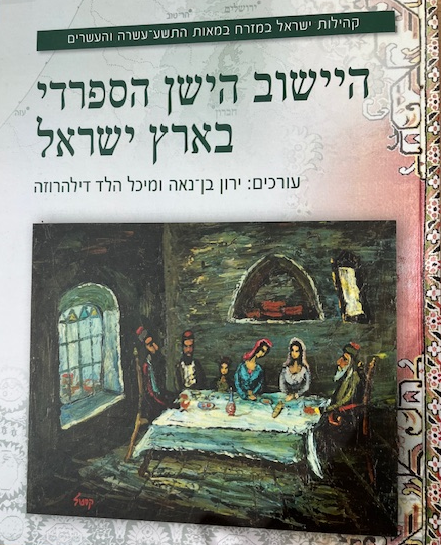
THE OLD SEPHARDIC YISHUV IN THE LAND OF ISRAEL
Editors: Yaron Ben-Naeh and Michal Held Delaroza. Ben Zvi Institute for the Study of Jewish Communities in the East (Jerusalem, 2023)
Reviewed by Shlomo Alon1
The Ben Zvi Institute for the Study of Jewish Communities in the East at the Hebrew University started in the year 2002, with the support of the Ministry of Education, a very wide project of books about the Jewish Communities in the East in the 19th and 20th centuries. The framework of this monumental project appeared in 15 volumes. Seven volumes were edited by Prof. Haim Saadoun (the volumes about Yemen, Iraq, Morocco, Iran, Libya, Tunisia and Algeria) and the other volumes edited by other prominent researchers: Prof. Shalom Sabar (The Life Cycle), Hagar Salamon (Ethiopia), Prof. Nahem Ilan (Egypt), Prof. Yaron Harel (Syria), Roni Weinstein (Italy), Prof. Eyal Ginio (Greece), Prof. Zeev Levin (Central Asia: Bukhara and Afghanistan). The work was almost completed in the year 2018. The missing part was completed in 2023 with the volume about The Old Sephardi Yishuv in Eretz Israel, edited by Prof. Yaron Ben-Naeh and Dr. Michal Held Delaroza. This volume was published with the support of the Tony Elyashar Center for the Study of Sephardi Jewry, the Old Yishuv Court Museum, Misgav Yerushalayim and the Council of the Sephardi and Oriental Communities in Jerusalem.
The first paragraph.
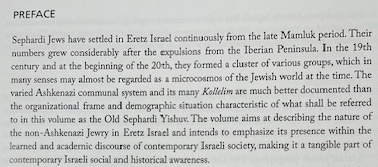
Prof. Yaron Ben-Naeh wrote in the preamble that "The Sephardi Jews in Eretz Israel in the 19th century and at the beginning of the 20th formed a cluster of various groups, which in many senses may almost be regarded as a microcosm of the Jewish world at the time. The volume aims to describe the nature of the non-Ashkenazi Jewry in Eretz Israel and to emphasize its presence and discourse of contemporary Israel society and the Israeli social and historical awareness." Actually, this volume illustrates it in a very precise and accurate way, rich in its contents and insights, and enriches the Jewish bookshelf with numerous pieces of information in all walks of life.
Four chapters describe linguistic issues: Yael Reshef concentrates on the Hebrew language. Prof. David M. Bunis writes about Judezmo (Ladino and Spanyolit) language. Dr. Michal Held Delaroza writes a chapter about Male and Female Judeo-Spanish Discourse in the Writings of Jacob Yehoshua. Prof. Simon Hopkins writes about the Arabic Language and Dr. Dalit Assouline writes a chapter on Yiddish in contact with Ladino and Arabic in the Old Yishuv. Dr. Zvi Zameret who served many years as the Head of Ben Zvi Institute, writes at length about the development of Jewish Education from the middle of the 19th century until the establishment of the State of Israel. Dr. Moshe Naor writes widely on Zionism and Prof. Alisa Meyuhas Ginio describes the Sephardi Yishuv and the Holocaust. Dr. Michal Held Delaroza describes the written Literature and Dr. Dov Ha- Cohen writes on the Ladino Literature. Prof. Leah Bornstein-Makovetsky describes the Rabbinical Literature in Hebrew and Prof. Tamar Alexander writes on the Folk Literature, while Dr. Tamir Karkason writes about Journalism.
Issues of Demography and Economics are dealt with in the chapters written by Dr. Michal Ben Ya'akov, Dr. Yali Hashash , Prof. Jacob Barnai and Prof. Orly C. Meron.
Prof. Yaron Ben-Naeh, the editor, deals in length with the Religious Life, besides the contribution of Dr, Yaniv Mezuman, about the Beit-El Yeshiva. The editors deal with the Yearly Cycle ( Yaron Ben-Naeh) and the Life Cycle (Michal Held Delaroza). Dr. Reuven Gafni writes at length on the Synagogues.
Prof. Israel Bartal gives us a panoramic survey about Eretz Israel and its Jewish Communities and Prof. Yair Wallach writes about the Jews in their Environment.
Dr. Shai Lavi wrote about Historical Photography, while Dr. Michal Held Delaroza entices the readers with the Culinary Tradition.
Prof. Edwin Seroussi and Dr. Netanel Cohen (Musai) write about Music and Prof. Shalom Sabar writes on Art and Folk Art. Prof. Yaron Ben-Naeh wrote a chapter on the Home, while Dr. Esther Juhas writes widely about dress between tradition and the modern. The book is completed by the author. Dr. Michal Held Delaroza, with a Self-Reflexive Epilogue: "the window through which all identities are shattered." The volume ends with Chronology, Bibliography, Transliterations, Photo Credits and a detailed Index by Adva Selzer.
Let me finish with the key words of Prof. Simon Hopkins (page 221): "Jewish life in Eretz Israel never stopped. Jews lived in Eretz Israel continuously from the Second Temple on.”
This volume is highly important for the comprehensive study of the history of our people and our land during the last two centuries. It is highly important that the Education System in Israel will invest all the needed efforts for the inclusion of the book in the core studies in our schools and the departments of education at our universities and colleges, for all streams of schools.
1 Dr. Shlomo Alon served many years as the National Supervisor for the teaching of Arabic and the World of Arabs and Islam in Israel, Head of National Supervisors and Deputy Head of the Pedagogical Secretariat. He is Member for Life of the Israel National Academy for Arabic Language.