
Ben ha-Melekh ve-ha-Nazir
Revisiting a Popular Much Republished Tale
By Marvin J. Heller1

Barlaam y Josafat
Manuscript – 14th -15th century2
Ben ha-Melekh ve-ha-Nazir (The Prince and the Hermit) consists of tales, fables, maxims, and proverbs intermingled with prose and verse. It is a Hebrew version of a popular Hindu (Pahlavi) Indian romance that has been translated into many languages including Arabic, Georgian, Greek, and Latin. In the original Hindu version, the tale centers around a prince (Buddha) who becomes an ascetic; the protagonists are Balauhar and Budasaph. R. Abraham ben Samuel ha-Levi ibn Hasdai’s (early thirteenth century) Hebrew translation was done in the first decades of the thirteenth century. The first printing of the ibn Hasdai’s Hebrew version of the popular Ben ha-Melekh ve-ha-Nazir, however, was in Constantinople in 1518.3
Ibn Hasdai was a translator and a poet in Barcelona in circa 1230.4 He was, reputedly, the son of the poet R. Samuel ibn Abraham ibn Ḥasdai ha-Levi. Our ibn Hasdai translated several classic works from Arabic into Hebrew. Among them is Sefer ha-Tappuah The Book of the Apple), the supposed famed death-bed conversation of Aristotle with his friends and pupils in which they engage in philosophical discussions concluding with Aristotle’s expressing a belief in Judaism and Jewish concepts.5 Another of ibn Hasdai’s translations is Moznei Ẓedek (Scales of Justice), an ethical work from the Arabic original Mizan al-Amal by the Muslim philosopher Abu Hamid al Ghazali (Algazali). In the introduction to that work ibn Hasdai wrote that al-Ghazali:
Brought evidence and proof in many places from the works of their faith and their lore which were available to their scholars… Therefore I decided to bring evidence in those places from our holy books, words that are parallel to theirs, so that I would be able to follow on the path of the author.6
The value of ibn Hasdai’s translations is attested to by Moritz Steinschneider, who includes him in a list of “the most important Translators and Commentators of Arabic works (by Arabs or Jews).”7 Ibn Hasdai was also the author of a maqāma, Arabic prose with interspersed poetry.
Additional works translated by ibn Hasdai are Maimonides’ Sefer ha-Mitzvot (The Book of Precepts) and Iggeret Teiman (Letter to Yemen). In the thirteenth century there was a serious controversy over Maimonides’ writings, initially his Mishneh Torah and afterwards his Moreh Nevuchim. Ibn Hasdai was a staunch defender of Maimonides (Rambam), as was R. David Kimchi, against their distinguished and zealous opponents, among them Judah ibn Alfakhar, court physician to King Ferdinand III, and R. Meir ben Todros ha-Levi Abulafia (Ramah).8 All the above notwithstanding, a somewhat less enthusiastic but still positive description of ibn Hasdai is given by J. Chotzner who describes him, as referred to by some historians, as the spiritual head of the Barcelona Jewish community and “among the minor poets who lived in Barcelona in the early part of the thirteenth century” but among them “none more remarkable than Abraham ibn Chasdai.”9
The original Hindu version, as noted above, features a prince (Buddha) who becomes an ascetic. A Christian version of the story, Barlaam and Josaphat, became so popular that it was introduced into the Catholic calendar and its protagonist became an unofficial saint. Ibn Hasdai’s version of Ben ha-Melekh ve-ha-Nazir, basically a long dialogue between a nameless ascetic (nazir) and the likewise nameless king’s son,10 contains ten parables not found in other versions, suggesting that it is closer to the original Indian tale and that some of the material may have been added by ibn Hasdai. His rendition of this work, together with the rhymed prose, attests to ibn Hasdai’s skills as a storyteller. Constanza Cordoni informs that Ben ha-Melekh ve-ha-Nazir is the first non-Christian text composed on European soil. Moreover, its popularity is attested to by the number of preserved manuscripts.
Praise for ibn Hasdai’s version of Ben ha-Melekh ve-ha-Nazir is also expressed by Meyer Waxman, who writes that it is not a mere translation but:
Practically a new version, and the poetic part of it testifies to the great skill of the translator as a poet, just as the delightful style of rhymed prose proclaims him a master of Hebrew.11
Similarly, Israel Zinberg, praises the work, also noting that:
The numerous parables, stories, and legends with which Ben Ha-Melech Veha-Nazir is filled were taken by ibn Hasdai not only from the Arabic text but also from Jewish sources, especially from the Talmudic Aggadah.
Zinberg writes that ibn Hasdai “employed the Arabic version of the Indian romance” which was not in accordance with the Christian-Greek version but rather the older Persian Pahlavi dialect. He notes, however, that in the last chapters in which the human soul is discussed, ibn Hasdai did not use the Arabic text of the romance but rather various contemporary philosophic works.12
In this article we will address the first and earlier published editions of Ben ha-Melekh ve-ha-Nazir, that is, those published through the eighteenth century, interspersed with examples of randomly selected texts. The Hebrew version of Ben ha-Melekh ve-ha-Nazir, concerned with the vanity of this world, consists of thirty-five chapters. As in the Hindu original, the book is a series of tales, fables, maxims, and proverbs, prepared, as noted above, by Abraham ben Samuel ha-Levi ibn Hasdai. Not to be too repetitive, in Ben ha-Melekh ve-ha-Nazir, a sybaritic king, after exiling his chief minister for becoming a hermit, has a son whose horoscope foretells he, too, will become an ascetic or hermit. To forestall this event and to keep his son ignorant of the troubles and sorrows of the world, the king has a castle built on an isolated island to which the young prince is sent. The king hopes to thus prevent the prince from obtaining worldly knowledge. Nevertheless, one day the prince, while walking, comes upon a hermit, the former royal minister previously exiled by the king. They begin a series of discussions and, over a period of time, the hermit instructs the prince in a variety of subjects among them ethics, philosophy, and theology. Intermixed with these discussions are others such as romance, diverting tales, parables, and even humor.
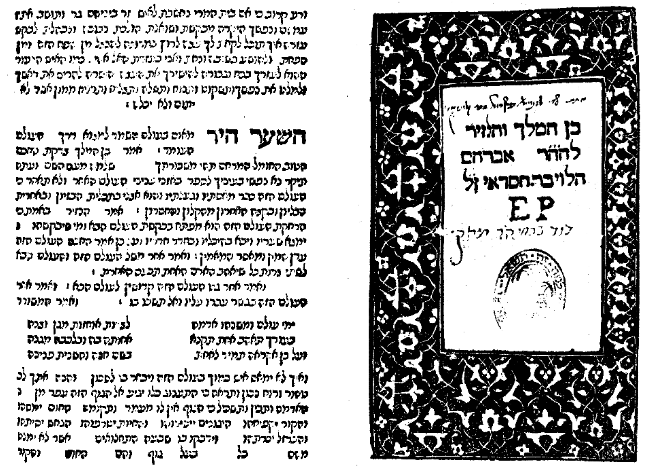
1518, Constantinople
The first Hebrew edition of Ben ha-Melekh ve-ha-Nazir was printed in Constantinople in 1518 in quarto format (40: [56] ff.) at the press of David and Samuel ibn Nahmias, refugees from Portugal. Their press was the first Hebrew press in Constantinople, the first press in any language in the Ottoman Empire, beginning with their edition of the Arba’ah Turim (1493). The title page of Ben ha-Melekh ve-ha-Nazir has an arabesque frame and limited text, simply the title and R. Abraham ha-Levi bar Hasdai’s name. The colophon dates the completion of the work to Monday, 2 Nissan, in the “Blessed year ברוכים ([5]278 = 1518) [of the Lord]” (Samuel I 23:21, Psalms 115:15).13 A valuable work, copies of this edition have been sold at auction several times.14 Except for headers, the text is entirely in rabbinic (Rashi) letters.15 The text begins:
Once upon a time there lived in a certain state in India a cruel and despotic king, who only lived for his own enjoyment. He hated, in consequence, every kind of religious restriction, and even persecuted those of his subjects who, like the members belonging to the sect of the so-called Dervishes, led a retiring and ascetic life. His hatred of them acquired additional intensity when the chief of his courtiers disappeared one day from the palace, and was reported to have become a Dervish himself. A royal decree was issued, which forbade the Dervishes to remain in any part of the king's dominions, and which at the same time fixed a severe penalty for any disregard of the proclamation.
Now it so happened that soon after this event a son and heir to the throne was born to the king. He summoned his astrologers to tell him of the future destiny of the newborn prince, and was informed that the prince would in the future become a great friend of the Dervishes, and favour and promote their cause. Thereupon the king ordered that the infant prince should be taken to a secluded castle, which stood upon a solitary island, and that he should be kept there under the closest surveillance until the time when he should ascend the throne. This order was strictly observed and carried out for a number of years by the king's servants.
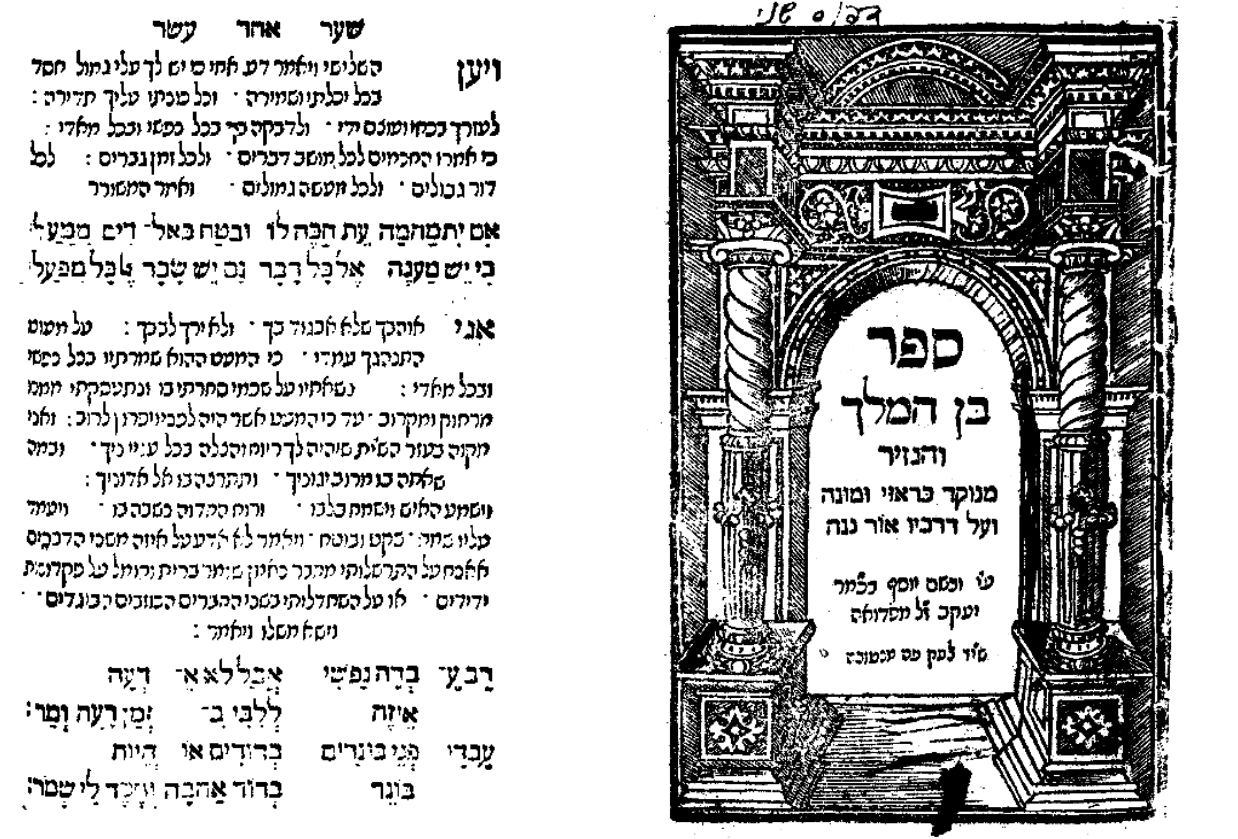
1557, Mantua
 The next Hebrew edition of Ben
ha-Melekh ve-ha-Nazir was published in Mantua in 1557 as a 14 cm.
work (92 ff.). The identity of the printer is unclear; his name is not
given on the title page or elsewhere in the book. Two printers were
active in Mantua at the time, Venturin Rufinelli and Jacob ben Naphtali
ha-Kohen of Gazzuolo. Various bibliographic sources assign Ben
ha-Melekh to each of the printers. It appears rather certain,
however, that the printer was Venturin Rufinelli because of a tail-piece
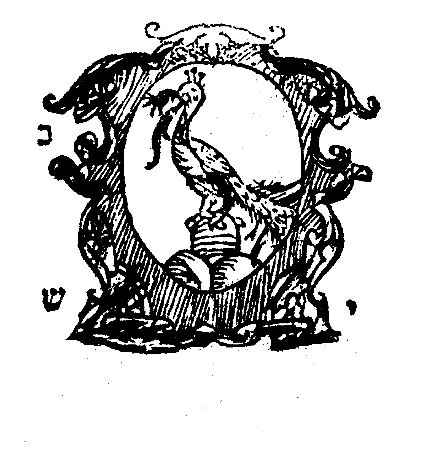
consisting of a peacock standing on three rocks, facing left, with a
fish in its beak within a cartouche (below) at the end of the book. The
letters יביש around this device stand for
Joseph ben Jacob Shalit who had previously been active in Sabbionetta
and was now associated with Rufinelli in Mantua. This tail-piece was
also used in Venice at the press of Giovanni di Gara, without mention of
Shalit. Avraham Yaari, after describing the peacock with a fish,
suggests that the fish might be a worm.16
The next Hebrew edition of Ben
ha-Melekh ve-ha-Nazir was published in Mantua in 1557 as a 14 cm.
work (92 ff.). The identity of the printer is unclear; his name is not
given on the title page or elsewhere in the book. Two printers were
active in Mantua at the time, Venturin Rufinelli and Jacob ben Naphtali
ha-Kohen of Gazzuolo. Various bibliographic sources assign Ben
ha-Melekh to each of the printers. It appears rather certain,
however, that the printer was Venturin Rufinelli because of a tail-piece
consisting of a peacock standing on three rocks, facing left, with a
fish in its beak within a cartouche (below) at the end of the book. The
letters יביש around this device stand for
Joseph ben Jacob Shalit who had previously been active in Sabbionetta
and was now associated with Rufinelli in Mantua. This tail-piece was
also used in Venice at the press of Giovanni di Gara, without mention of
Shalit. Avraham Yaari, after describing the peacock with a fish,
suggests that the fish might be a worm.16
In contrast to the previous Constantinople edition, the 1557 Mantua publication is comprised of vocalized square letters and rabbinic letters. It has both an introduction and an index from the editor, R. Joseph Shalit of Padua17. The text states:
Once, however, it so happened that the stranger, whom they had selected as their king, was a prudent man and experienced in worldly matters. Astonished at his sudden elevation, he made inquiries of one of the islanders whose confidence he had gained, and learned from him the real reason. He accordingly devised a plan, from which he hoped that he and his friend would derive some lasting advantage. They were simply to go on a dark night to the state treasury, and to take away from thence a quantity of jewels (which by right were the king's property for the time being), and hide them in a cave near the sea; they would thus have some means of subsistence when the year of the king's reign ended. The plan was speedily carried into effect. After his year's reign was over, he was taken back to the place whence he had come. He and his friend took possession of their hidden treasure, and with it they went on board a passing ship, which brought them to a foreign country, where the sale of their valuables enabled them to live a life of comfort and happiness.
This tale was related by the Dervish to the prince, in the course of one of their conversations, as an illustration of human life.
When we come into existence, the Dervish said, we are, every one of us, helpless and poor, but after we have grown up we have at our disposal all the wealth and delights which this beautiful world of ours offers to all men. But we must never ignore the fact that our stay on earth is but brief, and that we are thus, as it were, kings for one year only. It therefore behooves man to devote his brief existence to the performance of noble deeds which will, when his life is ended in this world, procure him in the world to come God's everlasting favour and grace.
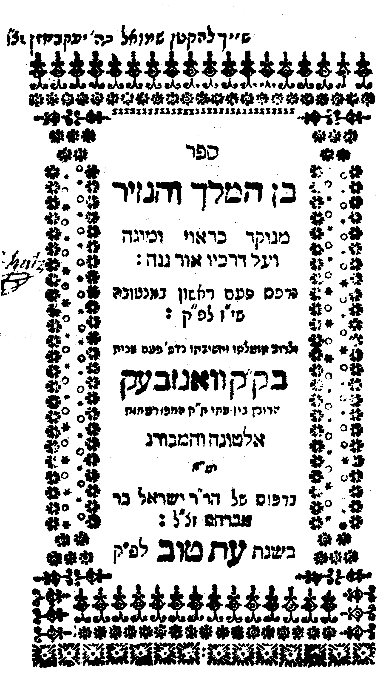
1727, Wandsbeck
Our next printing of Ben ha-Melekh ve-ha-Nazir was published a hundred seventy years later, in Wandsbeck in the year good time (עת טוב (487 = 1727 at the press of Israel ben Abraham.18 This edition was issued in 14 cm. ([4], 104 should say 106, 10 ff.). The title page states, in error, that the first printing was in Mantua. This error, as we shall see, was frequently repeated, indicating the influence of the Mantua edition. Appended at the end of the volume is R. Moses Hagiz’s Mi-Sihat Hullin shel Talmudei Hakhamim.19
The publisher, Israel ben Abraham, was a proselyte who, reputedly, had been a Catholic priest. He converted to Judaism in Amsterdam where he wrote a Yiddish-Hebrew grammar Mafte’ach Leshon ha-Kodesh (Amsterdam, 1713). In 1716, after leaving Amsterdam, Israel ben Abraham acquired the typographical equipment belonging to Moses Benjamin Wulff, the court Jew in Dessau; he printed in Koethen (1717-18), Jessnitz (1719-26), and then in Wandsbeck from 1726-33, returning, after a brief retirement, to Jessnitz in 1739, where he printed a small number of titles until 1744.20 Our next excerpt conveys the sense of the prince and ascetic:
Now it so happened that the farmer had a shrew for a wife, and, wishing to live in peace with her, allowed himself to be ruled by her in all domestic affairs. One day, while occupied in the farm-yard, he overheard a conversation between an ox and an ass, which amused him so much that he burst out laughing. At that moment his wife appeared, and insisted on being told the joke. He begged her not to press him to disclose a secret, on the keeping of which his very life depended. But she remained obdurate. Seeing that there was no way out of the difficulty, he told her that he would fulfil her desire in a few days, but that he had in the meantime to settle his worldly affairs, before going to meet his inevitable and premature death. To this she agreed. Next day, while again standing in the farm-yard, he heard his dog rebuking the rooster for crowing as loudly as ever, though he was aware of his master's approaching death. But the rooster said that since their master was a coward and a fool, he did not deserve to be pitied by anybody.
“Let him,said the rooster,take a lesson from me, and his life will certainly be saved. There are in the farm-yard a number of hens, who all obey me implicitly, as they know very well that any case of disobedience on their part would be attended with a well-deserved punishment. Now, our master has only one wife to deal with, and if he is idiotic enough to allow her to rule over him, he must bear the consequences.”
When the farmer heard the rooster's wise remarks he regained courage, and presently meeting his wife, he told her that he refused to let her know his secret, and that he was fully determined to be and to remain the ruler in his own house from that time forward. These words had the desired effect, and from that day forth he lived with his wife in harmony and undisturbed peace.”
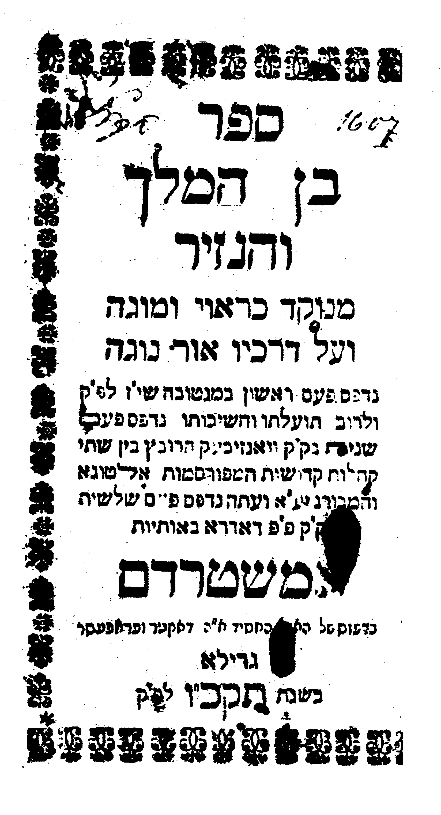
1766, Frankfurt on the Oder
In 1766, Ben ha-Melekh ve-ha-Nazir was published at the press of Professor Grilo in Frankfurt on the Oder, also as a 14 cm. work (108 ff.). Grilo, who acquired the press of Michael Gottschalk in 1740, was active until 1767, when he was succeeded by his widow, active from 1767-88, and afterward by his daughter from 1792-97. The importance of the Grilo press in the Hebrew book trade is indicated by its turnover which reached 80,000 Reichsthaler annually.21
The title page of this edition of Ben ha-Melekh ve-ha-Nazir is misleading. The place of printing, Frankfurt on the Oder, appears in a small font while Amsterdam appears below in larger font. This is not an isolated instance of the misleading identification of the place of printing. In many cases from the late seventeenth through early nineteenth century, presses in other locations also attempted to associate their imprints with Amsterdam. Their location is minimized on the title pages and emphasis placed on Amsterdam, as that city was then the foremost center of Hebrew printing in Europe.22
Three independent examples of maxims, one humorous, which provide a more accurate picture of the book appear in this printing of Ben ha-Melekh ve-ha-Nazir:
Go not too frequently thy friends to see,
Lest they grow weary of the sight of thee;
When rain is scanty, then we pray for more,
But love not one continuous downpour.
Now that the time has come for us to part,
I feel how much thy loss means to my heart;
For when the sun sinks suddenly to rest,
'Tis then that darkness grows most manifest.
Question. What is the most useful thing to any man in life?
Answer. Knowledge, or wealth, or a good and loving wife.
Question. But, if none of these commodities man has ever got?
Answer. Then by keeping golden silence he might improve his lot.
Question. And if he cannot do so, that poor and hapless knave?
Answer. Then let him go away at once, and dig himself a grave.
The Frankfurt on the Main issue of Ben ha-Melekh ve-ha-Nazir was printed in the year 1769, “wisdom preserves the life of him who possesses it והחכמה תחיה את בעלה (529 = 1769)” (cf. Ecclesiastes 7:12) at the press of Johann Beierhoffer in octavo format (80: 3,100, [1] [1] ff.). The title page mistakenly references the first printing as the Mantua edition and the second as the Wandsbeck edition. The text is accompanied by a translation from the Hebrew into Yiddish (Judeo-German), brought to press by R. Issac Homberg of Offenbach.
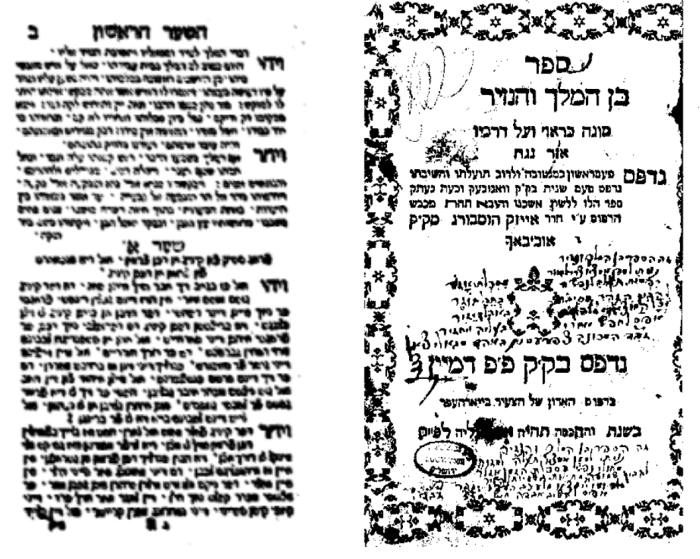
1769, Frankfurt on the Main
The following is an example of an amorous poem that appears in the Frankfurt on the Main version, showing the richness and variations of the popular text:
Thrice cruel maid, may Heaven frown on thee,
For that by day thou hidest thyself from me,
And yet thou robbest me of my nightly rest,
For that thy face is in my eyes impressed.
Ben ha-Melekh ve-ha-Nazir was printed twice in the Ukrainian city Zolkiew. The first printing was in the year 1771, “[Instruct Aaron and his sons] to be scrupulous [about the sacred donations] that the Israelite people consecrate [to Me, lest they profane My holy name] וינזרו בני ישראל (531 = 1771)” (cf. Leviticus 22:2). The second edition was published in 1795. The 1771 Ben ha-Melekh ve-ha-Nazir was issued by the partners David ben Menahem Mann, Hayyim David ben Aaron Segal, and the son of his uncle Ze’ev Wolf ben Gershon Segal. These printers’ families have a long, rich history of printing in Zolkiew. This Ben ha-Melekh ve-ha-Nazir is 19 cm. (146, [2] ff.). Here, too, the title page refers to the Mantua edition as the first printing; the text is also accompanied by Yiddish commentary. The 1795 edition, not seen, was printed by Abraham Judah Leib as a 20 cm. duo decimo (120: 90, 7 ff.), also with Yiddish commentary.
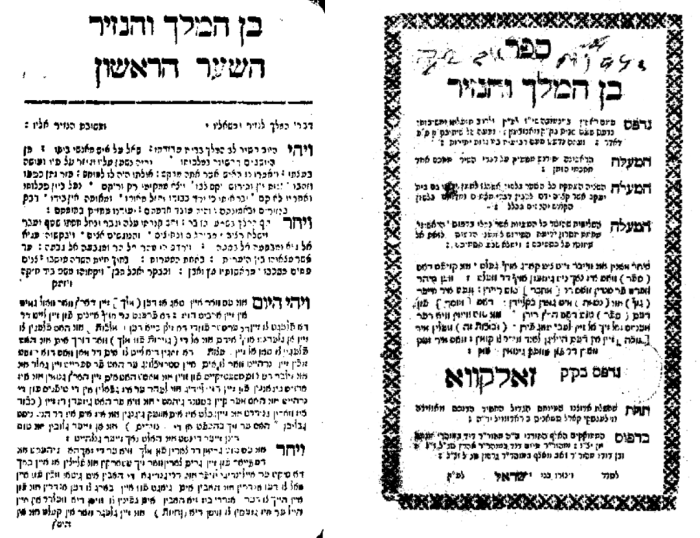
1771, Zolkiew
Ben ha-Melekh ve-ha-Nazir was also printed twice in Fuerth, in Middle Franconia (Mittel Franken), a joint possession of the Margravate of Ansbach and the city of Nuremberg reputedly founded by Charlemagne. The first edition, not seen, was published in 1753, also with Yiddish. The second Fuerth printing of Ben ha-Melekh ve-ha-Nazir was in 1783, the year “wisdom preserves the life of its possessors והחכמה תחיה את בעליה (543=1783)” (cf. Ecclesiastes 7:12) at the press of Itzhak ben Lev in octavo format (80: 101, 3 ff.). The title page refers to the Mantua edition as the first printing, again showing the influence of that printing or more likely the unawareness and unavailability of the earlier Constantinople printing. It then notes the Wandsbeck and a third Offenbach edition with Yiddish, an error apparently referring to the Frankfurt on the Main edition. This publication reflects its great appeal and the extreme rarity of the book, often found one to a city and two to a family.
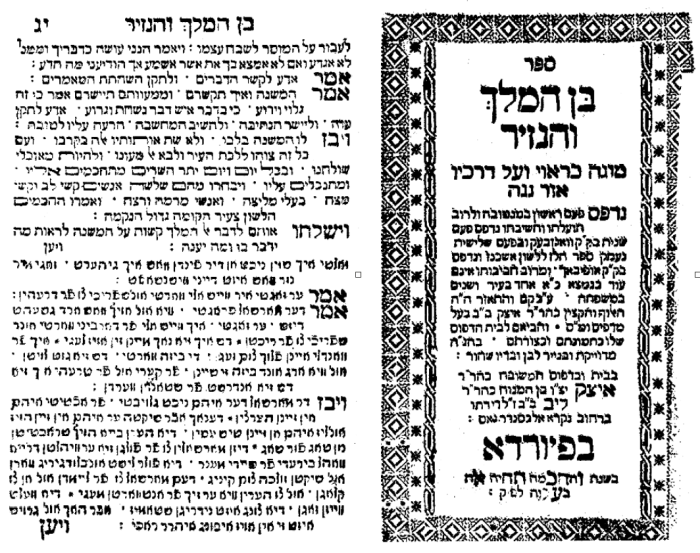
1783, Feurth
The second Fuerth printing of Ben ha-Melekh ve-ha-Nazir concludes:
The ascetic went his way to fulfil his work and his need. He left the prince crying and in low spirits, moaning and groaning, sighing and panting, despondent but troubled, for many days.23
In addition to J. Chotzner’s selection from Ben ha-Melekh ve-ha-Nazir, another somewhat similar work of the popular narrative is Joseph Jacobs’ Barlam and Josaphat: English Lives of Buddah, Edited and Induced by Joseph Jacobs. It is comprised of a 132-page introduction followed by the text of thirty-three pages, and a twenty page supplementary work. The following example of the translation and a parable appears in the first appendix in Jacobs’ rendition:
A man caught a nightingale, which promised him three precious pieces of advice if he would let him free. He agreed; whereupon the nightingale said, “Do not attempt the impossible. Regret nothing that is past. Believe no impossible tale.” The man then let the nightingale free. He, desiring to test him, cried “Fool, you little know what treasure you have lost. I have within me a pearl as large as an eagle’s egg.” The man, full of greed, tried to entice the nightingale within his door again, promising to let her go free. The nightingale said, “Now I see what use you will make of my three pieces of advice. I told you never to regret what was past, and yet you are sorry that you let me go free. I advised you not to try the impossible, and yet you are attempting to get me again within your power. I told you never to trust the impossible tale, and yet you believed me when I said that I had within me a pearl greater than my whole body.”24
The second appendix of Jacobs, Barlam and Josaphat is entitled The Lyf of Saynt Balaam. An unusual variation given here merely as a matter of interest, an example follows, and below, the front piece:
Of whom he en-quyred what Ihold befalle of his fone/ & they fayd to hym that he fhold be grete in power & in richefles/ & one more wyfe than another faid/ fyr this childe that is born Ihal not be in thy reygne/ but he llial be in another moche better without comparyfon / and know thou that I fuppofe that he fhal be of cryften relygyon / which thou perfecuteft/ & that fayd not he of hym felf/ but he fayd it by Infpyracion of god/ And whan the kynge herde that he doubted moche and dyd do make without the cyte a ry3t noble paleys / and therein fette he hys fone for to dwell and abyde/ and fette right fayre yongelynges/ and commanded them that they fliold not fpeke to hym of deth/ ne of old age/ ne of fekenes/ ne of pouerte ne of no thynge that may gyue hym caufe of heuynes but fay to hym alle thynges that ben ioyous.25
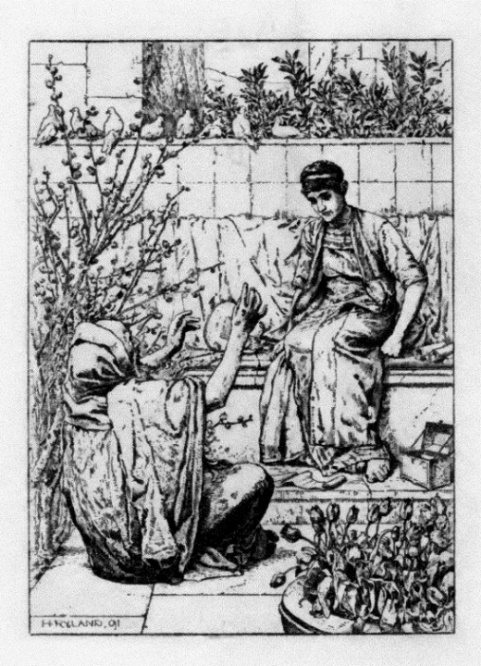
Image from Jacobs’ Barlam and Josaphat.
In conclusion, in this article we have described the sixteenth and eighteenth century printings of R. Abraham ben Samuel ha-Levi ibn Hasdai’s Hebrew translation of Ben ha-Melekh ve-ha-Nazir; apparently it was not published in the seventeenth century. The original Hindu (Pahlavi) Indian romance, as noted above, has been translated into many languages. Among them are Catalan, English, French, German, Russian, and Spanish. The popularity of ibn Hasdai’s Hebrew edition is attested to by the number of manuscript and printed copies recorded in the Jewish National and University Library catalogue. Forty-seven manuscript copies appear singularly or in collections of similar works; forty-six in Hebrew, dating from 1319 to 1912. Thirty-six printings of ibn Hasdai’s translation, nineteen editions of which were printed in the hundred years between 1925 and 2025, appear.
R. Abraham ben Samuel ha-Levi ibn Hasdai was a prolific author of varied works. It is eminently clear, however, that his most successful opus was Ben ha-Melekh ve-ha-Nazir, a lasting, enduring, much copied and reprinted masterpiece.
1 I would, once again, like to tank and express my appreciation to Eli Genauer for reading and expressing his comments on this article.
2 Barlaam y Josafat, manuscript – 14th -15th, courtesy Biblioteca Naciaonal de Espana via https://commons.wikimedia.org/wiki/File:Barlaam_y_Josafat.jpg. All of the other images in this article are courtesy of the Jewish National and University Library excepting the final image which is from Jacobs’ Barlam and Josaphat.
3 Ch. B.Friedberg, Bet Eked Sepharim, (Israel, n. d), bet 1078 [Hebrew]; Yeshayahu Vinograd, Thesaurus of the Hebrew Book. Listing of Books Printed in Hebrew Letters Since the Beginning of Printing circa 1469 through 1863 II (Jerusalem, 1993-95), p. 604 no. 96 [Hebrew].
4 Shimon Vanunu, Encyclopedia Arzei ha-Levanon. Encyclopedia le-Toldot Geonei ve-Ḥakhmei Yahadut Sefarad ve-ha-Mizraḥ I (Jerusalem, 2006), p. 79 [Hebrew].
5 Concerning Sefer ha-Tappuah see Marvin J. Heller, “Sefer ha-Tappu’ah (The Book of the Apple): Aristotle expresses an Interest in Jewish Concepts” Hakirah: The Flatbush Journal of Jewish Law and Thought, 32 (2022), pp. 273-85, reprinted in Further Essays on the Making of the Early Hebrew Book (Leiden/Boston, 2024), pp. 401-415.
6 Dr. Yaakov Goldenthal, “Moznei Tzedek: the Sefer that Quoted the Quran” Judaism Adventures.
7 Moritz Steinschneider, Jewish Literature; From the eighth to the Eighteenth Century with an introduction on Talmud and Midrasch a Historical Essay, (Hildesheim, 1967), p. 96.
8 Joseph Jacobs, Max Schloessinger “Hasdai, Abraham ben Samuel ha-Levi,” Jewish Encyclopedia vol. VI (New York, 1901-06), pp. 247-48; and Mordechai Margalioth, ed., Encyclopedia of Great Men in Israel I (Tel Aviv, 1986), col. 55-56 [Hebrew]; “Ibn Ḥasdai, Abraham ben Samuel Ha-Levi,” Encyclopedia Judaica, 9 (2007), p. 679.
9 Chotzner, “Abraham Ibn Chasdai, and His Book “The Prince and the Dervish,” in Hebrew Humor and Other Essays (1905, reprint 1979), pp. 117-26, reproduced on https://www.gutenberg.org/files/45037/45037-h/45037-h.htm.
10 Constanza Cordoni, “The Book of the Prince and the Ascetic and the transmission of wisdom,” CRMH Cahiers: Recherches Medievales et Humanities https://journals.openedition.org/crmh/
11 Meyer Waxman, A History of Jewish Literature II (1933, reprint Cranbury, 1960) p. 590; Israel Zinberg, A History of Jewish Literature: The Arabic-Spanish Period I (Cleveland & London York, 1972), translated by Bernard Martin, pp. 188, 190.
12 Ben ha-Melekh ve-ha-Nazir (Heb. וְהַנָּזִירְ הַמֶּלֶך בֶּן “The Prince and the Hermit”), Encyclopedia Judaica vol. 3 p. 351.
13 Avraham Yaari, Hebrew Printing at Constantinople (Jerusalem, 1967), pp. 76 n. 57 [Hebrew].
14 Among the auction sales are auction several times. Among the sales are those at Kestenbaum & Company, on Monday, June 20th, 2005; estimated price, $15,000 - $20,000, realized price $17,000. Also at Sotheby’s on December 2008, estimated price $20,000 - $30,000, realized price $17,000.
15 The text, given here, is from J. Chotzner, “Abraham Ibn Chasdai, and His Book “The Prince and the Dervish,” in Hebrew Humor and Other Essays (1905, reprint 1979), pp. 117-26, reproduced on https://www.gutenberg.org/files/45037/45037-h/45037-h.htm.
16 Avraham Yaari Hebrew Printers’ Marks From the Beginning of Hebrew Printing to the End of the 19th Century, (Jerusalem, 1943), pp. 12, 132 no. 19 [Hebrew].
17 In several instances rabbis also worked at a press, their training and knowledge making them a valuable addition to the press staff in dealing with Hebrew manuscripts and books. One outstanding example is R. Eliezer ben Naphtali Hirz Treves (Eliezer Frankfurt, 1495 - 1567), who served as rabbi in Frankfurt for twenty-two years and then operated a press in Thiengen in 1560.
18 Concerning the Wandsbeck press of Israel ben Abraham see Marvin J. Heller, “Israel ben Abraham, his Hebrew Printing-Press in Wandsbeck, and the Books he Published” in Further Studies in the Making of the Early Hebrew Book (Leiden/Boston, 2013), pp. 169-93. Concerning Moses Benjamin Wulff see Marvin J. Heller “Moses Benjamin Wulff - Court Jew in Anhalt-Dessau,” European Judaism 33:2 (London, 2000), pp. 61-71, reprinted in Studies in the Making of the Early Hebrew Book (Brill, Leiden/Boston, 2008), pp. 206-17.
19 R. Moses Hagiz (1672-c.1751), a Talmudic scholar and kabbalist, was born in Jerusalem and died in Safed. A prolific writer, Mi-Sihat Hullin shel Talmudei Hakhamim is one of his smaller works. He too was a translator, translating R. Isaac Aboab’s Menorat ha-Ma’or" into Spanish.
20 Avraham Yaari, “Converts in the Holy Work,” in Studies in Hebrew Booklore (Jerusalem, 1958), p. 250 [Hebrew].
21 Gotthard Deutsch, M. Seligsohn, Joseph Jacobs, “Frankfort-on-the-Oder,” Jewish Encyclopedia vol. 5 (New York, 1901-06), p. 496; Jewish Virtual Library, “Frankfurt on the Oder,” https://www.jewishvirtuallibrary.org/frankfurt-on-the-oder.
22 Concerning misleading title-pages and other errors see Marvin J. Heller, “Who can discern his errors? Misdates, Errors, and Deceptions, in and about Hebrew Books, Intentional and Otherwise” Hakirah: The Flatbush Journal of Jewish Law and Thought 12 (2011), pp. 269-91, reprinted in Further Studies, pp. 395-420.
23 Joseph Jacobs, Barlam and Josaphat: English Lives of Buddah, Edited and Induced by Joseph Jacobs (1896, reprinted 2012) and available at https://archive.org/stream/barlaamjosaphate00jacouoft/barlaamjosaphate00jacouoft_djvu.txt.
24 Constanza Cordoni, op.cit.
25 Joseph Jacobs, Barlam and Josaphat: English Lives of Buddah, Edited and Induced by Joseph Jacobs (1896, reprinted 2012), p. 5; and available at https://archive.org/stream/barlaamjosaphate00jacouoft/barlaamjosaphate00jacouoft_djvu.txt.
Copyright by Sephardic Horizons, all rights reserved. ISSN Number 2158-1800