
Lost Yanina
A Topography of Jewish Memory (2024)
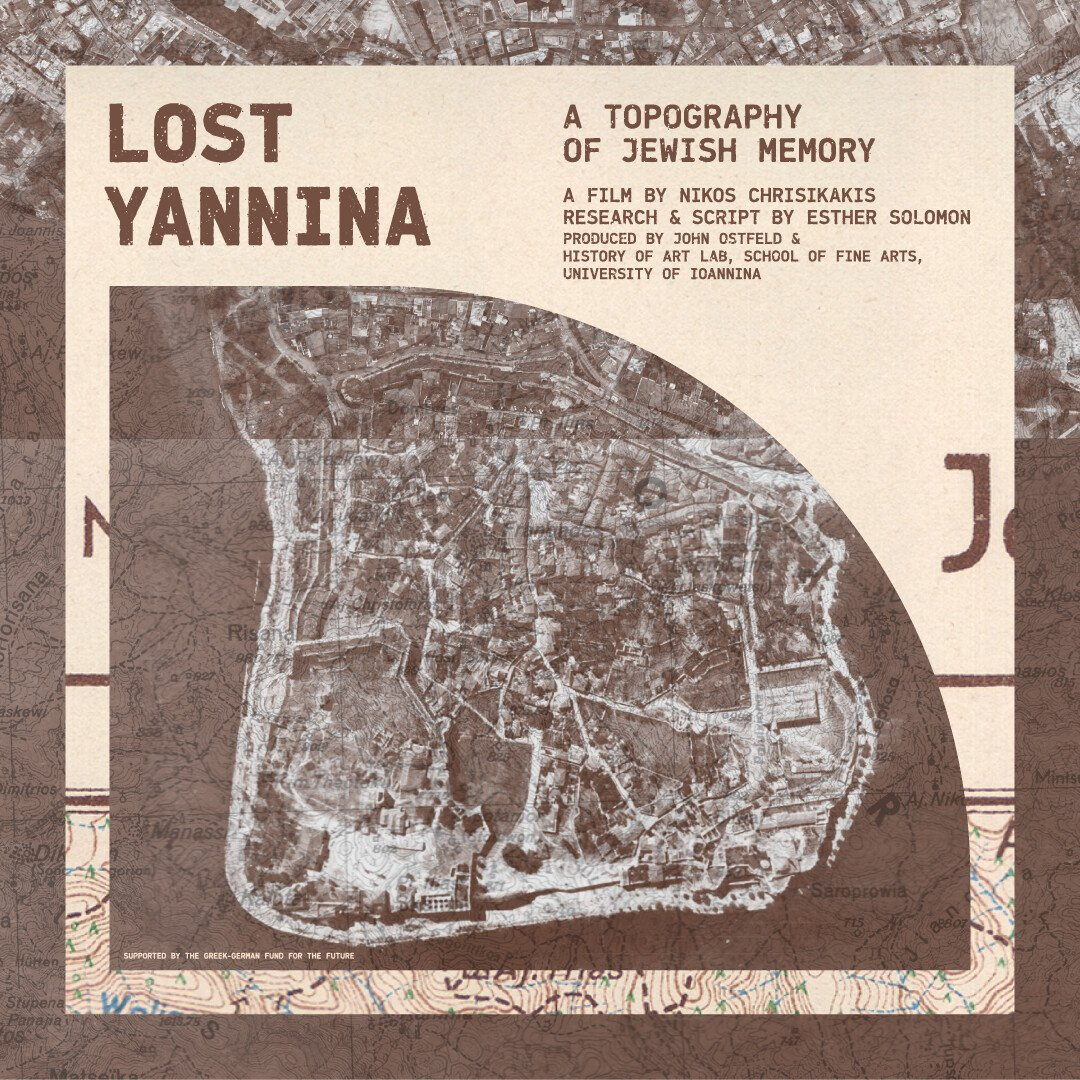
A film directed by Nikos Chrisikakis
113 minutes. In Greek with English subtitles
Reviewed by Annette B. Fromm1
This beautifully assembled documentary vividly portrays the impact of World War II on the lives of the Jews of Yannina (Ioannina), Greece, as well as the often silent spaces in the city that they previously occupied. The filmmakers drew together a selection of testimonies of Holocaust survivors,2 collected between 2009 and 2024, and one Christian observer, which movingly reflect upon their lives, their families, and their community. Their memories are paired with walks through the streets mentioned in their narratives to see where they lived, shopped, went to school, worshipped. This includes modest homes and the one mansion of a leading community member to whom one speaker was related.
Lost Yannina begins with a visual introduction to the past and present-day city in the mountains of northwestern Greece accompanied with wistful music that helps to set a somewhat thoughtful scene. Viewers are taken on a leisurely stroll along the lakefront, to the walls of the Byzantine kastro (castle), through the nearby neighborhoods where people live and work, and to the city’s central square. Contemporary images often paired with historic photos recreate the everyday life that came to a stop on March 25, 1944. In today’s language, viewers are able to see the sites of memory through the words of the individual narratives.
Through in-depth interviews, viewers learn about prewar daily life in homes in the kastro and in homes outside of the kastro. One of the women speaks at some length about the everyday life of Jewish women and praises their housekeeping skills.3 Another woman shows the empty space in which her family home had been located and describes the layout of the rooms.
Both synagogues and religious practices are addressed. The site and a memorial to the New “Hadash” synagogue and neighboring Alliance Israélite Universelle School, both of which were left in ruins by the Nazis, are visited outside of the kastro. Viewers are taken into the magnificent Old “Yashan” synagogue inside the kastro which has been beautifully restored. One of the narrators recalled the weekly custom of a crier who notified community members of the approach of the Sabbath.
From these recollections of everyday life of relative ease in which Jews lived together with Christian neighbors, the narratives transition to anguished experiences during the occupation and the deportations on the fateful day in March 25, 1944. The speakers’ memories are illustrated on maps of Ioannina as well as with film along the routes taken to reach the points from where they left the city. The one Christian witness to the German occupation included in the film speaks about seeing his Jewish neighbors being taken away.
Each of the survivors share painful memories of how their families were gathered in different locations and loaded into trucks then transported over the mountains to Larissa where they awaited the unknown. Here, several young men were able to escape and join the resistance. They also share recollections of well-known community members who chose to go to the resistance before the mass deportation.
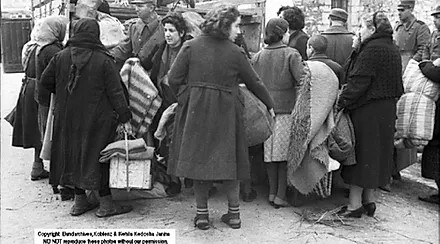
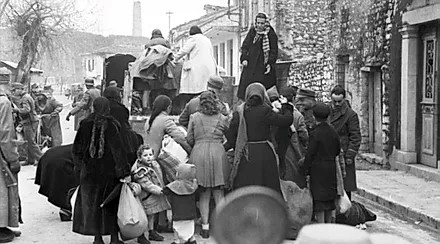
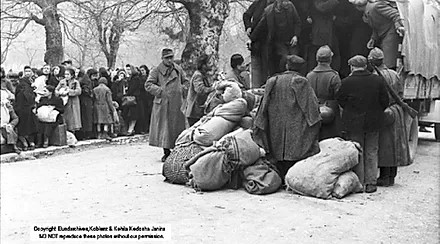
Photos courtesy of Yad Vashem
The Christian resident also remembered seeing the arrival of Kurt Waldheim4 in Ioannina at the time of the deportations. He talks about the hydroplane landing on the lake, the first ever in Ioannina. Among the Nazi officers he clearly recognized Waldheim as part of the arrivals. In a 1986 interview with a journalist that was never published, a Jewish man from Ioannina who moved to Israel recalls an interaction en route to Larissa; Waldheim struck him when he left the truck in which he was being transported.
The testimonies also address the disparate circuitous return experiences to Greece and Ioannina after the liberation of the camps and what was found upon their return. One survivor5 recalled the pain of being cruelly turned away from her family home. Another woman, the daughter of a woman who survived because she had converted to Christianity before the war, recalls the return of a trunk filled with family possessions that had been stolen after the Jews were deported.
Lost Yannina is replete with memories and recollections of a rich life in the city by the lake. Emotionally moving testimonies gathered from various sources visually illustrate and support the contemporary footage paired with vintage photos and maps. Together, the individual experiences shared in Lost Yannina stand for the collective of the Jewish community of Ioannina before the war, during the German occupation, and after the war.
Indeed, this documentary presents a topography of memories that recalls generation after generation of Jews that lived in Ioannina.
Lost Yannina presents one other piece in the complex puzzle of European Jewry and the World War II. The Jewish community of Ioannina at the time of the Shoah was small compared to other communities. Of the 2,000 people deported, fewer than 200 returned. It is an old community, among the oldest in Europe. It is a distinct community, now distinguished as Romaniote or “Hellenized, Greek Jews.” The essence of this Jewish community in Greece is expressed succinctly toward the end of the film when one of the narrators states, “We Are Greeks.”
Finally, Lost Yannina is a perfect fit in the programs of any and all Jewish film festivals. The beautifully written narration running through the film that links together all of the testimonies is accompanied with English subtitles. Among the images used is a rare set of photos of the Jewish community being loaded onto trucks for transport. They were taken in Ioannina on the morning of March 25, 1944 by a German paratrooper and were found many years later in the Bundarchives in Koblenz, Germany by Greek journalist Alekos Raptis. These photos are now available on the internet, open-sourced; in the documentary a number of the individuals are identified.
1 Annette B. Fromm is the review editor and associate editor of Sephardic Horizons. She is a descendant of a Greek Jewish family on her mother’s side.
2 I had the privilege to speak in-depth with four of the individuals whose testimonies are included in Lost Yannina when I conducted doctoral research in the mid-1980s. Those taped interviews are archived at the Jewish Museum of Greece.
3 Eftihia Nachman wrote that the Jewish women of Ioannina were especially renowned for their housewifely skills. Eftihia Nachman. Yanina, A Journey to the Past (Greek). Athens: Talos Press, 1996: 60. (Nachman, 2004, 60).
4 Kurt Waldheim was the fourth Secretary General at the United Nations from 1972-1981.
5 Several times she also shared this experience with me in greater detail.