
Interview with Navah Shemesh
A Daughter of Jerusalem
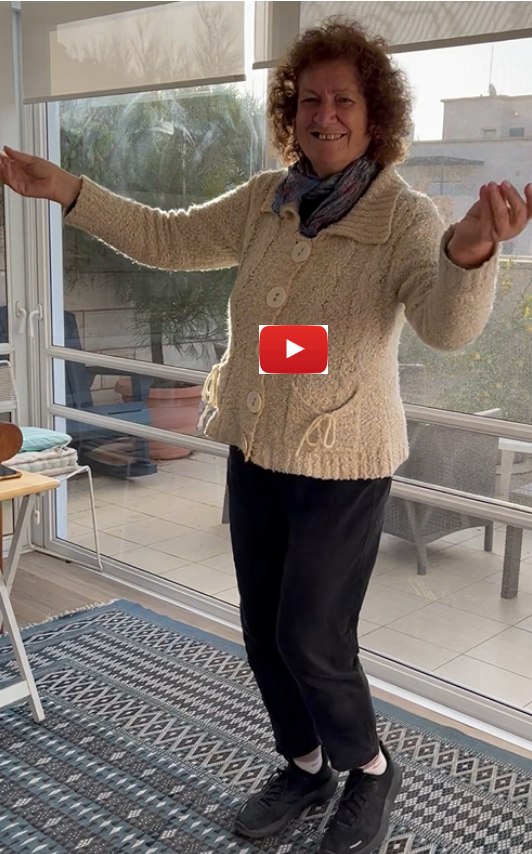
Interviewed by Judith Roumani1

Audio
JR: Hi, Navah, it is a privilege to be able to talk with such a talented person as you. I know you are a Feldenkrais instructor, a former literature teacher, and above all a talented trained musician and singer. And you have lived almost all your life as a Sephardic woman in Jerusalem. Let’s start from the beginning. Please tell me first about you parents, and where they were from.
NS: My parents immigrated to Israeli from Iraq. My father came from Baghdad. When he was eighteen he had to run away to Damascus, because his big brother brought some ammunition to their house, and the Arabs found out about it and wanted to kill the brothers. There he worked with his uncle to get a visa to come to Israel/Palestine. He came on a donkey and then got a ride with an Arab, paying him his last hundred dinars. The Arab took the money but betrayed him to the British at the bridge on the road to Safed, and he was arrested and sent to the prison in Akko. He worked inside the prison, writing letters in Arabic and Hebrew, and later as a carpenter. After a year, the British decided that, since he had not committed any crime besides being an illegal immigrant, he could be set free, this was in 1947. He fought in the War of Independence, but was wounded in the leg. My mother, who was also from Baghdad, immigrated in 1951, their families had been in touch. Her father, who had had a huge house in Iraq, containing eight apartments, one for each of his eight children, was given a hut in South Tel Aviv, and died in poverty.
JR: I think not many Jews nowadays have the privilege of living and walking in the neighborhood where they spent their early years. You were born in Jerusalem, you grew up in Jerusalem, and you still live here .How does it feel?
NS: It felt here like a little village, even less than a village. We were a neighborhood of eight houses. We are sitting now in the garden of the house of Shai Agnon, and across the street was Professor Klausner, representing the Hebrew University. There was my family and, across the street a Yemenite family who had the first falafel shop in Jerusalem, in Nahlaot. So we were the Sephardim, and down the hill there were four families of agronomists, professors at the Hebrew University, who were researching agriculture and had a dunam of land. So we were, in all, eight families, and nothing else around. The houses here were old, and Shay Agnon described in his writing how from the second floor of his house there was nothing in between and he could see all the way to the Old City. So, actually, when we needed water, or oil, we could go to someone and ask for it. We didn’t have very much. Once a week we got a package from the government containing oil, twelve eggs, water, milk and flour, so we could bake challah for Shabbat. We also got coupons to buy chicken, and some vegetables, usually we had onions, a cucumber, and tomatoes.
JR: You had a story about being outside your house and meeting a Dutch woman and guiding her…..
NS: One Shabbat, after lunch, August 1968, I was taking a walk towards Kibbutz Ramat Rahel and I saw a tall blonde woman, which is the first time I saw a blonde woman. [Oh, really? Oh, that's an interesting detail.] And I thought to myself, "Where is she from?" And she was looking around it looks like she lost her way. So I asked her, what are you looking for? She said, Kibbutz Ramat Rachel. And I said to her. I will show you the way, but please let's go to my parents' house and have some cold water before we continue. It's about a mile of walking. So fifteen minutes later, we continued towards Kibbutz Ramat Rahel. I asked her, where she was from. She said, she was Dutch, from Amsterdam, and she was looking for the kibbutz because there was a hostel there where she could sleep. We need to remember that until '67, we didn't have hotels for tourists. She was 17. I was 14, I think, and she was 17. Anyway, I showed her, we found a hostel, and we said goodbye. She asked my address, now I remember. And she said, maybe we'll be pals, what do you call this? [Pen pals. Pen friends]. I have been friends or pen pals. Okay. Three weeks later, I got a message from the post office that I have something there to pick up. I went to the post office and there was a package with six different spices that she had sent me as a thank you gift. Yeah. We have been corresponding for five years in English. [Which was not your first language and was not her first language either.] So that's how we could correspond and it forced me to dive into English, which I'm very happy I did. I took on myself [to read] an English storybook, and every day I [would] read one page and look in the dictionary, for the words I didn't know. It was very good. And I finished the book, I was, yeah, I was happy!
JR: Good, very good. So this was sort of your opening to the outside world… the world beyond Israel and the world beyond Jerusalem, at the same time by meeting this Dutch girl.
JR: Also, when you were a child, your father decided to build a new house, and you yourself helped him build. How old were you? Was it hard work?
NS: Yes, all right. I was nine years old and it took two years, from [when I was] nine to [when I was] eleven. It took two years to build that house! I was the first born, so my father put the yoke on my shoulders. Yes. It was a privilege. I don't know. I'm dual about it. I'm proud, but at the same time, my father never mentioned that I helped him. Oh, because I'm a girl. and that's why I wasn't so preferred. And it prevented me from playing with my girlfriends.
JR: Can you please tell us what it was like to be in Jerusalem during the Six-Day War. How old were you? Did you feel in danger?
NS: I was fourteen. I had studies in a school in Old Katamon, next to the Jerusalem Theatre. And there were times of tension. Every day that year we did practice to go to the shelter! The school was far from my home. There was no high school nearer. On the first day of the war, the headmaster of the school said, "Don't worry, I have ordered lunch and you're going to go to the shelter, and I am here for you.” And then at 11, the siren went off. And he said, "Go home, go home. We're closing the school. There is no lunch." So I start walking towards my home, under the bangs [explosions and guns firing]. I was hiding in the entrances of houses or next to cars lying down on the ground with my hands on my head, terrified. For six days, I I couldn't get home to Arnona. I was in the street because the army blocked the way. You couldn't cross Derech Hevron. Where Derech Hevron is now, there was the army base. So if I tried to get beyond Derech Bethlehem, I couldn't get there anymore. I mean, further. So I was six days in the street, lost, no food, no toilet, no shower, no imma, no abba. [My goodness, you must have been quite traumatized by all of that.] Yes, and every time in the next wars, yes. since then, I have been shaking and crying every time. It took me a long while to recover from it.
JR: When you could walk into the old city for the first time in your life, how did that feel? Did you go? Did you go with your parents? Did you go with your friends?
NS: I did walk with my parents, later on with a friend of mine, a woman friend of mine. But all the time, when we passed through Zion gate, and you see the bullets, the signs of the bullets…. Yes, and I'm thinking of the soldiers, oh, who fought there and got to the western wall crying. Yes, it moved me. It takes so much courage to fight and give your life. Yes, for me to walk in the market, for business to [take place]. I mean, until now, I am asking about myself, how to say, I'm not comfortable with soldiers dying for us to be able to live normally. [Yes, and they are, right now, that's what's happening, yes.]
JR: How was it here, right after the unification of Jerusalem? Did you go to Mamilla, where they had the wall built across the street and then they could finally demolish it? Did you go there?
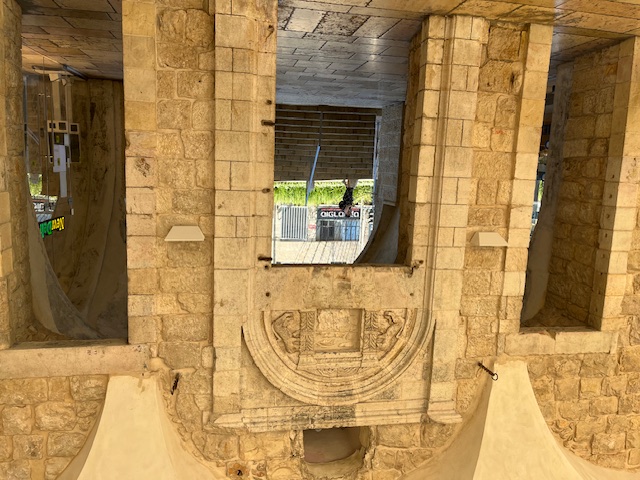
Entrance to former Sephardic synagogue in Mamilla This archway may have been the Aron Hakodesh. The name of the synagogue, which was between the two carved lions, has been erased.
NS: I did go, go there later on, when I was a student, for two reasons. One, I wanted to see the Museum of Herzl, which was at the end of Mamilla. There was a museum of Herzl, which was moved later on from there, and they built a house [for it somewhere else] when they took it away. And that was one thing, and the second thing is that when I was a student,, the Sephardim began to become active, which was in the early 1970s. I was a student in 1972, after two years in the army. Yes. So, between 1972 and the 1980s, the Sephardim started to wake up in Jerusalem because they felt they were … How do you say? Second-class citizens. Second-class citizens and serving the Ashkenazim and doing all the hard work such as cleaning the streets, so they didn't let them develop. And so they joined the panterim hashehorim [Israeli Black Panthers]. Yes. And the panterim had a whole cause with Yemin Moshe and Mamilla. And I went there to support them. So they found as far as the synagogue in the beginning of Mamilla to the left, that is as far the synagogue. [Oh, I didn't know that!] Yes, and the municipality took the Sepher Torah out and turned it (I will take you there some time), they turned it into I don't know what, an exotic entrance, but it was a synagogue and we fought. I was with them, we fought so that the Bet Knesset would be there. This was a synagogue that is Sephardic, sefaradi Jews lived and they prayed in the synagogue across the street, and the government destroyed that synagogue. Israel destroyed the bet knesset, not the Arabs. Not the Arabs and not the Goyim. And we were demonstrating there every day, but somebody bought the lot for a lot of money and the municipality liked that. So I have a very bad taste for Mamilla. [Oh, Interesting!] And the same with Yemin Moshe, they were expropriated. They were told to leave. [With regard to the sefaradim who lived in Yemin Moshe, and were evicted, the government] gave them very little compensation. Yes, a shikun, maybe a 60 meter block apartment in Kiryat Menachem or Kiryat Hayovel. [The government was] selling their lots in Yemin Moshe to rich Americans, Teddy Kollek wanted their money but the sefaradi citizens were the ones who had fought and protected Yemin Moshe, a neighborhood named after Moshe Montefiori. Yes. And now 60 meters maybe. Now who lives in Yemin Moshe? Americans who bought. Millionaires, yeah. Let's put it this way. They did allow one artist, I have to remember his name. They did allow one famous artist to buy a place, so they could say it's an artists’ colony, but mainly the millionaires bought houses and they never lived there. [I know, absentees. And David’s Village, next to Yemin Moshe?] Oh, that's much later. It's this new construction. [You go there and it's empty, uncanny.] That's how the municipality gathered money from rich people, rich Jews.
JR: Did you participate in a Sephardic community? Did you go to the hut where Shai Agnon prayed?
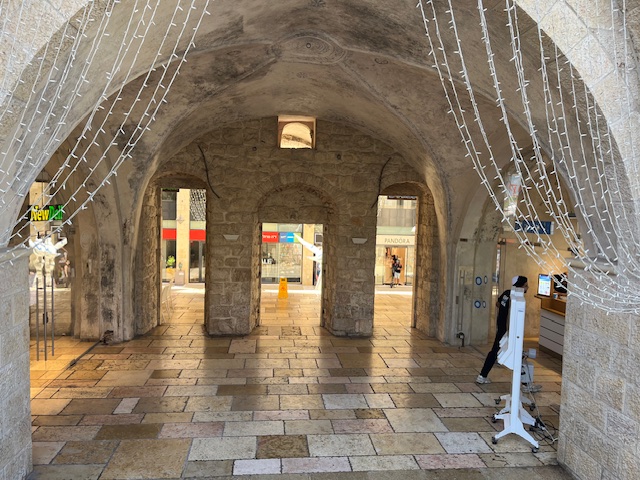
The ceiling of the synagogue survives. It is now occupied by two small fast food establishments, to the right and left.
NS: Yeah, when I was a child, I went with my father to the sefaradi synagogue, which was a srif [wooden hut]. Yes, yes. Shai Agnon also went there. Because it served, it was sefaradi, but also Ashkenazim went there, because literally few Ashkenazim were [around]. It was a very happy time because I always felt that this wooden house was like a Mishkan, you know, like the Mishkan in the midbar. It didn’t have walls like the Bet Hamikdash. It wasn't solid. It [felt as if it was] transparent, even though it was from wood. You could feel close to heaven. And I liked it, especially in Simkhat Torah, I remember when my father used to put me on his shoulders and dance. Later on, I went to the Sephardic Synagogue of Emouna in Baka, which I visit until today. They came in the early 1980s with the Manitou movement, Jews from Algeria, and formed a community who lived partially in the Old City and partially in Talpiot/Arnona. [There was an Algeriarian Kahal, this side of the Shay Agnon synagogue when we first came here twenty years ago. ] They are these [same] people. [Are they still there?] Ken, some of them, some, yeah. [Because I wasn't sure whether they were the people who joined ATRID.] Some of them moved to the new houses that they built in Derech Hevron 15 years ago or some 20 years.
JR: Did you know about Shai Agnon or ever see him?
NS: Yes. One Shabbat on the road, I went with my Yemenite friend to the shul and he was going in the other direction and he said to us “Shabbat Shalom Banot nehmadot!”
JR: What were relations like between Ashkenazim and Sephardim as you were growing up? Were they friendly relations? Were there tensions or did the tensions develop later with the panterim?
NS: The panterim didn't come from a religious point of view, they came from a cultural point of view. Within the religious people, there was no tension, I think that it was that they were all serving Hashem, each in their way, and they respected each other. And I'll tell you why is that, now when I think about it. Because there was no representation of the religous in the Knesset, like today. I mean, it has to do with money. To be religious has nothing to do with being in a parliament and getting money being shared out through the parties. Living a religious life had nothing to do with politics. Today, the religious people are holding the government, and they get paid for it. But it wasn't like this in those days. In those days religion was separate from politics. Which is really how it should be.
JR: So that was your experience growing up. Which high school did you go to?
NS: It's the one in Katamon. The atmosphere in the school had a discipline, compared to today. Yeah, there was discipline. We had to come on time and our headmaster walked the corridors among the classes to see who was late and punish him, and there was discipline, which I think is good. And there was also competition between the students [to see] who was better. This was a silent competition, though it was there. I was the best, I was the best student, by the way. [Oh, I'm sure you were.] Yes…. [So you feel it gave you a good self discipline for life?] Yes, we had to respect the law. That's something that today is far from reality.
JR: Next question. I’m going to change the subject. How did you become interested in music? Were your family musicians?
NS: A friend of my father was a music teacher, and he had an old guitar that he didn't need, so he gave it to my father as a gift. And my father gave it to me. Ah! I was 17, and I started to take lessons, which I.. .I worked for in order to pay for them, as a babysitter or a cleaner. And then I began to play guitar. With time, the guitar became my best friend, and music is nonverbal communication, which I love. After I finished the university at the Hebrew university, studying Hebrew literature, I thought, "Oh, I want to advance myself in guitar. And I got a scholarship to learn in the Academy of Music. [The Academy of Music, in Jerusalem?] Ken. But I had to support myself and pay for the studies and play, and I couldn't do it all, as my father didn't see music as a profession. [What did your father want you to do?] Be an accountant. [Oh. But that didn't appeal to you?] Yes, I did promise him because I wanted peace with him, that I will do the courses, and I did numbers one, two and three, in accounting, but I wanted music.
JR: And as your parents got older, who took care of them? Did you feel obliged, as the daughter, to live near them?
NS: Absolutely. As a daughter, and the firstborn, who is more sensitive, who feels responsibility as a firstborn. And meanwhile, my brothers got married and moved to Haifa, to America, and I had to take care of my parents.
JR: How did you get your musical training, and why did you turn later to being a teacher and a Feldenkrais instructor? You’ve had several careers . . . .
NS: When I finished university, I got a job to teach Hebrew literature in a school, Paula Ben Gurion, in Rehavia. I worked there for five years and I was tired from it. I felt lonely because the students didn't want so much to cope with stories and when I was asking help from the other teachers, they were busy.... Being a woman teacher who has a family and she has to worry about the children, babies at home, and so the discussion with the other teachers was about what they're cooking for the children, how the babies are. And I never was able to discuss with them about discipline in a school, what should I do with the pupils? So after four or five years, I felt I wanted to advance. I wanted to do something for myself. So I went to learn in the Academy of Music, and then after that year, one of the students in the academy told me, "You're looking for something very unique and and I think that I know what you're looking for. They have it in Jerusalem only in the Academy of Dance. And they name it Feldenkrais. So I went to study in the Academy for Modern Dance. And there we had Feldenkrais classes three times a week. After the second year, I realized that that's what I want to be when I'm a big girl, as a profession. So I did ask the teacher who taught us, "Where can I learn this profession?" She said, " Only in Tel Aviv." And I did call Tel Aviv and I joined the second. … [The term is Toar sheni, which means a graduate degree, equivalent to a master’s or professional degree.]
JR: What is your preferred kind of music? I have the impression you veered a little away from Western music.
NS: Music, for me, is a language which tells the story of a period in history, or of a group of people. So when I learned in the academy about classical music, I understood that it belongs to the classical period and what are the characteristics of that period in art as well as in music or in books. So it satisfied my intellect. Later on, I went to study flamenco in Tel Aviv for two years, music and dance, because I was attracted to the gypsy music, which tells stories mainly through the rhythms. Later on, I wanted to find out the influence of the gypsy music on Jewish music, like Hasidic music, or Ladino, or Arab music. So I went to a school which opened up in the 1990s, a school of music from the East and I studied there flamenco music and Arabic music. Until today, I do understand that music is a language that describes a history of culture and people. So there are different musical languages. The flamenco and Arabic music talk to my being and heart, and the rhythm, the rhythm is also a language for me, which describes emotions like joy or sadness, or... It's the same in classical music, when the composer changes rhythm to express a different atmosphere.
JR: Can you describe what Jerusalem means to you?
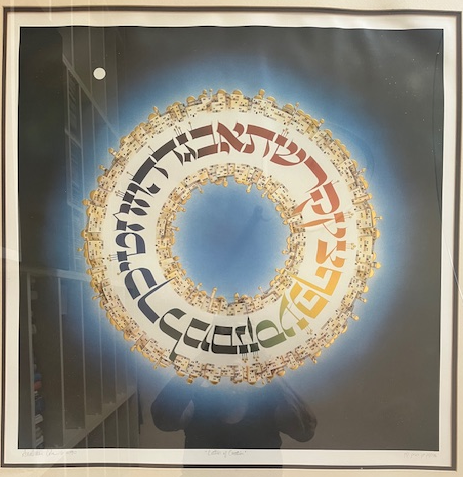
NS: Yeah. I always have seen Jerusalem, after 1967, I have seen Jerusalem as a big mother with a big womb, receiving everyone who is looking for some meaning to their lives, and wants to be born again. It's a big womb, and people come from all over the world to look for some meaning to their lives. Who they are, where they are heading. What is the purpose of life? Is there something beyond what we call holiness? What does it mean? Where do heaven and earth meet? Jerusalem is a place when heaven and earth meet. [ Can I show you my painting? Just as you talk. Come and look at this. This is by an artist who lives in Baltimore.2 It has Yerushalaim Shel Lemata and Yerushalaim Shel Lemala]. And there's the womb in the middle. [Ah, that's a womb in the middle?] I don't know, I just thought. It's amazing, yeah. I tell you why, because we, in Western culture, we think linear, but a round shape is the shape of something wholesome, something complete, something which is infinite, because it's always, it's like how the Earth turns... you know, in space. Its round shape is a matter of indicating space. Yes. And that's why it's beyond the linear line of history or time. Right? [Thank you so much, Navah. I really appreciate this.. I hope this did not make you too tired. Thank you!]
I wanted you to know that I tell myself that I got three presents. I was born in Jerusalem. My father is a Levi, so that's why I see music as a language of the spirit. And I was born on Shabbat. And Shabbat is also a time which is a bit internal. So that's those three. It's a different dimension. These three presents guide me in my life. [Yes. Well, I really admire what you've achieved and I wish you much success and spiritual fulfillment.] Amen!3
1 Judith Roumani is the editor of Sephardic Horizons. With thanks to Navah Shemesh, and to Michael Lowy for help with the transcription. This interview took place on January 4, 2025.
2 The painting is called “The Letters of Creation,” by Avraham Cohen, 1990.
3 Navah continued: “I also want to mention about Feldenkrais that you asked me, his name was Moshe Mikovic. The father and his grandfather, was a Hasid, and in Russia, and he took from them the ability to contemplate on processes, like they contemplate in words in the name of God and Kabatala, he had this ability to see processes in motion in space. And that really attracts me because I found the Jewish point in the Feldenkrais, and I felt that is what motivates me. People who do Feldenkrais, as he was living in Tel Aviv, most of the teachers after him saw him only as a scientist, but they don't look at his Jewish heritage. and for me, what his message is that, like, we have the light and we need a vessel, like a bulb, to contain the light. We have the spiritual essence and our body contains that spiritual essence.”
Copyright by Sephardic Horizons, all rights reserved. ISSN Number 2158-1800