
A Sephardic Diaspora in Sepharad
Exile and Longing in the Poetry of Moses ibn Ezra
By Matthew D. Warshawsky1
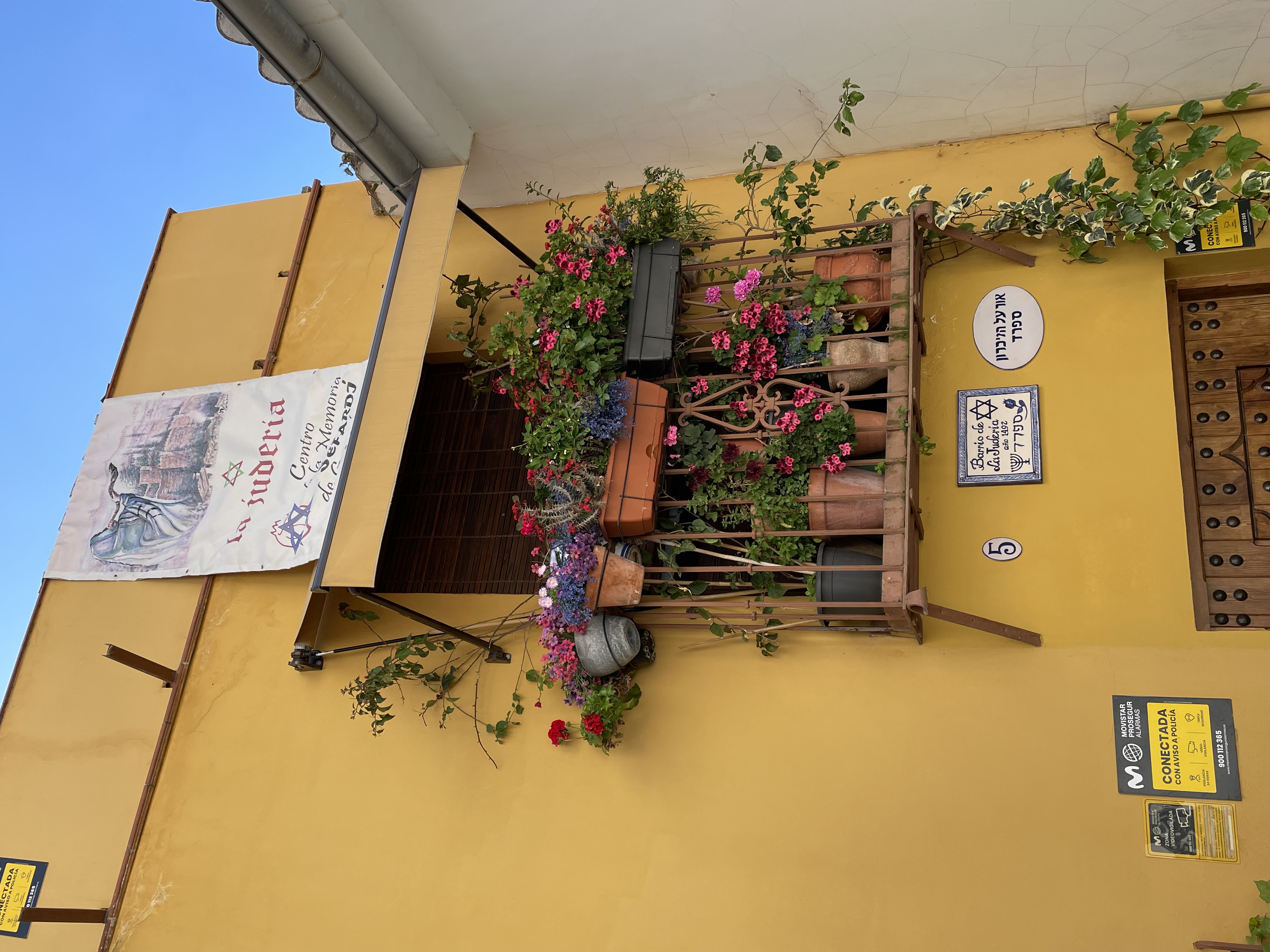
Centro de la Memoria Sefardi, a house in the former
Jewish quarter of Granada. With thanks to Theresa Burks.
The expulsion and forced conversion of the Jews of Spain in 1492 decreed by the Catholic monarchs Isabel and Fernando is the most famous and far-reaching example of Jewish exile from the Iberian Peninsula. However, medieval Spanish Jews suffered other instances of displacement during the eleventh through thirteenth centuries as well, first upon the disintegration of the caliphate of Córdoba into small kingdoms called taifas, and then during the short but violent rule of the Almoravids and the Almohads. Instead of providing political, and military support in al-Andalus, or Islamic Spain, as individual taifas had requested, these Berber Muslims imposed increasingly stricter forms of Islam than had existed under the caliphate. During their control, from the end of the eleventh century until the middle of the twelfth, the Almoravids maintained the status of Jews as ahl al-dhimma, or protected people, while simultaneously marginalizing them, for example, by compelling them to wear an identifying symbol on their clothing (Ray p. 58).2 Likewise, the Almohads, who ruled until the first part of the thirteenth century, compelled their Jewish, Christian, and even Muslim subjects to convert to the form of Islam that they practiced (Ray pp. 59–61). Many Jews who refused to convert fled to comparatively more tolerant Islamic and Christian kingdoms elsewhere in Iberia; others, such as the family of Moses ben Maimon (Maimonides), left the Iberian Peninsula for North Africa.
This article studies five examples of secular poetry written by Moses ben Jacob ibn Ezra (c1055–c1138), a Jew whose exile from al-Andalus to regions in central and northern Spain impacted his work indelibly. This physical and emotional uprooting informs how these texts communicate the love of Ibn Ezra for Granada, the southern Spanish city of his birth and early residence, as well as the pain of isolation and the resentment occasioned by his fate, all accompanied by an insistent regard for his abilities as a writer. The profoundly personal character of these poems also reveals the humanity of the poet, showing the complex and contradictory worldview of this embodiment of the Hebrew Golden Age of medieval Iberia.
A summary of the biography of Ibn Ezra and the historical context of his life can illuminate the resulting setbacks and melancholy that permeate his exile poetry. Born in approximately 1055 to “one of the most prestigious families of the [Jewish] community” of Granada (“una de las familias más prestigiosas de la comunidad”; Cano Pérez p. 97),3 he enjoyed a privileged upbringing that included the study of Hebrew, Arabic, Greek, and maybe Latin (Brody pp. xx–xxi). While Ibn Ezra was a child, his family left Granada for the nearby city of Lucena due to rioting against Jews in 1066 whose casualties included Joseph ha-Nagid ibn Nagrela, the Jewish vizier to the king and son of the illustrious poet and courtier Samuel ibn Nagrela (Brann p. 61). In Lucena, which at that time was a center of Jewish scholarship, Ibn Ezra studied in the rabbinic academy of the Talmudic scholar and poet Isaac ibn Ghiyyat. In his prose analysis of Hebrew poets of al-Andalus written in Arabic, Kita̅b al-muḥa̅ḍara wal-muda̅kara (Book of Conversation and Deliberation), Ibn Ezra described Ibn Ghiyyat as a “master of correct Hebrew expression . . . [who] wrote meticulously in prose and created verses brilliantly (“maestro de la correcta expresión hebrea . . . redactó en prosa con pulcritud y compuso versos con brillantez”; p. 80; translated from Arabic to Spanish by Abumalham Mas and from Spanish to English by the author).
After a short stay in Lucena, Ibn Ezra and his family returned to Granada, where the youth developed his creative talent in the company of other Hebrew-language poets including Yehudah Halevi, a recent arrival to whom he became a mentor. Ibn Ezra also served as șaḥib al-šurṭa, or chief of markets, in the court of Abd Allah ibn Buluggin, the last king of the Zirid dynasty in the taifa of Granada. Beyond poetic and courtly pursuits, Ibn Ezra married and became a father, although for unknown reasons he does not mention his wife in his writings (Brody p. xxi).
This period of happiness ended abruptly in 1090, when Ibn Ezra would have been approximately thirty-five years old, due to the seizure of Granada by the Almoravids led by the emir Yusuf ibn Tashfin. The theological inflexibility of these Berber Muslims ended the relative tolerance of Jews in the city and surrounding area, uprooting them from a place that in Arabic had been called Garnata al-yahud, or Granada of the Jews. Partially due to this catastrophe, few Jews remained in Granada during the subsequent reigns of the Almohad and Nasrid dynasties, the latter of which ended January 2, 1492, barely three months prior to the edict mandating the expulsion or conversion of all Jews from the kingdoms of Castile and Aragon.
The three brothers of Moses ibn Ezra fled from Granada due to the Almoravid invasion: the eldest, Isaac, to Córdoba; the second, Joseph, to Toledo; and the youngest, Judah, to an unknown destination (Brody xxii). A greater mystery is why Moses remained in Granada for five more years and then, when he did leave, in 1095, why he did so without his wife and children. Upon noting that the king, Ibn Buluggin himself, and his courtiers fled Granada for North Africa at the time of the Almoravid takeover, María José Cano Pérez has claimed that politics, not religion, likewise contributed to the exile of the poet (p. 98). Ibn Ezra spent the next four decades wandering unhappily throughout the Iberian Peninsula, with stops in Castile, Zaragoza, and Barcelona. Penury forced him to seek financial support from his brothers and friends and to endure the indifference of his sons and the uncultured communities in which he lived. Sometime before 1128, at the age of nearly seventy-five, Ibn Ezra acceded to the wish of his favorite and only living brother, Judah, that he return to Granada. However, Judah died before Moses ibn Ezra could make this journey (Brody p. xxv). His last writing is dated 1138, so scholars have assumed he died shortly thereafter.
Scholars consider Ibn Ezra one of the four most outstanding poets of the Hebrew Golden Age of medieval Spain, together with Samuel ibn Nagrela, Solomon ibn Gabirol, and Judah Halevi. He wrote secular and religious poetry in Hebrew, as well as prose in Arabic (Scheindlin p. 261). According to Ángeles Navarro Peiro, Ibn Ezra wrote eighty poems of lament, the subject of many of which is his unhappiness as an exile (“Mošé ibn ‘Ezrá” p. 382). The following analysis studies five such texts that I have read with undergraduates in my class studying Muslims, Jews, and Christians in medieval Spain, most recently in spring 2024, when teaching in the study abroad program in Granada in which my university participates. Citations to these poems use the translations from Hebrew to Spanish by Ángel Sáenz-Badillos and Judit Targarona Borrás in their anthology of Hispano-Hebrew medieval poets and that I have translated subsequently to English. The first such poem, “The flight from Granada” (“La huida de Granada”), cited entirely due to its brevity, communicates the impact of exile on Ibn Ezra:
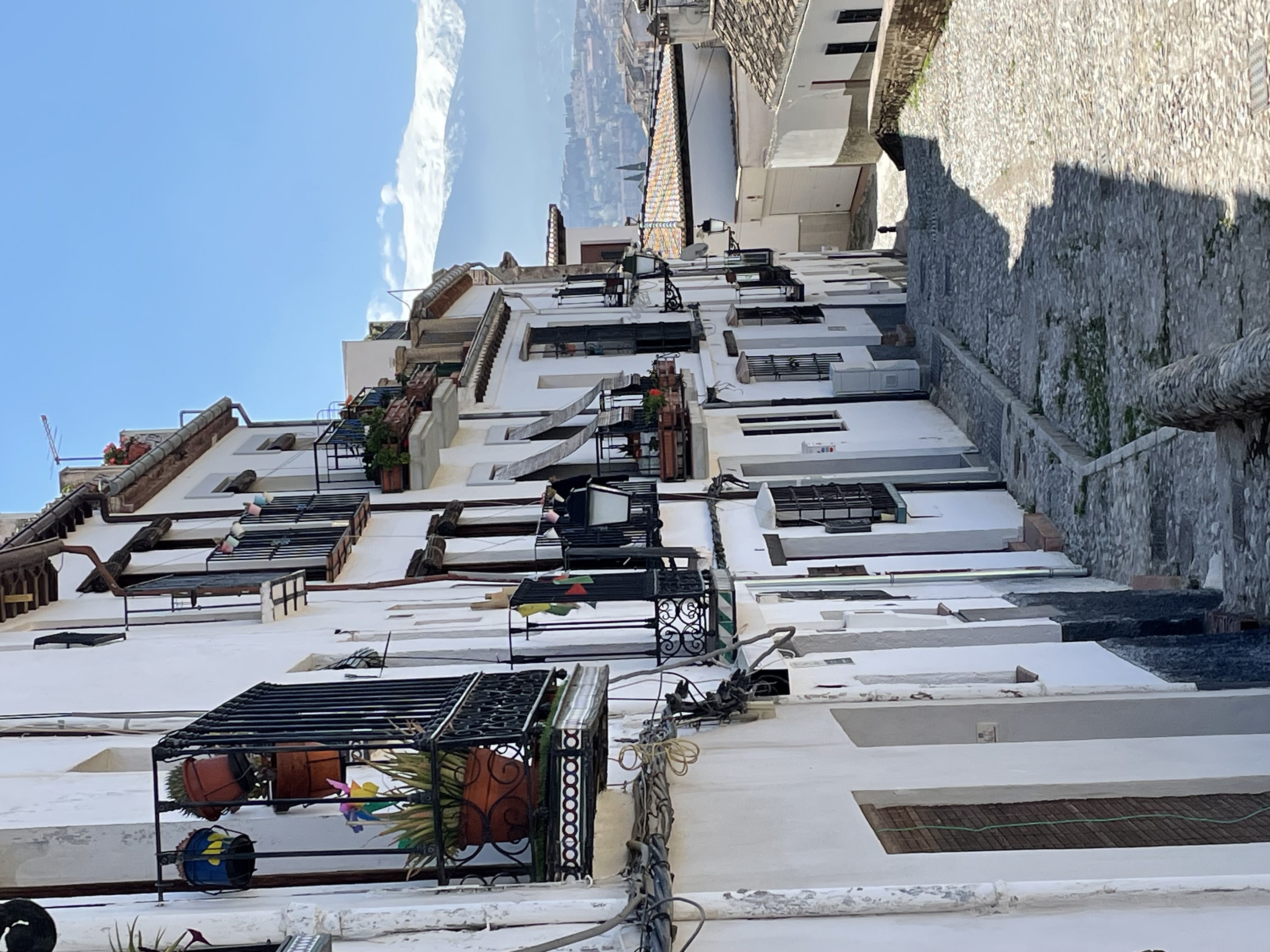
A typical street in the Realejo neighborhood of Granada,
where Jews lived before the community was decimated in 1066.
With thanks to Theresa Burks.
After the days of my youth became
like a shadow and the steps of my years were shortened,
flight shouted to me, “Arise, carefree one!”
and my ears tingled at its shout.
With a restless heart I arose and set forth,
a wanderer, while my children beseeched God.
They were the source of my life; how will I be able to live without them,
if the light of my eyes is not with me?
Fate has led me to a land in which
my thoughts and desires tremble from fear,
a people of stammering lips and indecipherable speech.
On seeing their expressions my face becomes discouraged,
until God heralds my liberation
from them, saving me by the skin of my teeth.4
Después que los días de mi juventud se tornaron
cual sombra y se acortaron los pasos de mis años,
la huida me gritó: “levántate, despreocupado!”,
y a su clamor retiñeron mis oídos.
Me levanté con corazón agitado y partí
errante, mientras mis hijos imploraban al Señor;
eran la fuente de mi vida, ¿cómo podré vivir sin ellos,
si no está conmigo la luz de mis ojos?
El Destino me ha conducido a una tierra en la que
mis pensamientos y deseos tiemblan de temor,
una gente de labios balbucientes y habla impenetrable;
al ver sus caras decae mi rostro,
hasta que el Señor me anuncie la liberación
de ellos, salvándome con la piel de mis dientes.
(Sáenz-Badillos and Targarona Borrás, p. 160)5
The first two lines of the poem contrast the contentment of Ibn Ezra in Granada with the unhappiness of separation from the city. This sadness as an exile arises from the poet’s separation from his children for still-unexplained reasons; here, he suggests that he left Granada against their will. Ibn Ezra then laments the destiny that has compelled him to live among uncouth people, whether Christians or Jews, who do not understand him and whom he does not understand. Mired in this isolation, the poet looks to God to set him free from such individuals, comparing himself with Job, who in the biblical text complains that family members, friends, acquaintances, and servants have become hostile due to what Job considers unjust persecution by God (Job 19). For this reason, the “liberation” that Ibn Ezra longs for harkens to the lament of Job, for whom “Those I love have turned against me. / My bones stick to my skin and flesh; I escape with the skin of my teeth” (Jewish Study Bible, Job 19.19–20). As Edward L. Greenstein has observed, at this moment in the narrative the jaw bones of Job are stuck together, thus preventing him from speaking; however, given that he continues speaking, the expression is “a literary conceit” (note to Job 19.20, 1523).
From beyond Granada, Ibn Ezra continued writing panegyrics, or poems praising others, adapting to his circumstances a genre common among Muslim and Jewish writers of al-Andalus. For example, in the second work that this article studies, the poet includes an anonymous elegy within a text that also laments his isolation in Christian Spain, longs for the Granada of his youth, and boasts of his talent. Of these components, the one that most stands out contrasts his early life with his current melancholy. Thus, removed from loved ones due to the Almoravid takeover of Granada, Ibn Ezra laments,
it is as if my pupils had become wineskins
to moisten my cheeks, or storm clouds,
because of the absence of friends who left me and whom I miss
even if they are present in my thoughts.
es como si hubieran convertido en odres mis pupilas
para humedecer mis mejillas, o en nubarrones,
por la ausencia de los amigos que me dejaron y me faltan,
aunque estén presentes en mis pensamientos” (p. 161, vv. 12–13).
This solitude is even more piercing as the antithesis of his former life in Granada, where “the days of my life full of the nectar of love / and drunk from just the wine of my youth / I spent in the most pleasing of lands” (“los días de mi vida saciados del nectar del amor / y ebrios tan sólo del vino de mi juventud / los pasé en la más agradable de las tierras”; p. 162, vv. 16–17).
At the same time, the poet emphasizes that the inhabitants of Granada, rather than its physical attributes, ennobled the city, thus showing the impact of his displacement: “as it is men who give life to homes, / and when they [men] are absent, they [homes] only watch over spirits” (“pues son los hombres que dan vida a las casas, / y cuando ellos faltan sólo guardan espíritus”; p. 162, v. 21). Ibn Ezra complains of living “in a desert of wild asses [onagers]. / They are violent men in need of a little knowledge” who scorn his wisdom (“en desierto de onagros. / Son hombres salvajes necesitados de un poco de ciencia”; p. 162, vv. 24–25). This disparagement of people living north of al-Andalus shows that Iberian Jews were not a monolith and did not regard each other as equals. It also confirms a paradox by which, at least during the 1100s, Jewish cultural life was richer in the increasingly intolerant setting of Islamic Spain than in Christian-controlled areas of the Iberian Peninsula that accepted the presence of Jews.
In contrast with the solitude that features prominently in his work, Ibn Ezra maintained a friendship with Yehudah Halevi (c1070–1141), the most iconic embodiment of Hebrew poetry of al-Andalus. This friendship began when Halevi, a native of Tudela, in the Navarre region of northern Spain, traveled to al-Andalus as a young man to study (Brody pp. 189–90n27a). During the years after Ibn Ezra’s exile in 1095, Halevi unsuccessfully urged his older friend to join him in the south, but Ibn Ezra refused to do so despite the complaints set forth in his poems. Sáenz-Badillos and Targarona Borrás state that Ibn Ezra refers to Halevi in one of these texts, “The eyes of the rocks wept bitterly” (“Los ojos de las rocas lloraron amargamente”), which they categorize as a “poem of friendship” (“poema de amistad”), even though he does not openly mention his friend from Tudela (pp. 164–65). Besides the apparent friendship with Halevi that the poem describes, its most noteworthy aspect is its treatment of familial conflicts that contributed to Ibn Ezra’s exile from Granada: “the sons of my mother hardened their heart although / my friends held it open for my cause” (“endurecieron su corazón los hijos de mi madre aunque / mis amigos lo tuvieran abierto por mi causa”; p. 164, v. 4); and one line later, “unknown people have approached me quickly upon seeing / that my own children were insulting me” (“gente desconocida se me acercó deprisa al ver / que mis propios hijos me ultrajaban”; p. 164, v. 4). These references to the brothers and children of Ibn Ezra lead the reader to wonder what had occurred between them and the poet to provoke their respective hardened hearts and insults. Likewise, Ibn Ezra does not identify these friends nor the “unknown people,” nor does he explain why they supported him, even as his own family did not.
Like his description of the people among whom he lives as onagers in the previous poem, here Ibn Ezra laments living “among wolves, dwellers of a desert in which / they have not even heard the word ‘man’” (“entre lobos, habitantes de un desierto en el que / ni tan siquiera han escuchado la palabra ‘hombre’”; p. 164, v. 10). The poet then tells his own heart to leave, but it replies, “the rivers of goodness have dried up” (“los ríos de la bondad se han secado”; p. 165, v. 14) due to the absence of friends in northern Spain. Increasingly isolated from such friends, Ibn Ezra writes near the end of the poem, “may peace be with those who are distant from me, / but who touch my heart close up!” (“¡la paz sea con ellos! que muy lejos me quedan, / pero tocan de cerca a mi corazón”; p. 165, v. 18).
In the fourth poem, “When I remember my youth” (“Cuando me viene a la memoria / . . . mi juventud”), Ibn Ezra again emphasizes his present sadness through comparison with prior happiness in Granada. As a young man, the poet contemplated a future that would be of his making and enjoyed the esteem of close friends, “awaiting like dew drops the words of my mouth” (“aguardando como rocío las palabras de mi boca”; p. 167, v. 6). However, destiny turned against him inexplicably, causing Ibn Ezra irremediable suffering: “In my insides I feel pain, but what use is it, / my brothers, that my anger against God be incited?” (“En mis entrañas siento dolor, mas ¿de qué sirve, / hermanos míos, que se encienda mi ira contra el Destino?”; p. 167, v. 13). The text uses imagery of the physical senses to communicate this anguish. As a result, Ibn Ezra remembers growing up amongst his brothers in Granada, “whose mouth tasted to me like honey and smelled like myrrh” (“cuya boca me sabía a miel y me olía a mirra”; p. 167, v. 4). Conversely, later in the text he asks, “how will I be able to see / without them [my friends], if the stars of my soul have darkened?” (“¿cómo podré ver / sin ellos [mis amigos], si se han oscurecido las estrellas de mi alma?”; p. 167, v. 12).
Similarly, in “How far will my feet have to walk / in exile without finding rest?” (“¿Hasta dónde tendrán que caminar mis pies / por el destierro sin encontrar descanso?”; pp. 168–169), the last text that this article studies, Ibn Ezra summarizes his geographic and physical exile by complaining of the bitterness and solitude of his life far from Granada. He communicates in physical terms the impact of a fate beyond his control, likening his tears with “the waters of Noah” (“las aguas de Noé”) and saying such tears are “of torrents of sulfur . . . / since they flow in order to burn my heart” (“de torrentes de azufre . . . / pues fluyen para abrasar mi corazón”; p. 168, v. 7). Additionally, the poet describes the regions of Castile and Aragon as an intellectual wasteland where nobody understands him:
If I could find in my exile an intelligent
man, I would forget even his transgressions.
I run from city to city, and I find tents
of stupidity made taut by the hands of men.
Si pudiera hallar en mi destierro un hombre
inteligente, olvidaría incluso sus delitos.
Corro de ciudad en ciudad, y encuentro las tiendas
de la estupidez tensadas por manos de los hombres (p. 168, vv. 14–15).
Due to his fruitless search for likeminded companions, Ibn Ezra boasts of his superiority to poets of Christian Iberia who imitate him. While his voice is “the roar of a lion“ (“el rugir de un león”), those of other writers are “the noise of dogs about to bark” (“el ruido de perros a punto de ladrar”); therefore, he consoles himself affirming, “my verses will endure as long as the sun revolves / in its orbit, but they will be forgotten completely” (“se mantendrán mis versos mientras esté el sol / en su órbita, pero ellos serán del todo olvidados”; p. 169, vv. 23, 24). Together with the oblivion of these unidentified and unskilled poets, Ibn Ezra also fantasizes a return to Granada by remembering his friends there and the physical setting of the city.
The poet then dramatizes his exile by comparing it with the Babylonian captivity of biblical Jews, exhorting himself regarding the memory of his friends, “May my right hand be forgotten if I forget them, and if, / deprived of their faces, I wish to be happy!” (“¡Olvídese mi diestra si los olvido, y si / privado de sus rostros quiero alegrarme!”; p. 169, v. 30). In Psalm 137, the psalmist notes how the Israelites weep by the rivers of Babylon when they remember Zion, that is, Jerusalem. The biblical narrator then proclaims that if he neglects to remember Jerusalem, “let my right hand wither; / let my tongue stick to my palate (Jewish Study Bible, Ps. 137.5–6). While the Babylonian rivers provoke tears of the exiled Israelites, the memory of the Genil River in Granada inspires Ibn Ezra to write with melancholic longing:
If my God were to lead me again to Granada,
my paths would be fortunate,
and God would satisfy me from the waters of the Senir [of the Genil], pure
until the delicious roiling torrents descend.
Si me condujera de nuevo mi Dios a Granada,
serían dichosos mis caminos,
y me saciaría de las aguas del Senir (del Genil), puras hasta
cuando bajan turbios los torrentes deliciosos (p. 169, vv. 31–32).
Senir was the name by which the Amorites, one of the peoples living in Canaan, identified Mount Hermon, located in the border region of present-day Lebanon, Syria, and the Israeli-controlled Golan Heights. In a parenthetical note to their translation, Sáenz-Badillos and Targarona Borrás suggest an equivalence between the biblical river and the Genil (p. 169; see above). Additionally, their marginal gloss to this note directs readers to Psalm 36.9, where, as Adele Berlin and Mark Zvi Bretter note in their own commentary, the “refreshing stream” from which God permits humans to drink is the life-nourishing river that flows from the Temple (1307, note to Ps. 36.8–10). Through this comparison to a spring in Jerusalem, Ibn Ezra attributes sacred powers to the Genil as a source of life opposed to the barrenness symbolic of the lands of his exile.
Through its references to an exilic mourning for Jerusalem as described in Psalm 137 and to Ibn Ezra’s idealized vision of Granada, also imagined in exile, the poem “How far will my feet have to walk . . . ?” is an apt place to conclude this article. The analysis of it and the preceding works has emphasized the impact of the poet’s physical and emotional displacement on his worldview. In so doing, the study has also attempted to show how questions about problematic relationships with his brothers and children that Ibn Ezra leaves unanswered contribute to the evocative nature of the poems, prompting the reader to wonder about the causes of this enmity. Given the paucity of biographical details in these texts, one imagines relationships made fraught by religious coercion as well as by intrafamilial resentments, petty jealousies, and other insecurities. Additionally, in light of the tribulations that Ibn Ezra suffered due at least partially to his Jewish identity, these poems also question the problematic myth of harmonious coexistence (convivencia) between Muslims, Jews, and Christians in al-Andalus. The laments of Ibn Ezra referring to the Babylonian exile of biblical Jews and to his longing for Granada depict another reality of medieval Spain, emphasizing the impermanence, marginalization, and exile that for centuries characterized the existence of Jews there.
Works Cited
Brann, Ross. The Compunctious Poet: Cultural Ambiguity and Hebrew Poetry in Muslim Spain. Baltimore: Johns Hopkins UP, 1991.
Berlin, Adele, and Marc Zvi Brettler. Notes to Psalm 36. The Jewish Study Bible, 2nd ed., Oxford University Press, 2014, p. 1307.
Brody, Heinrich. Introduction and Notes to Introduction. Ibn Ezra, Selected Poems of Moses Ibn Ezra, pp. xix–xxxv.
Cano Pérez, María José. “La judería de Granada en los textos.” Granada y la memoria de su judería: Punto de debate, edited by Miguel Ángel Espinosa Villegas. Granada, Spain: Editorial Universidad de Granada, 2022, pp. 91–113.
Gerber, Jane S. The Jews of Spain: A History of the Sephardic Experience. New York: The Free Press, 1994.
Greenstein, Edward. L. Notes to Job 19. The Jewish Study Bible, pp. 1522–24.
Ibn Ezra, Moses. Kita̅b al-muḥa̅ḍara wal-muda̅kara (Libro de la disertación y el recuerdo), vol.2. Translated by Montserrat Abumalham Mas. Madrid: Consejo Superior de Investigaciones Científicas, Instituto de Filología, 1986.
---. Selected Poems of Moses Ibn Ezra (Maḥberet Me-Shire Mosheh Ben Yaʻaḳov Ibn ʻEzra). Edited by Heinrich Brody, translated by Solomon Solis-Cohen. Philadelphia: Jewish Publication Society of America, 1934.
The Jewish Study Bible. Edited by Adele Berlin and Marc Zvi Brettler, 2nd edition. New York: Oxford University Press, 2014.
Navarro Peiro, Ángeles. “Mošé ibn ‘Ezrá: El poema de los dos exilios. Sefarad, vol. 61, no. 2, 2001, pp. 381–93.
Ray, Jonathan. Jewish Life in Medieval Spain: A New History. Philadelphia: University of Pennsylvania Press, 2023.
Sáenz-Badillos, Ángel, and Judit Targarona Borrás, editors. Poetas hebreos de al-Andalus (Siglos x-xii): Antología. 3rd ed. Córdoba, Spain: Ediciones El Almendro, 2003.
Scheindlin, Raymond P. “Moses Ibn Ezra.” The Literature of Al-Andalus, edited by María Rosa Menocal, Raymond P. Scheindlin, and Michael Sells. New York: Cambridge UP, 2000, pp.252–64.
1 Matthew D. Warshawsky is professor of Spanish at the University of Portland and the author of, most recently, From New Christians to New Jews: Seventeenth-Century Spanish Texts in Defense of Judaism (LinguaText, 2024). He presented an earlier version of this article in Spanish at the conference of the Pacific Ancient and Modern Language Association in November 2024. He wishes to thank Mark Bennett, site director of the Independent Liberal Arts Colleges Abroad (ILACA) program of Willamette University in Granada, Spain; María Ortega Titos, ILACA program coordinator in Granada; Olga Ruiz Morell, Aurora Salvatierra Ossorio, and María José Cano Pérez, professors in the Department of Semitic Studies at the University of Granada; and David Wacks, professor of Spanish at the University of Oregon.
2 The designation of Jews and Christians in medieval Islam as ahl al-dimma, or dhimmis, conferred upon them the status of nonbelievers protected as marginalized peoples, as well as the obligation of paying “discriminatory taxes” (Gerber p. 23; also see Ray p. 28).
3 All translations from Spanish to English in this article are mine.
4 See also “When the Morning of Life Had Passed,” the translation of this poem by Solomon Solis-Cohen in Ibn Ezra, Selected Poems of Moses ibn Ezra p. 10.
5 Given that all translations from Hebrew to Spanish of poetry of Ibn Ezra quoted in the essay are by Sáenz-Badillos and Targarona Borrás, subsequent citations to their anthology will indicate page and verse numbers only. I have relied extensively on this text because I do not read Hebrew (yet), nor was able to find English translations of the poems discussed, except for the first one quoted (see the preceding note).
Copyright by Sephardic Horizons, all rights reserved. ISSN Number 2158-1800