
Aviva Ben-Ur and Wim Klooster, editors
Jewish Entanglements in the Atlantic World
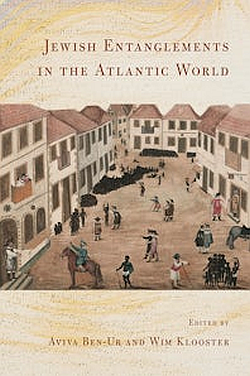
Ithaca: Cornell University Press, 2024, ISBN: 978-1501773150
Reviewed by Jonathon Derek Awtrey1
Historians have often presented American Jewish history in a “linear” and “nationalistic” manner that has privileged “U.S. exceptionalism.” The scholars who contributed essays to Jewish Entanglements in the Atlantic World instead presents American Jews within a web of “entanglements,” including economic and intellectual networks, across the early modern Atlantic world.
John M. Dixon’s essay shows how earlier scholars, chiefly amateur historians of Jewish descent, created the American Jewish Historical Society. The sources they gathered helped to construct a “metanarrative” that largely ignored Jewish cultural elements not of North American origins. Such scholars hoped to further the notion that the United States had unleashed Jewish political freedom and civil rights as well as Jewish commercial prosperity as a means to assimilate the recent influx of Jewish migrants to American shores in the nineteenth century. By the twentieth century, historians celebrated the “Americanness” of Jewish communities in North America, not broader histories of Atlantic entanglements, or networks. Jacob Rader Marcus, for instance, offered a periodization of Jewish history in the Americas that neglected deep inquiries into Caribbean and South American Jewish histories. Even when, beginning in the 1990s, Atlantic world scholars took direct aim at the old paradigm, the nation-oriented framework persisted and continues to do so today.
Oren Okhovat’s essay investigates “Portuguese Jews,” who not only served the economic interests of the Spanish Empire in the seventeenth century, but who also traded with other Atlantic empires when it best served their interests. In time, Portuguese Jews shifted their allegiances to Amsterdam, where toleration of Jews and Judaism allowed them to openly profess their Jewishness, while maintaining deep ties to Iberian trading networks. Amsterdam’s Portuguese Jews, for example, served as intermediaries, who fomented often illegal commercial exchanges between the Spanish and Dutch empires. Okhovat concludes that Portuguese Jews overcame their cultural exclusion through their economic usefulness to imperial ambitions, echoing Jonathan Israel’s previous claims. In Okhovat’s words, “pragmatic economic decision-making…broke down political and social barriers across imperial divides” (p. 43). In other words, what the Spanish Crown wanted mattered more than what the Grand Inquisitor wanted. Economic pragmatism, then, mattered more than religious purity.
Yda Schreuder’s essay places Portuguese Jews in the context of Amsterdam’s seventeenth-century Caribbean sugar business. The rise of Barbados as the world’s sugar capital drew Portuguese Jews there in droves. The English offered them rights to trade in the empire, but Jews often succeeded by hiding their Judaism to further their financial interests in the sugar trade.
Holly Snyder’s essay shows that political and social factors complicated Jews’ exclusion from the political culture of Lower Canada. Snyder uses the experiences of Ezekiel Hart as a case study. When Canadian voters elected Hart, not once but twice, Lower Canada’s Legislative Assembly refused him his seat in 1807 and 1809, respectively. Most scholars have assumed that Hart’s Jewishness had barred him from taking the oath of office in British Canada. Snyder, though, provides us with nuance by situating Hart’s case in the local political struggles ongoing in Lower Canada, as well as the larger context of the rights of Jews and other minorities in the empire. Neither Hart’s Jewishness nor his Jewish ethnic identity was unique. Snyder demonstrates that English Jews’ proximity within the British Empire and their social and political relationships within their local communities determined their prospects for political inclusion. Rather than “linear” in nature, Snyder contends, the history of Jewish emancipation in the British Empire is a “patchwork” of successes and failures.
English Jews had dealt with legal ambiguity for decades, even after the Naturalization Act of 1740, which had bestowed English Jews in the American colonies with citizenship rights. Like the Quebec Act that had bestowed some rights on English Catholics, the statute was never applied uniformly throughout the empire, which allowed colonial officials to implement imperial laws according to local conditions. In Lower Canada, conflicts between francophones and anglophones, governors, and political parties created a contested political environment into which Hart unknowingly stepped. Snyder asks, was anti-Jewish sentiment writ large across the empire to blame for Hart’s disfranchisement? Snyder contends that Hart’s inexperience in politics combined with local factors had excluded him from Lower Canada’s political culture. It was “partisan,” not “personal” (p. 134).
Toni Pitock’s essay follows the eighteenth-century exploits of various members of the Franks family, merchants and traders, whose empire spanned from London to New York City to Philadelphia. The Franks clan helped the British Empire expand its backcountry trade networks, supplied Anglo-American frontier armies, and speculated in borderlands in the North American interior. Pitock shows, however, that to achieve such cultural milestones, the Franks family hid their Jewishness from their gentile friends. In the end, the imperial crisis forced the Franks clan to choose sides. Their deep loyalties to the British Empire became a liability. David was arrested and accused of treason. His business networks collapsed thereafter, his debtors refused to pay, his creditors remained unpaid, and his land claims denied. By the 1790s, the Franks family’s commercial empire had slowly disintegrated into insolvency.
Pitock writes, “There is no evidence the British authorities regarded the Frankses as expendable because they were Jewish” (p. 115). Instead, the Franks clan’s imperial allegiances had ended their transatlantic economic prosperity. On the face of it, Pitock’s assessment is certainly correct. On the other hand, if we follow Holly Snyder’s advice and view this episode from the perspective of Philadelphia’s colonial officials, we come away with a sense that David Franks’ Judaism played a larger role than Pitock admits. When viewed from London, Judaism had nothing to do with the family’s business failures across the empire. But when viewed from Philadelphia, Protestant anti-Semites responded to David’s acquittal of treason at trial that, as it turns out, precipitated a chain of events that led to his family’s business failures.
David’s determination to obtain from imperial officials the debts owed him, unfortunately, squared with the prevailing anti-Jewish stereotypes held among Protestant radicals, some of whom now controlled Philadelphia’s local politics, the German Lutheran Henry Mühlenberg, for example, who led a political coalition that sought to exclude all infidels, including Jews, from local politics. In local newspapers, Mühlenberg immediately seized upon David’s perceived treason and tied it to David’s Judaism.
Conservative partisans, led by Mühlenberg, molded public opinion in their favor, then used the levers of state power to seize Franks’s fortune and assets and expelled him from Pennsylvania. David died in London. The Franks family never recovered, thus its transatlantic empire collapsed. The politics of empire does not occur in a metropolitan vacuum, because it is inexorably “entangled” with localized, colonial conditions—in this case, Philadelphia’s anti-Jewishness.
Victor Tiribás’s essay tells the stories of four Jewish soldiers in the ranks of the Dutch West India Company’s army who fought against Spain in northern Brazil. Emphasizing themes of honor, masculinity, and violence, Tiribás demonstrates that material interests often remained secondary to religious considerations. “Through military service,” Tiribás writes, “they expressed their Jewishness, reinforcing, rather than weakening, their ties with Judaism” (p. 80).Whereas scholars, like Schreuder and Pitock, have contended that Portuguese Jews converted to Christianity, or hid their Judaism to further their commercial interests, Tiribás shows how these Jewish soldiers expressed their religious faith through violence against their one-time oppressors. Put otherwise, seventeenth-century Jewish soldiers fought Spain in Brazil as “revenge” for religious persecution. Tiribás’s argument thus moves beyond previous scholars’ “pragmatic” explanations, or that Jews had hidden their Judaism to further their own or their empire’s commercial prospects. The limitations of Tiribás’s argument is obvious; it is difficult, with only four case studies of obscure Jewish soldiers, to paint a broad picture across the Atlantic world of Portuguese Jews, who had maintained their religious convictions.
Like Snyder’s comparison of Jewish experiences with Catholics, Stanley Mirvis’s essay connects Jewish demands for rights on the island of Jamaica with the demands of free people of color. Both groups experienced political and social exclusion in the eighteenth century. Jamaica’s free Blacks and Jews lived in the same neighborhoods and engaged in sexual relations, drawn together by their otherness. By the late eighteenth century, a sizable population of Jews of color emerged alongside free Blacks. When Jews of color and free Blacks allied to demand political rights, colonial authorities pitted them against each other in a divide-and-conquer strategy. It worked. Jews of color and free Blacks fought each other to be first in line for civil and political rights. Mirvis shows that the struggle for equal rights in Jamaica was an “entanglement” between the groups, long before the 1820s, when civil rights protests emerged in earnest.
Wim Klooster’s essay looks at Jewish thought and behavior in the Age of Revolutions. Klooster shows that individual Jews made little effort to collectively demand equality, choosing instead to maintain control over their own communities. Jews wanted to worship freely, but also to control Jewish relationships. They feared that emancipation would undermine traditional Jewish ways of life, especially those social in nature. Jewish individual autonomy, Klooster concludes, mattered more than collective emancipation.
In the town of Bridgeport, Barbados, Jews lived in the same neighborhoods with enslaved and free Blacks and poor white Christians. Aviva Ben-Ur’s essay investigates the sexual relationships between them, and shows how defying Jewish norms led to public ridicule, at least for poor Jews. A double-standard existed, because affluent Jews, especially men whose extramarital affairs with women of color remained hidden from public purview, did as they pleased, shielded from public scorn by their sex and status. The downtrodden underclasses held no such sexual licenses, showing that one’s integration into elite slave society overcame social stigmas.
Scholars of Isaac Leeser, the most recognizable Jewish leader in the antebellum United States, have heretofore ignored his direct connections to Caribbean Jewish communities. Building on the scholarship that provides us a framework for understanding the communications networks that Leeser and other Jewish journalists had built in the United States, Laura Newman Eckstein’s essay argues that “Rev. Isaac Leeser foregrounded the Atlantic Jewish world in his attempt to build a readership and a sense of Jewish community…” (p. 199) Put otherwise, Isaac Leeser’s journal The Occident connected Jews across the Jewish Atlantic world, particularly the Jewish Caribbean and United States, through shared reading materials that addressed common cultural problems. Leeser employed a network of local agents, subscribers, and correspondents across the Jewish Atlantic world, and focused much attention in his correspondences, sermons, and in the pages of his periodical to Caribbean Jewish communities. Leeser even brokered economic exchanges and also shared synagogue officials with Caribbean communities. Jewish journalists in the 1840s, such as Isaac Mayer Wise, abandoned their focus on Caribbean Jewish culture, in favor of a more national perspective, chiefly because of the influx of Jewish immigrants arriving in the United States at that time. Eckstein argues, on the other hand, that Leeser tied the future of Caribbean Jews with those in the United States, which sets Leeser apart from contemporary Jewish pundits.
Such a collection of essays achieves its stated goal at the outset; it places American Jewish history into the context of a broader Atlantic world connected by commercial enterprise, political alliances, and social relationships. These essays provide a more nuanced, if fuller, picture of the “metanarrative” of American Jewish history, which John Dixon’s essay encourages. Scholars of imperial, national, and regional historical approaches, in addition to scholars of sexuality and family dynamics, and economic, political, and social historians, among others interested in Atlantic and American histories would all benefit from a close reading of this collection of essays.
My only caution is for restraint. Scholars must not go too far with this corrective narrative, for fear of silencing the salient contributions of other historical paradigms and approaches, particularly those national in nature. In the final analysis, a fuller understanding of Atlantic “entanglements” must include those points of observation, too. After all, national histories have dominated American Jewish history for more than a century, and not because those histories are inaccurate.
1 Dr. Jonathon Derek Awtrey served as the Sid and Ruth Lapidus Fellow at the American Jewish Historical Society and the Bernard and Audre Rapoport Fellow at the American Jewish Archives. Dr. Awtrey has published on American revolutionary ideology and American Jewish history and is currently working on a monograph, tentatively entitled, Patrons of Liberty: The Jewish Founders & Religious Freedom in Early Pennsylvania. Dr. Awtrey is Assistant Professor of the Practice at Fairfield University, in Fairfield, Connecticut.