
Rahelika
By Judy Belsky1
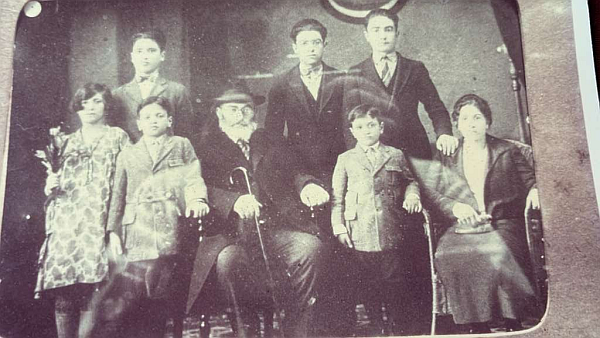
Center is my grandfather, Rabbi Avraham Maimon, who traveled with his family
from Turkey to Seattle to be the rav of Sephardic Bikur Holim Synagogue.
On the left is my 9 year old mom, Rahelika. Circa early 1920s.
Rahelika's front porch reaches right over the Sea of Marmara. In the morning, when she wakes up, the first thing she smells is the good, clean, salty smell of the sea. When she goes to bed at night, the last sound she hears is the gentle slap, slap of the water against the wooden poles under her house that reach down into the sea.
During the day when Rahelika plays on the porch, she looks between the boards and sees the water moving. Sometimes she stares so long at the water she imagines she is on a ship. Then suddenly, her mother calls her, "Rahelika, ven aki, Rahelika, come here," she jumps up and feels dizzy until her eyes get used to looking away from the sea.
Rahelika's mother is known as Robisa, rabbi's wife. To Rahelika, she is just Mama. People call her father Ribbi Abraham or Haham, wise one. To Rahelika, he is just Papa.
Then there are her brothers and sisters. Seven, including her baby brother Solomon, the roly-poly baby with big dark eyes and curly black hair. Rahelika likes Solomon, but ever since he was born, Mama has no time to braid her long blonde hair. Now her older sister Luna makes her braids and she makes them so tight that tears spring to her eyes and her face feels stretched.
Rahelika's big sisters, Luna and Khadoun, like to tease her. They tease her because her ears are not pierced like theirs. Although most girls her age have pierced ears, Rahelika does not. She does not want anyone to pierce her ears.
"Ven aki, Rahelika," they say. "We have just the right needle to pierce your ears." Hearing this, she darts out of the house her long braids flying out behind her like swift birds. As she runs, she can hear Luna and Kadhoun laughing and her Mama gently scolding them, "Dexala, leave her be."
But when Mama goes away, the sisters tease. Twice a year Mama goes away for a three-day trip to purchase clothing for the family. She writes down all the sizes of the children and a list of all the things they need. The neighbors bring her their lists and money to buy clothing. The boat takes all night stopping at every little port along the sea until it comes to a town large enough to have stores in which to buy clothing. Between trips, if someone needs a new dress or a shirt, Mama sits at her machine and sews them. Everyone is happy to have store-bought clothing, but Rahelika is happy to have Mama home.
In school the children learn to read and write and they play games like children everywhere. But Rahelika is afraid of the big, tough Turkish boys in that school. When she passes them they call out "Djudia, djudia, little Jewish girl."
She does not need the big Turkish boys to remind her she is different. She knows she is Jewish. Don’t her family and her whole community have Shabbat each Friday night? What a welcome guest. She can close her eyes and smell the delicious smells that came out of Mama's kitchen on Friday morning when she is still in bed. The halla, the Sabbath bread; the komidas, cooked foods for Friday night; the delicious dezayuno, breakfast foods for Saturday morning after synagogue. The flaky plump potato-filled borekas and the crusty bulema rolls filled with spinach and tangy cheese. And the guevos haminados, the brown eggs that cook all night with onion skins to darken and flavor them. So deliciously different than weekday foods. How hard Mama works for Shabbat. No guest could be more welcome.
Sitting together in the glow of the Shabbat candles and listening to her Papa's strong sweet voice, Rahelika feels herself lift right along with the melody into the hidden place in the house where the Sabbath Queen must surely be watching and listening.
Djudia, djudia, yes she knows she is a Jewish girl. When the Turkish children leave school to go home to play, Rahelika begins the long walk to Hebrew school which is held in the synagogue. There she and other Jewish girls and boys study Hebrew letters and prayers and stories from the Torah. Sometimes, Rahelika's legs ache from sitting so long on the hard high bench. Sometimes, she can feel her feet wanting to run on the grass while the sun is still overhead.
One day when the teacher dismisses her Hebrew class, Rahelika runs as fast as she can. She runs and runs enjoying the mild breeze and the warm sun on her head. As she runs she keeps her eyes on the big trees above her head that sway in the wind. She feels she is moving right along with the trees.
Suddenly a noise behind her makes her turn around. She has run off the road into a big field and behind her something else is running. Rahelika turns just long enough to see the face of an angry bull grunting and charging after her. Seeing a fence running alongside the field Rahelika orders her feet to jump. She lands face down in the soft grass. The bull, seeing her out of reach on the other side of the fence, stops short and begins calmly to nibble the grass.
School days are long when a girl wishes she could be playing outside. But there is one school day Rahelika will never forget. It is the day of the parade.
The mayor of the city has sent a messenger to Rahelika's papa to invite him to represent the Jewish community in a parade. The mayor himself leads the parade. He is very tall. He wears a tall black Turkish hat with a tassel that hangs off to one side. In his hat, his long black robe and black beard, he is an unforgettable sight.
But to Rahelika, it is her papa who stands out in the parade, his beautiful red beard shining in the sunlight as he walks along so straight and serious, so kind and sweet. Rahelika stares at him so hard that tears spring into her eyes and when her father passes the spot where she is standing she sees him through a blur. But there are no tears of excitement in Papa's eyes, and as he passes the place where she stands with her classmates, he winks at her. Little girls on all sides nudge her and giggle; "Was that your papa?" they ask. Then a whisper is passed down the long rows of children, "Rahelika's papa, that was Rahelika's papa."
There are many days that Rahelika misses school. She never misses school because she is sick. Sometimes her brother or sister has a cold and is tucked into a big warm kolcha (quilt), curled up on the couch. Later they get to eat some of Mama's good soup that is simmering on the stove. As she gets ready for school she thinks sleepily, "Why don't I ever get sick?" But then she begins to think of the fun she could have in the bright day and she stops wishing to be sick.
So when Rahelika misses school it is for a different reason than being sick. It is because of the Jewish holidays that wrap around the year like a beautiful necklace. Each holiday, like every jewel, is different. Now it is just a few weeks before Passover. Pesah is Rahelika's favorite holiday, but it seems that she will never get a chance to get away from the house to play. As her mother and sisters clean the house they call out to her, "Rahelika bring me the rags, Rahelika bring me the soap." They clean so hard that Rahelika is sure that no crumb would dare to remain in the house.
Today Liza, the laundry lady, has come. In addition to the family's wash, Liza has taken down every curtain in the house. Rahelika's job is to hang the newly washed curtains on the clothesline in the yard. The thin cloth dries quickly in the sun. Then she has to bring the curtains back and hand them to mama who stands on a stool to hang them over the windows again.
Rahelika holds a hand full of pins for mama to take one at a time from her as she re-hangs the curtains. The pins pinch her hand. She stands first on one foot then on the other to give each tired foot a chance to rest.
Rahelika thinks this is too much trouble to go to for curtains and she says so. She cannot understand why everyone finds this so funny. Her mama and her sisters laugh so much they have to sit down and rest with their laughter. Soon they are back at work. As they hang the fresh curtains that smell of the sunshine and clean out shelves where their Passover dishes will be put, Liza begins to sing in a sweet, low, voice old Spanish songs that Rahelika has heard since she was a baby. “Durme, Durme” she sings. “Sleep, Sleep.” The melodies fill the house and help the time go by more quickly.
Finally the last curtain is hung and her sisters rush to help Mama prepare dinner. As Liza prepares to leave, Rahelika watches her mama take down the small purse where coins are kept. Then Mama gets a jar of lotion and carefully rubs it into Liza's red hands. Liza kisses mama's hand and blesses her for her kindness. Liza wipes tears from her eyes as she leaves saying to herself, "Who else but the Robisa would take time for such kindness?"
Rahelika thinks it is natural for Mama to take care of Liza's hands. Mama takes care of everyone. She always knows someone who is sick or a visitor who needs a place to eat or sleep. Many times Rahelika carries whole pots of food to a sick neighbor or to a new mother. Sometimes a coin makes its way into Rahelika's hand for being the messenger but these coins she always slips into the charity box on the window sill because there must be no payment for zahut, for a kindness.
As Passover nears, Rahelika's heart grows happier. Besides the arrival of her favorite holiday, her favorite uncle Tio David will be with them. No one is more fun than Tio David. With his dark hair and laughing dark eyes he is as different as night and day from his brother, Rahelika's red-bearded, fair skinned Papa.
Tio David's pockets are always filled with strange objects - magnets, magnifying glasses, and interesting-looking foreign coins. Some of these always made their way into Rahelika's small collection.
One night, as Rahelika lay in bed listening to the slap, slap of the sea against the porch boards, there is a sudden commotion as Papa's chair scrapes against the floor, away from the dining room table where he has been studying Torah. Mama jumps up from the chair where she has been sewing Rahelika's new Pesah dress. “David, David,” she hears them call. Rahelika jumps out of bed and runs down the stairs. She is about to run into the room and fly into David's arms, but she sees something that makes her stop. Her heart stops too, and when it starts beating again it beats heavy and slow.
Rahelika backs silently away. Is this Tio David, her jolly, handsome uncle? His shoulders are bent over; his clothing hangs loosely on his bony frame. Where are his sparkling eyes and funny laugh? Is this Tio David or some horrible likeness of him?
Rahelika shivers on the stairs in her nightclothes and listens as Mama sets out hot food for him murmuring, “Vista mia Vista mia.” Papa asks gently what has happened.
Tio David begins his story. This story will never be forgotten by Rahelika, for it will change her life.
One day, Tio David receives a notice that says he must present himself to an official of the Turkish army. As Tio David says these words, a hush falls over her house. These words are an unseen but terrible thing that enters her house. The Turkish army is the dread of every Jewish home. If you were taken into the Turkish army you would never be able to have Shabbat, to eat kosher food, to see your family, unless, like Tio David, you were sent home too sick or weak to stay to be a soldier. There are many dangers in the army. The roughest men join the army, criminals who think it is better than sitting in jails for the crimes they have committed. Once the Turkish army takes you, you might never be released until you were old or sick. Many men die for lack of proper food and water and medical care.
Until recently, Rahelika's father and the other rabbis from Turkish cities have had a special exemption made for Jewish men. But now a new general is in charge who cares nothing for special exemptions. All the rabbis in Turkey could not keep Tio David from being forced to serve in the army.
Mama cares for Tio David, nursing his fever and feeding him whenever he can manage to eat. Little by little, he regains his strength. Each day he begins to look a little more like his old self. He begins to tell stories and play games with Rahelika. One day, Papa comes home with the news that he has gotten Tio David discharged from the army because of his illness.
Now added to the usual excitement of Pesah is the happiness and relief that Tio David is safe. On the Seder night, they begin to read the Hagaddah, which tells about the freeing of the Jews from Egyptian slavery. When Papa raises the first of the four cups of wine, he gives special thanks for Tio David's freedom from danger and the freedom to live as a Jew. During the Seder, just like every year Rahelika can remember, each family member takes turns carrying on their shoulder a package of matza, the special unleavened bread of Passover. The matza is wrapped in a very old, golden cloth. When it is Rahelika's turn to hold the matza on her shoulder she imagines she is a little girl going out of Egypt with the bread that has had no time to rise.
Although the news is good for Tio David, the worry that entered Rahelika's heart and the heart of her family does not end. Now her three big brothers, Yaakov, Yizhak, and Ben Zion are in danger of being called to the Turkish army. After the last Pesah dish is put away there is not a single night when her parents do not sit up late talking. And no matter how many times Rahelika falls asleep and wakes up, she can still hear the soft, sad voices of her parents as they talk.
One day, shortly after Pesah, when Tio David is still living in their house, something happens which puts even the army out of their minds for a while. A young woman comes to the door. She is dressed in Muslim-style clothes, a long black dress and head scarf. She tells mama that although she is dressed as a Muslim, she is a Jewish girl.
When papa comes the young woman tells him her story. She had been kidnapped when she was ten years old. Taken by a Muslim family, she has been forced to be a servant in their home. She speaks in Turkish. She has forgotten how to speak Ladino, the Jewish Spanish language spoken by the Jews in Turkey. But she remembers how to say the prayer Shma Yisrael. Her name is Dona. Dona longs for her family and for her Jewish life. Every day, year in and year out, Dona has been guarded carefully in case she tries to run away. She pretends to accept her new life as a servant in the Muslim home. She pretends to pray with them but when they take their eyes off her face she recites the Shma. She prays to be rescued. Then one day, she is sent to the marketplace with the cook to buy the vegetables. When he stops to talk to his friends, she escapes. She asks a Jewish storekeeper the way to the rabbi's house. Papa invites her to stay.
Papa advertises in the Jewish newspapers. Soon after, a woman comes to the house. Before she can say a word, she sees Dona standing behind Rahelika's mama. "Dona, my Dona," she calls out and then she falls to the floor in a faint. When she recovers from the shock of seeing her daughter alive and well after so many years, Dona and her mother have a happy reunion.
In the weeks that Dona spends in Rahelika's home she becomes happier each day. Instead of the shy, worried look she had worn on her face, her dark eyes begin to sparkle as she joins the family in their meals and other activities. She begins to remember Ladino words again. Each day she asks Rahelika to remind her of the names of things. Best of all, she loves helping Mama prepare for Shabbat. She had missed Shabbat the whole time she had been kept in the Muslim house. On Shabbat, she enjoys being in the synagogue. Each week she seems to remember more of the prayers and songs she learned as a child. She and Rahelika sing as they walk and sing as they help Mama.
Everyone in Rahelika's family loves Dona. They see how she changes from the frightened young woman who first appeared at their door to the happy one she is now. With the arrival of her mother, Dona has her own family back. Secretly, Rahelika wishes that Dona would never leave her family, and in a way, her wish comes true.
Tio David has been waiting to see who would come to claim Dona. He waits to see who could tell the story of her upbringing. Now when Dona's mother is ready to take her home, Tio David asks Papa to speak for him and to ask Dona's mother if Dona will marry him. Dona's mother asks her if she would like to marry Tio David. Dona likes Tio David's kindness and happy nature. She says yes, and her mother gives her consent.
And so in the summer, Rahelika wears a new white dress and carries a bouquet of freshly cut pink roses to the Hupa, the wedding of Tio David and the beautiful Dona. Far into the night, songs are sung and the tambourines are played for the new bride and groom. Rahelika's favorite song is played over and over:
| Tzena U'rena | Go and see |
| B'not Zion | Daughters of Zion |
| Ba'melech Shlomo | King Solomon |
| B'atarah | In the crown |
| She Itra Lo Imo | That his mother crowned him with |
| B'yom hatunato | On the day of his wedding |
| U'byom simhat libo | On the day of his heart's gladness |
Rahelika loves this song. A feeling of gladness fills her heart for her Tio David and for her pretty new aunt, Tia Dona. Tio David is finished with his illness and the dangers of the army. Dona has escaped being a servant in the Muslim home. A feeling of lightness fills the air. A feeling of freedom. She imagines this is simhat libo, this is heart’s gladness.
But, the happiness Rahelika and her family feel for Tio David and Dona does not erase their fears of the Turkish army. Soon after the wedding, Mama and Papa begin their late night talks again. One evening Papa calls the whole family together.
Papa is holding a letter in his hand. At first, Rahelika cannot take in the words Papa is saying. She stares at the letter as if it is a dog that could bite her. It seems to her as if the words are strange and mean, like an enemy, like the voice of the rough Turkish boys who tease her.
They will be leaving their home, Papa tells them. They will leave their synagogue. They will leave their friends. They will leave their town of Tikir Dag. They will leave the Sea of Marmara. They will leave Turkey. They will travel by ship to America, and then by train all across America to a place called Seattle in the state of Washington. There, some of the families from their town have settled. They want to build a new synagogue there. They want Papa to be their rabbi.
Rahelika will hear no more the gentle slap, slap of the sea as it plays against the porch of her house. To get to their new home they have to cross an ocean much bigger than the Sea of Marmara. They will leave Turkey and the Turkish army behind them.
In the next weeks, Rahelika does not have to go to school. All day the family packs. She helps Mama by playing with her little brothers, Moshe and Solomon. Then one day, there is nothing left to pack. All the good-byes are said. Rahelika's house stands empty. Inside her is an empty feeling to match.
When it is time to leave, her big sisters, Luna and Kadhoun, have to remain behind with friends.
They cannot get the necessary passports to travel to America because they are too old to be included as family members.2 For the first time, Rahelika's family is separated. Rahelika feels the separation from her sisters and from all the familiar people and places she has always known. As they prepare to leave, she has to remind herself that all this is true. It is not a dream from which she can hope to awaken.
Leaving day comes and it is no dream. They take a train to the port city of Marseilles where they can board the huge ocean liner that will take them to America. On the ship, a family the size of Rahelika's needs two cabins. After mama tucks in the little boys and Rahelika begins to get used to the feeling of the sea moving beneath her bed, a sudden crack of thunder and a bright bolt of lightning split open the night sky.
Every time the thunder stops, it begins again. Rain starts out hard and falls harder. The ship begins to pitch and roll. Papa comes in to check on them. Mama does her best to soothe the children. Papa looks worried as the storm continues and Mama is frightened. No one sleeps.
A young man Papa knows is working on the ship to pay his way to America. He tells Papa that the captain fears for the safety of the ship. He has never known a storm as bad as this one.
Suddenly, Papa calls her three big brothers. "Ben Zion! Yaakov! Yizhak!" Rahelika hears her Papa's voice from the next cabin. His voice is low and deep. "Put on your coats," he tells them. Where is Papa taking them in such a terrible storm?
Papa ignores the thunder and the terrible rolling and pitching of the ship on the strange, angry sea. Rahelika gets out of bed and pushes open the door of her cabin until she can see her father and her brothers standing on the deck. She can hear every word her papa says.
Ijikos, my sons, we have left our home. Right now we have no home. We are strangers. We will be foreigners. We will seem silly. We will not know the simplest words for things in English. We will know neither the language nor the ways of the new country.
But it is because we are Jews that we are leaving and it will be as Jews that we will enter the new land.
Rahelika begins to shiver from the cold and rain as she listens at the door, but she is spellbound by her father's words.
Perhaps in America they have no time for Shabbat or the other commandments. But as Jews we leave and as Jews we will enter. We will be strangers in a strange land but we will not be strangers to ourselves. To tear up roots, to leave their homes, to be strangers, to wander, this Jews have had to do throughout our history. We are not the first. Now we are tossed on the sea by a storm. There, we will be tossed around trying to live in a strange place. But no matter how bad the storm, we still have to answer to God for our lives. I want each of you to swear that as long as you live you will always keep Shabbat. Shabbat is one seventh of our life. One seventh keeps us free from work. One seventh is for God. This will insure your future as Jews.
Then Rahelika hears each of her brothers say, "I will, Papa. I swear it Papa. I will." Rahelika calls out to her Papa "Me too Papa!" Papa gives her a hug and sends her back to bed. As she turns to go back to her cabin, Rahelika looks at the sky. It seems to her that the rain is slowing and that the thunder might have stopped altogether. Yes, the storm is easing up. The rain continues but it falls more gently now.
The shouts of the crew members are happy. The ship begins to move easily, steadily on its way to America.
Did God hear Papa, wonders Rahelika. Does He want us to promise to be faithful Jews? Does He want us to remember Shabbat to anchor us down and give us safety?
Rahelika does not know for sure. But now, the idea of moving to a strange place does not frighten her. They will be strangers but they will not leave everything behind them. With them will go their familiar ways. Shabbat, the visit of the Sabbath Queen, the holidays that string the year together like a beautiful necklace. Their old and precious ways will not be left behind.
It is strange to be on a ship going to America. But Papa is no stranger as he says in his low firm voice; as Jews we leave and as Jews we will enter. To ourselves we will never be strangers.
Papa's words begin to roll around in Rahelika's mind as the steady movement of the ship finally sends her to sleep on her way to America.
1 Judy Belsky is a writer, artist and clinical psychologist. She lives in Israel. She has published a memoir and several volumes of poetry. One of her main themes is her Sephardic background in Seattle, Washington. A second memoir in progress is entitled The Passover Scarf.
2 As unmarried young women, they could not get into America. They succeeded instead in getting visas to Canada, and journeyed together to Vancouver, where they stayed with a family. Eventually their father arranged for them to meet young men from Seattle as potential husbands. Two became their husbands. They then rejoined the family in Seattle. It was a scary and harrowing time for two young women who had never traveled or been away from family.
Copyright by Sephardic Horizons, all rights reserved. ISSN Number 2158-1800