
Yaron Ayalon
Ottoman Jewry
Leadership, Charity, and Literacy
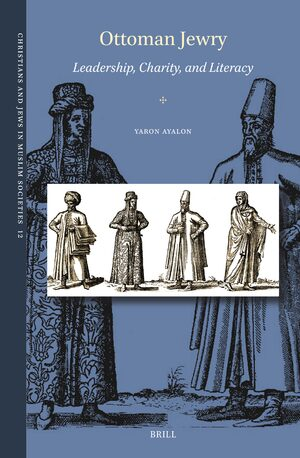
Leiden: Brill, 2025, ISBN: 978-90-04-71196-9
Reviewed by Ilan Benattar1
In the 2017 journal article “Rethinking Rabbinical Leadership in Ottoman Jewish Communities,” historian Yaron Ayalon offers a compelling argument for assessing anew the nature, function, and extent of effective rabbinic authority in pre-nineteenth century Ottoman Jewish life.2 Collating historiographical insight from Jewish history and Ottoman studies, along with Ottoman bureaucratic documents and Hebrew responsa literature, Ayalon contests the received notion, sometimes explicit, sometimes implied, of a hierarchical rabbinic structure which governed Jewish communities large and small, across the Sultan’s vast realm from the onset of mass Jewish settlement until the reforms of the nineteenth century. That such an impression has reached us at all, Ayalon argues, is a product of scholars taking our richest source record for early modern Ottoman Jewish life, rabbinic literature, as more or less a disinterested record of prevailing communal conditions, rather than as the ideological expression of a social class profoundly committed to asserting its own legitimacy and independent prerogative.
In Ottoman Jewry: Leadership, Charity, and Literacy, Ayalon expands considerably on this position and develops its implications further in compelling fashion. In this brisk volume, imbued with a sharp polemical vigor, the author takes aim at a “standard” narrative of pre-nineteenth century Ottoman Jewish history and its “problematic conceptual orientation.”3 If we begin from the position that rabbinic leadership was far less decisive, uniform, or meaningful than previously thought and oftentimes the subject of bitter communal conflict, what further insights might we draw concerning such crucial issues as communal practices of charitable giving or the growth of print culture? How might this then reshape how we imagine ways of being Jewish in the Ottoman Empire? A particularly welcome feature of Ottoman Jewry is its deep engagement with Ottoman historiography, especially regarding the significance which early modern climactic transitions held for Jewish life. Here Ayalon builds onto the central concerns of their first monograph, Natural Disasters in the Ottoman Empire: Plague, Famine, and other Misfortunes (2014). Of equal significance is the fact that this work considers the Ottoman Jewish experience as a whole, addressing both its Ladino-speaking contexts, its Arabophone contexts, as well as the often-blurry space in-between. The primary source base of Ottoman Jewry consists largely of rabbinic responsa literature (she’elot u-teshuvot), penned in the Hebrew/Aramaic idiom of the learned scholarly elite in the expectation that ha-mevin yavin, the one who understands will understand. Ayalon’s textured and thoroughly historicized reading of this often-challenging genre is praiseworthy in its own right.
Chapter 1, titled “Ottoman Jewry, Origins & Growth,” reassesses a number of received notions regarding the roots and early characteristics of Jewish life in Ottoman lands. Why did Jewish life seem to flourish so strikingly in its new surrounding from the 1490’s until roughly the 1570’s? Discarding folk-history explanations which attribute early Jewish enthusiasm for settlement in the early Ottoman state to largely unsubstantiated cultural or political factors, Ayalon identifies environmental conditions as the central reason for what he terms the “Sephardi Revolution” of the sixteenth century: this micro-era between the 1492 Alhambra Decree, through the warm first six decades of the sixteenth century and into the climactic downturn of the final quarter of the century, over which Iberian Jews were able to reestablish communal life across the Mediterranean littoral “and build incredibly wealthy mercantile and intellectual networks.”4
Chapter 2, titled “Ottoman Jewry, Opportunities and Crises,” outlines the variety of social, economic, and environmental transformations which the empire’s Jews confronted across the seventeenth century, with ripple effects reaching far into the eighteenth. Here Ayalon is on relatively well-trodden ground as he narrates the overlap between a generalized crisis of the Ottoman political order, the arrival of European merchants and diplomats as competition to Jewish trade networks, the messianic movement of Sabbatai Zvi, and the aforementioned “Little Ice Age.” The author’s primary contribution here lies in drawing back some of the historiographical overreach in earlier generations, identifying, for example, the limitation of Ottoman tax records for informing Jewish demographic trends and questioning the notion that rising European commercial domination resulted in the total marginalization of Jews from the Ottoman economy. The substantive consideration of environmental factors in this chapter is, as previously alluded, salutary for the field of Jewish Studies in which the historical study of the environment remains radically underdeveloped. Ayalon’s treatment of Sabbateanism rests on an extended consideration of its central figure as a “proto-populist” whose movement “bear[s] many of the markings of [modern] populist political movements.”5 It is not specified whether Ayalon is alluding to here. Certainly, to compare is not to equate; the argument warrants serious consideration. Ayalon’s contention, for example, that Zvi’s initial success in challenging the rabbinic order points to a degree of anti-elitist resentment among the Jewish masses is well-taken.6 It certainly substantiates the book’s position on the significance of communal conflict as driving factor in Ottoman Jewish history. Still, the political claims of an early modern messianic figure and those of a modern populist leader seem far apart. It is not specified whether Ayalon regards populism as spanning the political spectrum à la “horseshoe theory” or whether the operative conception is more circumscribed. One looks forward to future publications by the author on this topic.
Chapter 3, titled “Communal Leadership, Rabbis and Others,” engages most directly with the argument of Ayalon’s previously mentioned 2017 JQR article. Pre-nineteenth century rabbinical positions, whether in the capital or in the provinces, were largely informal and their occupants often failed, sometimes dramatically, at their most basic self-assigned task: “to impose their opinion and enforce halakhah.”7 Rabbis, Ayalon illustrates, rarely had final say on communal matters and were oftentimes extensively beholden to communal lay leaders. Within this pre-nineteenth century frame of reference, to whatever extent rabbis exercised “effective” authority, it rested mostly on intellectual prestige and powers of persuasion. It was, therefore, highly dependent on individual personality and local political factors. To illustrate the essential argument of this chapter, Ayalon helpfully identifies a certain category error of considerable significance for the study of pre-modern Jewish life; though the average Ottoman Jew may have been attached to the Jewish community as a “sociocultural framework,” it does not necessarily follow that said individual was fully committed to following the halakhic lifestyle which rabbis expected of them.8
The following chapter, “Poor Relief and Communal Authority,” Ayalon deftly traces a key transformation in practices of Ottoman Jewish charitable giving over the period in question. From the sixteenth century on accelerating in the eighteenth, charitable societies developed apart from sanctioned communal frameworks, transforming into private charitable associations. Increasingly specialized and outside the effective reach of communal oversight (rabbinic or lay), they offered their membership a new space for (Jewish) socialization which “offered an alternative to the congregation’s social system.”9
Finally, Chapter 5, “Education, Reading, and Rabbinical Authority,” wades into the extensive historiographical debate over the long-term ramifications of the Sabbatian challenge to communal authority, touching on such topics as the expansion of communal educational initiatives, the impact of printing technology on trends in rabbinic scholarship, and the development of vernacular Jewish print cultures over the eighteenth and nineteenth centuries. Of particular interest to a specialist audience will be a fascinating study of the citational practices of early modern Ottoman rabbis in responsa literature. In addressing the development of popular Jewish literature in Ottoman lands—To what extent did it reinforce rabbinic authority? To what extent may it have served to undermine it? Ayalon offers a noteworthy reflection on the chronological gap between the appearance of Ladino print culture in the eighteenth century and the emergence of Judeo-Arabic print culture over a century later. Specialists have yet to engage closely with this particular question. Ayalon’s foray is thus welcome. Further attempts to investigate this problematic will also require adopting a broader geographic lens, considering that two leading centers of modern Judeo-Arabic print—the Indian Ocean Baghdadi Diaspora and the Maghreb—were beyond Ottoman reach.10 Moreover, it will be necessary to further consider the phenomenon of Middle Eastern Jewish print houses producing material in both Hebrew and multiple Jewish vernaculars, Ladino, Judeo-Arabic, and sometimes, generally in Ottoman Palestine, Yiddish as well.
In sum, Ottoman Jewry offers a significant contribution to a rapidly expanding field of scholarly study. It offers a helpful corrective to persistent received notions on the nature of the premodern Ottoman Jewish experience and brings the study of Jewish life into conversation with important trends in the study of the premodern Ottoman state. Finally, it offers a compelling narrative which specialists might develop further to bridge the artificial boundary between the early centuries of Jewish settlement in the empire and the latter centuries. Ottoman Jewry will interest Jewish Studies specialists and Ottoman generalists, as well as those with a historical interest in minority communal politics, the environment, print cultures, and critical historiography.
1 Ilan Benattar is Robert F. & Patricia G. Ross Weis Visiting Assistant Professor of Judaic Studies & History at Franklin & Marshall College in Lancaster, Pennsylvania. His monograph project, “A Rod of Punishment”: Ottoman Jewish Liberalism from Opposition to Establishment, 1892-1912 investigates the emergence of Jewish liberalism and liberal communal activism across the Ottoman Jewish Mediterranean from the late Hamidian era into the early Second Constitutional Period, focusing in particular on the early career of Abraham Galante (1873-1961). He holds a PhD. in Hebrew & Judaic Studies/History from NYU. His work has appeared in a recent issue of Jewish Quarterly Review.
2 Yaron Ayalon, “Rethinking Rabbinical Leadership in Ottoman Jewish Communities,” Jewish Quarterly Review 107.3 (2017): 323-353.
3 Yaron Ayalon, Ottoman Jewry: Leadership, Charity, and Literacy, (Leiden, Netherlands: Brill, 2025), 1-7.
4 Ibid. 43.
5 Ibid. 79.
6 Ibid. 80.
7 Ibid. 123.
8 Ibid. 95.
9 Ibid. 173.
10 Interested readers may consult Noam Sienna’s excellent recent monograph Jewish Books in North Africa: Between the Early Modern & Modern Worlds (2025) for more on the Maghrebi context.