
The Alba Bible
How the Images Trampled on the Words
By Leah Bonnín1
Translated by Google Translate
Edited and Abbreviated by Judith Roumani

Gideon Selects the Soldiers who Drink from their Hands. Wikimedia Commons.
The fifteenth century and, in particular, the years of the reign of Juan II (1405-1454), was characterized by the promotion of translations into Spanish of the Iberian literary heritage, in Latin, Arabic, or Hebrew. They were promoted and sometimes sponsored by the king himself, who, according to the chronicler Fernando del Pulgar, "was pleased to read and know the explanations and secrets of sacred Scripture" and not really interested in war conflicts of the moment. Fray Lope de Barrientos commissioned the bishop of Cuenca to write the Book of Casso et fortuna and the Tractados del dormir et despertar et del soñar (translation of Aristotle's Parva naturalia) and the Especies de adevinanzas. The humanist Juan de Lucena, counselor and ambassador, dedicated his Blessed Life to him. Thanks to the royal promotion, such important writers flourished as Enrique de Villena, the archpriest of Talavera and the Jewish convert Pablo de Santa María, author of a Proposition on the preeminence of the king of Castile over the king of England, the soldier, poet, and friar Juan Rodríguez del Padrón and the Jewish-converted scribe and chronicler Alvar García de Santa María. In addition to the poet Juan de Mena, author of the extensive poem Laberinto de Fortuna, and the scholar Íñigo López de Mendoza, and many other poets who appear in the Cancionero de Baena, compiled by Juan Alfonso de Baena and dedicated to Juan II, and in the Cancionero General which, compiled from 1490 by Hernando del Castillo, contains a metaphorical and stylistic repertoire of poetic images that would later be used by writers of the Spanish Golden Age. The translations of Seneca's De moribus saw the light of day; De Ira, also by Seneca, translated by a friar named Gonzalo sometimes before 1445 for Inés de Torres, wife of the Calatrava master Luis González de Guzmán. In 1419, Pedro de Toledo made the first translation from Hebrew and Arabic of Moré Nebujim or Guide for the Perplexed that Moshe ben Maimon, the Rambam, had finished writing in Arabic with the title Dalalat al-hairin in 1191 and that Samuel ibn Tibbón had translated into Hebrew in 1199.
In this climate of intense literary activity in the crown of Castile, the Calatrava master Luis González de Guzmán, in a letter dated April 5, 1422, asked Rabbi Moshe Arragel to translate the Jewish Bible into the Romance language directly from Hebrew, from Bereshit to the books of the Chronicles:
“We, Master of Calatrava, salute you, Rabbi Moshe Arragel, our vassal in the town of Maqueda, where you have recently come to dwell... We have been told that you are very wise in the law of the Jews, and that not long ago you came to dwell in this town. Know that we have covetousness for a Bible in Romance, glossed and historic, for which we have been told you are good enough to make it. In order to demand it, we were moved by two things: one, that the Bibles that are found today have a very corrupt Romance; second, that such as we consider the gloss necessary for obscure passages; for God knows that in the times when we are exempt from the persecution of the wicked Moors, enemies of the holy Catholic faith, or from the service of our king and the honor of his kingdoms, as befits our order, that we would rather give ourselves to hear from the Bible, in order that we may contemplate with God, than go hunting or listen to historical books or poets, or play chess or tables or similar games: how manifest it is that one gains good walking and happiness, and this good walking is true because it is the law of God; and on the other hand man deviates and turns away from this good wandering: for we see that kings and lords, who in order to discard idleness and evil thoughts to avoid, have their acuteness in what is said and scarcely remember the law of God. And as we say, once they have a surplus from work, at home they give themselves to idleness. But as for us, we would like so much that after the prayers are said, we should hear the Bible at the best possible time.”
He could not take on the request, replied Moshe Arragel, because neither his opinion nor that of any Jew was worth anything in those days, since:
“the Jews who used to be of so much prosperity in Castile, crown and diadem of all the Hebrew transformation into fixed dalgos, wealth, science, freedom, responding with the properties to the virtues of the King and kingdom in whose imperative we are in the most noble famous Castile, today, due to the young age in which John II was orphaned, with his labors caused that today we have everything against us, that we are in great misery and that they have no knowledge left, and least of all himself, that if the relic of a relic remained in the Jews, it will be found in others more than in him and that is why he asks that he make the commission to the most learned Christians.”
He praised and praised again the goodwill of the Master, but confirmed that:
“the Jewish faith in which I want to die, being the law of my fathers, would make me gloss the Bible in such a way that you, as a Christian, would profit nothing and I would work in vain... The Jews believe that not a title of the Hebrew Bible has been changed. So that if I were to translate into Romance in a different way from the Latin and St. Jerome, I would consider the translation very corrupt, and if I were to make it conform, others have already done it better than I.”
What interest could Luis de Guzmán of Calatrava have had in translating the Bible into Romance? Why did he choose Moshe Arragel from Guadalajara? Why did Moshe initially refuse to accept the commission? Who were these two characters?
Very little is known about Moshe Arragel of Guadalajara. From the surname, it is thought that he was born in Guadalajara, was orphaned as a result of the massacres of 1391, and as a child had remained a Jew, because his name did not appear among the converts in those fateful days. As an adult he was described as a man of neat and simple appearance, with long hair and a bushy beard and dressed in the marked clothing required of Jews. It is known that around 1422 he left what had been a prosperous and cultured Jewish quarter of Guadalajara to settle down to try his luck in the Toledo town of Maqueda, where many Jews who had fled the assaults of 1391 had settled.
Master Luis de Guzmán belonged to one of the two great lineages that had held power in the Order of Calatrava and had reached the position of master in 1407. The Guzmán lineage had risen thanks to the Trastámara dynasty. The affiliation of Master Luis González de Guzmán is not known for sure; he was probably, in any case, a descendant of the one who inaugurated the Guzmán lineage. What is certain is that Luis de Guzmán was an important figure in the court of Juan II and a personal friend of the Constable Don Álvaro de Luna, with whom he had exchanged the town and castle of Maqueda and the village of San Silvestre, which belonged to the Order, for the towns of Arjona, Jimena and Requena, on the border of the kingdom of Valencia, where he had acted as captain and had acquired much booty. After the figure of King Juan II and Álvaro de Luna, he was the third most important political figure of the time.
Located forty kilometers from the capital, Maqueda was a pleasant town that belonged to the diocese of Toledo. During the assaults of 1391, two synagogues had been destroyed, but the Jews had not been massacred and thanks to the arrival of those who had fled from the assaults of the Jewish quarters of Toledo and Talavera, the Jewish population of Maqueda had increased considerably. It had a mikveh, a butcher's shop, and a hospital/shelter for widows and orphans maintained by the community. And unlike what happened in many other villages, the Jews could cultivate the land and even have property title and lease out land.
Maqueda was located in the Campo de Calatrava, a group of towns and villages that extended from the Despeñaperros Pass, in the Sierra Morena, to Los Yébenes, in the Montes de Toledo and had its center in Almagro. That territory was under the fiefdom of the Order of Calatrava, in whose territories and encomiendas both Jews and conversos had found refuge, despite the anti-Jewish laws. It was a Cistercian religious order. The Order of Calatrava had been founded in the kingdom of Castile in 1158 to protect the town of Calatrava from the incursions of the radical Almohads. In their origins, the Castilian Calatravans were warrior monks and over time they resisted having a Cistercian abbot as their superior and decided to separate and became a military order under the mandate of the first master, Don García, who obtained from the Cistercians and the pope the first rule for lay brothers: to make religious vows of poverty, chastity and obedience, of silence, to sleep in armor and wear a white tunic with a fleur-de-lis cross.
At the time when Rabbi Arragel arrived in Maqueda, and when he received the request from Master Guzmán, the Order of Calatrava was in an advanced stage of aristocratization. As members of a military order, the Calatravans continued to comply with the requirements that allowed them to go from simple novices to friars, commanders or masters. But little by little they had assimilated the mentality of the lay nobility and sought to exhibit their power through chivalric values, political positions, tournaments and hunting, banquets and games, the consumption of literary works such as Amadis and the Conquest of Troy and, above all, trying to project the order’s image to posterity through sponsoring tombs, and works of art. The work that Luis González de Guzmán wished to sponsor by Rabbi Moshe Arragel was going to surpass in importance all other deeds.
Moshe Arragel's refusal to satisfy Luis de Guzmán's wish brought a harsh response. He accused him of haughtiness and arrogance and ordered him to set himself to the task of translating, leaving no alternative for the Jewish vassal to decide otherwise. He confirmed that he had consulted in the convent of San Francisco de Toledo with Master Fray Arias de Encinas, and ordered the rabbi to go to Toledo to meet the said friar or to contact him in some way.
The unappealable order of Luis de Guzmán was part of the process of re-establishing peaceful relations between the Church and the Jews since the bull of Martin V, which had abolished the anti-Jewish provisions contained in the bull “Etsi Doctoris Gentium” issued by Benedict XIII on May 22, 1415. The second bull ordered that Jews should hand over all books written in Hebrew, particularly the Talmud, and that all males over the age of twelve should attend the public preaching of friars and priests three times a year. The participation of the Franciscan friar Encinas and the Dominican friar Juan de Zamora, who would be joined by other Christian actors destined to supervise the work and paint the images, underlines the importance that the project had for the Church.
Friar Arias de Encinas wrote that he would have liked the rabbi to recognize the truth of Christianity and asked him to convert because it was a pity that he insisted on living according to the law of his fathers. But he proposed an arrangement that consisted of carrying out a work under his and the Dominican Fray Juan de Zamora’s joint tutelage:
“When you come to the chapter on the Hebrew opinion, you will put what I give of the opinions of the Roman faith; and when you come to the chapter where you do not give an opinion of the Latins, you will very fully be able to put your glosses and since you are so hardened that you do not even want to hear about the paintings,”
that Fray Arias should not worry, that he should leave blank what he thought they should understand, and that he himself would give the instruction in writing to the painters of Toledo.
Moshe Arragel took his precautions, expressed his conditions and limits, and tried to ensure some guarantees about freedom of expression and the eventual consequences of his work on the life of his family and the Jewish community. He detailed his working method and ensured that the translation would be done according to Jewish principles. First, he presented himself as a Jew faithful to his faith and to the religion of his fathers and enunciated Maimonides' Thirteen Principles of Faith as the only ones by which he would be guided. He affirmed that the Law of Laws prevented him from historicizing the Bible with drawings or paintings, since only with the reproduction of the utensils of the Temple do Jews allow Jews to decorate and adorn the pages on which the words of the Torah are embedded. This was what Maimonides had expounded in Mishneh Torah and this was how Nachmanides' disciple Bajiya ben Asher had commented on it. Vessels are material and terrestrial replicas of concepts that are beyond human intelligence, unobservable, and unverifiable, places where the unseen, incorporeal spirits that form God's entourage are hidden, mediating utensils for performing a mitzvah, not sacred in themselves. And this was so because thanks to the representation of the utensils of the Temple, the one who read from the pages of the Torah, no matter how distressing his existence, would establish the connection between the incorporeal divine presence that was in the Tabernacle and the material Bible that contained the representations. But no images or drawings with histories:
“Many times I hear the reverend Christian master theologians say that these stories are made in temples and books so that the people are impressed ….”
The Franciscan, for his part, considered that the project was a good opportunity to lead the rabbi to a kind of “soft” conversion that would serve to convert the other Jews of Maqueda:
“... Rabbi Moshe friend, it would be better for you to come to know the Holy Trinity and the Roman faith, and to enlighten your soul with truth ...”
He then decided that Moshe Arragel would send him each of the translated books for verification before beginning the translation of the next one.
Moshe Arragel began the translation in April 1422 and finished it on Friday, June 2, 1430, in the town of Maqueda, when Master Luis González de Guzmán was in Pastrana, collecting troops for the war against the Kings of Aragon and Navarre. It had taken him eleven years to complete it, during which time his wife and daughter had eaten for the value of a thousand doubloons, of which he had received none, despite the fact that Master Luis de Guzmán had promised him many annual favors for executing the translation.
On November 5, it was presented for final review to the Franciscans of Toledo. Once the review, supervised by the superior of the monastery Fray Arias de Encinas, the archdeacon don Vasco de Guzmán, and the Dominican Juan de Zamora was done, the amendments were introduced, the stories were painted. The translation was accompanied by 6,300 exegetical glosses, rabbinical interpretations and commentaries and those of the Fathers of the Church in those passages in which Jewish and Christian dogmas are different and illustrated with 324 miniatures. It did not have the support of the Church, which had adopted the Vulgate as the official version. Unlike other translations of the Bible in Europe, Moshe Arragel made it directly from Hebrew and added a prologue in which he recounted the entire process followed from the first letter of the Master of Calatrava to the final execution.
The prologue is a book in itself and is part of the tradition of those written by Jewish authors, translators, or commentators who served as intermediaries between the Islamic and Christian traditions. It was a literary genre that involved several actions: exposing the purpose of the work, pointing out its place in the field, showing its interest, listing its parts, explaining the method used and relationship with different areas of knowledge, as well as naming the collaborators.
In the prologue, Moshe Arragel uses types of argumentation and themes developed by Maimonides in his introduction to the Guide to the Perplexed; he explains that the work aims to translate the Bible from Hebrew to Romance and that there are Jewish and Christian commentaries and illustrations. The codex also includes correspondence between the different parties involved, explanation of the method, and an important glossary (see below). Except for including the Christian commentaries, the work seems to be a Miqraot Gedolot, the Masoteric biblical text, with rabbinical commentaries and Aramaic translation. And despite the inclusion of Christian commentaries, the rabbi disagrees with the important opinions imposed from Toledo and Salamanca.
It also incorporates the content of the glosses and problems of biblical interpretation that he encountered, as well as problems of translation and exegetical sources. The commentaries that accompany the biblical text take up point by point, eight years after the Disputation of Tortosa, the elements of the Judeo-Christian controversy – the arrival of the Messiah, baptism, the Eucharist and transubstantiation, among others – and present the Jewish perspective without making concessions to the Christian one.
He juxtaposes literary sources when points of view diverge and, when they do not, he proposes to establish a single reference text, without mentioning the sources. As for the translation itself, it demonstrates the three fundamental virtues that the translator should have: good knowledge of the two languages, good knowledge of the subject matter, and possession of the virtues of the translator that Ibn Ezra enunciated in the Book of the Astrolabe where he had exposed the difficulty of translating from Arabic to Hebrew:
“Words of Abraham the Sephardi, the author: it is not easy to translate from one language to another and it is especially difficult when it comes to the holy language, since we only know about it what has been written in the Bible.”
Arragel writes with total freedom a gloss and its opposite, even though both came from Jewish sages (such as Talmud rabbis, Rashi, and others) because:
“a teacher comes and makes a gloss and the listeners are content with it; another comes and makes a different one, and the hearers are also content with it, and the same with all those that are made; which denotes the infinite perfection of the law, which is divine.”
And so that the glosses and their origins are better understood, he includes proverbs and examples and allusions to the customs of the rabbi's own time. And stories and fables written as if they were about nature, like that of the cunning serpent.
The glossary included in the prologue is one of the first in Romance (Castilian) which, after the capture of Toledo by the Christians in 1085, was replacing Arabic with the vernacular languages. Arragel explains the new words in the language of Castile with Latinisms and transliterations of Hebrew and relates the new words to other languages. He adds the “wrong” words as the cause of all the controversies between religions and explains them, while defining them, according to the religious context in which they appear so that each reader, Christian or Jew, can interpret them according to their beliefs.
Whenever possible, he makes Hebrew agree with the Vulgate, from which many Latinisms come, and when not, he leans towards the Hebrew version. It is curious that for him “synagogue,” “church,” and “mosque” come to be the same. On other occasions he clearly specifies the significant differences, as in the word “martyr” who is the one who dies for the law and faith of God at the hands of the infidels: for Christians, for the faith of Jesus and for the Jews the one who is killed for love of Adonai their God and for defending the Mosaic law. The imprint of Hebrew is noted through the insertion of transliterated or direct words from the biblical language, I did not find that he rejects certain morphological aspects through the use of the Romance forms more adapted to the Spanish syntax, giving rise to a tension between the use of the traditional Jewish biblical lexicon and the more modern Romance words.
He explains the terms that do not have difficulty for Christians such as “relic,” “pulpit,” “moral,” “reveal” and abounds in technical terms such as “angle,” “centre,” “geometry,” “line.” He attempts to reconcile the essence of the original Hebrew and produce a text understandable to Christians. As the most notable philological contribution, in addition to providing a “universal” reading, the glossary establishes the premise of and attempts a modern Spanish dictionary.
The miniatures that illustrate the prologue, without gloss or commentary, are related to the projection of power that the Calatrava Master Luis González de Guzmán wanted to convey. He is represented in a majestic posture, as if he were King Solomon himself; on the other hand, Moshe Arragel, bowing in a position of submission and smaller, appears guarded or trapped by the two friars. His head is turned towards Fray Arias, who wears his doctoral bonnet while Arragel appears with a beard and with the discriminatory sign of the 1412 laws, even though they were no longer in use in the translation years. In addition to openly flattering his advisors, whom he calls "very honorable, famous, wise and lordly divine angels," the wise Moshe proclaimed his ignorance and that of other Jews, survivors like him of the dark years of Castilian Jewry:
"The divine holy theology teachers should have been approached rather than me, so unworthy."
But the most deceptive representation is the one in which Arragel appears delivering the translation of the Bible in Latin, with which the image symbolically deprived the translator not only of the work done, but of the effort of those eleven years that he invested in carrying it out. On folio 11vºa, although the king appears as a protective figure of the Jews incarnated in Rabbi Mosé himself, it is equally clear that this protection implies the Jewish servile condition with respect to the Crown, a condition that is verbally manifested by the "susieruo rrabi mose" legible in the phylactery held by the rabbi.
And so, through the contemplation of the images, it can be deduced that a work that aspired to tolerance and understanding became in reality one more episode of the old debates between Christians and Jews. And that that translation with glosses ended up being used to show how the images of the rude painter friars of Toledo, directed by Fray Arias, prevailed over the words on which Rabbi Moshe Arragel of Guadalajara had worked for so many years without compensation.
Although in medieval Christianity there were iconographic models for the Bible, the friars of Toledo in charge of the images did not show great expertise in the art of painting history. Moshe Arragel had introduced several interpretations and glosses and it must have been a long and laborious work because in order to translate and gloss he had to decide which commentaries to include among the many that he had at his disposal, written by Rashi, Ibn Ezra, Nachmanides, David Kimchi or Gershonides, and those that came from the Talmud, from Bereshit Rabbah, or Midrash Tanhumah. But the master painters adjusted point by point to the indications of the friars.
Most of the graphic representations that accompany the Bible itself are small miniatures distributed in an unbalanced way. There are books that lack any illustration (Psalms, Zechariah, Lamentations, Song of Solomon, Ecclesiastes, Proverbs, and Chronicles), while others overflow with images such as Genesis, Exodus, Judges, or Samuel. On the other hand, passages that highlight the Christian orthodoxy of the volume are illustrated, as is the case with the representation of God as Jesus Christ.
After the Edict of Expulsion promulgated by the Catholic Monarchs in Granada in 1492, Moshe Arragel went into exile in Portugal, where he died in 1493. Most of the Jews of Maqueda converted in 1492 and, as a literary curiosity, in 1500 a certain Diego Sánchez de Cortinas, maternal great-grandfather of Miguel de Cervantes, would be mayor of the town.
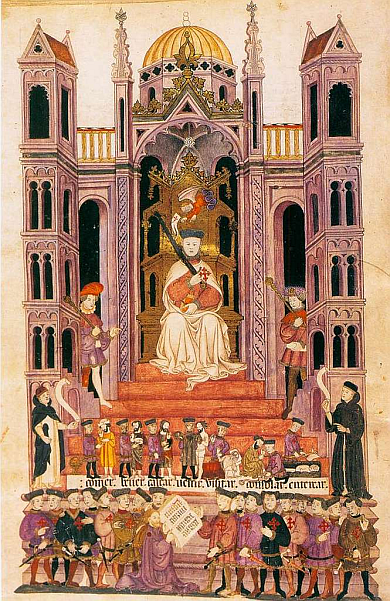
Presentation miniature depicting Rabbi Moses handing over the manuscript to Luis de Guzmán. Wikimedia Commons.
Beyond the images that appear in the final text, it is not known if Moshe Arragel's translation reached the hands of the Master of Calatrava, since the first documentary news of the physical volume is from 1474 in the Alcázar of Segovia, among the assets of King Enrique IV. Subsequently, in 1480 it was sent to the chamber of his half-sister, Queen Isabel I of Castile, and in 1501 it disappeared from the royal inventories.
It is assumed that the book remained for two hundred years in the hands of the Inquisition, although it is not certain. In 1578, the inquisitor Gaspar de Quiroga (1512-1594) refers to the presence of a translation of the Bible into Romance in the Council of the Order of Santiago, belonging to the Duchy of Escalona, created by Enrique IV in 1472 for the master of the Order of Santiago, Juan Pacheco (1419-1474), first Marquis of Villena, in whose hands we assume it remained. On January 30, 1615, the Dominican friar, professor of Hebrew at the convent of San Esteban in Salamanca, and writer of a treatise on rabbinical glosses, Pedro de Palencia (1584-1620), explains in an inquisitorial interrogation that, though knowing it was forbidden by the Holy Office of the Inquisition, he had asked permission to consult a Bible in Romance because it was necessary to know Hebrew in order to defend the Latin text in disputes against Jews and heretics.
In 1618, the book came into the hands of Bernardo de Sandoval (1546-1618), Inquisitor-General from 1608 to 1618, linked to the University of Alcalá and a well-known dispenser of protection to writers such as Fray Luis de León, Miguel de Cervantes, Lope de Vega, Francisco de Quevedo, and Luis de Góngora. The inquisitor decided to donate it to his relative the Duke of Lerma (1553-1625), the most powerful man of the reign of Philip III, whom he convinced to move the court from Madrid to Valladolid. Between 1618 and 1622, the Jesuit Fernando Quirino de Salazar (1574-1646), a descendant of a noble Jewish converso family, appointed advisor to the Inquisition in 1631, confessor to the Count-Duke of Olivares, a supporter of Felipe IV, and an inveterate bibliophile, obtained permission to consult the book. From Valladolid the book was sent in 1622 by the Duke of Lerma himself for safekeeping to the Carmelite friar and royal preacher Francisco de Jesús Jodar (1569-1634), appointed by Felipe IV as a member of the Reformation Board and in charge of examining the books that could be suspicious to include them in the Index. He kept it in his own cell for a while, according to an inquisitorial file.
In Madrid, on January 19, 1622, the Dominican secretary of the Holy Office Sebastián García de Huerta (1576-1644), nephew of the parish priest of La Guardia (Toledo) Luis de Huerta, asked the Carmelite Francisco de Jesús Jodar for a Bible in Romance which (as testified) he had a license to use. A few days later, on January 26, in an inquisitorial interrogation, the Carmelite explained that the book came into his hands in the following way:
“that the most illustrious Cardinal of Toledo having it, Inquisitor General Don Bernardo de Sandoval y Rojas, seemed to him to present it to the Cardinal Duke of Lerma, in faith that he was already assured that he could read it without inconvenience, which he communicated to the Bishop of Valladolid, Don Henrique Pimentel, and to this deponent.”
In 1624, the Inquisitor General Andrés Pacheco (1550-1626) got hold of the Bible and gave it to the Count-Duke of Olivares Gaspar Guzmán, as it was a translation commissioned by an ancestor of his and in recompense for the favors that the Council of the Inquisition had received both from him and from his father, formerly ambassador in Rome. In the donation license letter, it states:
“Don Andrés Pacheco, by the grace of God, Bishop, Inquisitor (...) inasmuch as we have collected a Romance Bible, handwritten (...), because of the great confidence we have in the person of His Excellency Don Gaspar de Guzmán, Count of Olivares (...), and of his great Christianity and zeal for our Catholic faith, we are pleased to give him and deliver to him the said Bible in Romance, and license, as we hereby give you (...) This in consideration of the favors and grace that Your Excellency has done and is doing and we hope that you will do for the Holy Office of the Inquisition and of those that the Count of Olivares, your father, did when he was ambassador in Rome...”
It finally passed to the aristocratic house of Alba sixty years after the donation to Olivares, after Olivares’ heiress married the Duke of Alba, Francisco de Toledo y Silva, in 1688. It is still preserved today in the Library and Archive of the House of Alba in the Liria Palace, in Madrid: manuscript 399.
Bibliography
Avenoza, Gemma. 2012. "Mosé Arragel de Guadalajara," Biographical and Bibliographic Dictionary of Spanish Humanism (XV-XVII Centuries), ed. Juan Francisco Domínguez, Madrid, Ediciones Clásicas: 122-126.
Idem. 2016. “Imagen y texto en manuscritos bíblicos hispánicos” [Image and Text in Hispanic Biblical Manuscripts], Revista de poétia medieval: 23-45.
Catalogue. 1430. Bibles of Sephardic Translation and glosses by Moisés Arragel of Guadalajara. Copy completed in Maqueda (Toledo), Madrid, Library of the Liria Palace
Cantera Montenegro, Enrique. 2012. "La legislación general sobre los judíos en el reinado de Juan II de Castilla," UNED Espacio, Tiempo y Forma Serie III, Hª Medieval, t. 25.
Fellous, Sonia. 2015. “Fifteenth-Century Castilian Translations from Hebrew Literature.” Javier del Barco, ed. The Late Medieval Hebrew Book in the Western Mediterranean. Hebrew Manuscripts and Incunabula in Context. Brill Leiden/Boston: Koninklijke Brill NV: 203-248.
Fernández López, Sergio. 2008. “Algo más sobre la supuesta Biblia de Alba. El hebraísta Pedro de Palencia interrogado por la Inquisición” [Something more about the supposed Alba Bible. The Hebraist Pedro de Palencia interrogated by the Inquisition], Etiópicas 4.
Girón-Negrón, Luis Manuel, and Andrés Enrique-Arias. Forthcoming Dec. 2025. “La Biblia de Arragel y la edición de traducciones bíblicas del siglo XV” [The Bible of Arragel and the edition of biblical translations of the fifteenth century], Pontifical University of Salamanca.
Gutwirth, Eleazar. 2003. “The transmisión of Rabbi Mosses Arragel: Maqueda,” Paris, London. Sefarad 63: 69-87.
Pueyo Mena, F. Javier, and Andrés Enrique-Arias. 2015. “Innovación y tradición en el léxico de las traducciones bíblicas castellanas medievales: el uso de cultismos y voces patrimoniales en las versiones del siglo XV” [Innovation and tradition in the lexicon of medieval Castilian biblical translations: the use of cultisms and heritage voices in the fifteenth-century versions] Yearbook of Medieval Studies 45/1: 357-392.
Sainz de la Maza, Carlos. 2007. “Poder político y poder doctrinal en la creación de la Biblia de Alba” [Political Power and Doctrinal Power in the Creation of the Alba Bible], e-Spania.
1 Leah Bonnín was born in Barcelona. She holds a degree in Clinical Psychology (University of Barcelona), a Master's degree in Latin American literature (University of Havana), a Master's degree in Jewish Studies (University of Barcelona and Hebrew University of Jerusalem), and a PhD in Literary Studies with a thesis on Testimonial Literature (University of Barcelona). Her publications include an essay, La memoria en el espejo. Aproximación a la literatura testimonial (Anthropos), and three novels Flor de acacia ( Obelisco); Come on, baby! ( Certeza); Enterrado mi corazón (Betania). She is the scholarly editor of Gad Nassi's book Estorias de los tiempos biblikos (Tirocinio) and has contributed to both academic and non-academic publications: Letras Libres, Lateral, La Ilustración Liberal, Libertad Digital, Cuadernos de Pensamiento Político, Raíces.