
Harnessing AI to Preserve and Revitalize the Ladino Language
By Shai Cohen1
Recent advancements in Artificial Intelligence (AI), particularly in machine learning, Natural Language Processing (NLP), and speech recognition, offer robust tools for tackling the challenges inherent in language documentation, revitalization, and preservation. AI applications extend beyond mere archival purposes to active language learning, making these technologies central to modern linguistic strategies. For instance, speech recognition technologies enable the automated transcription of oral narratives, which is essential for languages that primarily exist in spoken form. Moreover, AI significantly enhances the translation and transcription processes. Neural machine translation systems, which learn from extensive bilingual data, are particularly adept at improving translation fluency and accuracy. Such Machine Learning (ML) systems not only support linguistic analysis but also aid in the creation of educational resources, making endangered languages more accessible to learners and researchers.2
Challenges, particularly concerning data bias, the need for culturally sensitive AI applications, and the ethical considerations surrounding data privacy and consent, remain. The developer of AI tools must beconscious of these issues to ensure that technological solutions do not inadvertently undermine the cultural integrity of the linguistic communities they aim to support (Ray et. al., 2024).
This exploration into AI's applications within language preservation demonstrates not only the vast potential of such technologies but also showcases the need for continued interdisciplinary collaboration to refine and expand AI's capabilities in this field. The ultimate goal is to ensure that endangered languages do not merely survive but thrive in the digital age.
From the Beginning
Today, I regret not having had the mindset, at age five, to take my grandmother's advice and learn Haketia which she fluently spoke. I must disclose that aside from a few expressions and phrases, I didn't truly learn the language of my family's heritage. As of today, I still feel more comfortable in Spanish than speaking Ladino or Haketía, though, I am a constant learner. However, because of my family history, this subject holds immense importance for me.
How can we make Ladino or Haketia accessible to me and the many others in my situation? A century ago, we could have probably managed to find someone in our vicinity who spoke the language and take some classes, but today this is unthinkable, I live thousands of miles away from my family and have a crazy, around-the-clock work schedule. However, in today's digital age, AI has become a pivotal force across various fields, revolutionizing linguistic and cultural preservation. This is the reason why I began this research. Modern technologies now allow for impressive feats, such as producing videos from simple prompts or generating excellent levels of poems in any known language. With this objective in mind, my research explores the use of AI to revitalize endangered languages, with a specific focus on Ladino, a language steeped in rich historical and cultural heritage.
Ladino is considered a Heritage Language (HL); it originated from the Spanish spoken by Sephardic Jews who were expelled from Spain in 1492. Ladino is often referred to as Judeo-Spanish, though it is also known as espanyol, Spanyolit, judyó, lingwa judia, and Judezmo, among others (Harris, 1994). As communities of the expelled spread throughout the Mediterranean and the Ottoman world, Ladino incorporated elements from Hebrew, Turkish, Greek, Arabic, French, and more, becoming a language uniquely rich in culture and language. This study aims to explore how AI technologies can support the preservation and ongoing use of Ladino, ensuring its survival and continued relevance in the modern era.
Ladino faces many difficulties: Sephardic communities are scattered, it is increasingly difficult to find native speakers, and the modern rhythm of routines complicate the effort. Factors such as lack of resources, documentation, gaps in transmission, dialectal diversity, and lack of practical motivation exacerbate the situation. This capability is pivotal, as it enables researchers and communities to access and learn from linguistic data even when the native speakers of the language are no longer present, thereby aiding in the broader efforts of language revitalization (Bird & Chiang, 2012).
Despite its profound cultural heritage, Ladino is considered endangered, with a dwindling number of native speakers and limited contemporary usage (Harris, 1994; UNESCO, 2010). This crisis underscores the urgency for innovative preservation strategies that not only capture the language's unique linguistic features but also engage the broader global community in its revitalization (Crystal, 2000; Harrison, 2007; Fishman, 1991). The incorporation of AI in the preservation and revitalization of endangered languages has emerged as a pivotal area of research, reflecting significant potential for addressing the linguistic challenges of our time (Besacier et al., 2014). As the world grapples with the potential loss of linguistic diversity, over forty per cent of languages are at risk of extinction.
This brings us to modern technology, particularly AI, which is transforming the field of linguistic and cultural preservation. Soylu and Şahin’s (2024) exploration of AI's role in supporting indigenous languages provides a crucial framework that can also be applied to Ladino. This research highlights the reciprocal benefits of decolonizing speech and language technology, enabling indigenous languages to achieve greater visibility and preservation while simultaneously enriching the nuanced understanding of globalized languages. This dual benefit emphasizes the importance of developing AI tools that respect and integrate diverse linguistic heritages which is particularly vital for the revitalization and educational initiatives surrounding Ladino (Soylu and Şahin, 2024). AI gives us the ability to document, analyze, reconstruct languages, and reconnect generations with their heritage. With AI, we can more effectively create platforms for learning, and discover linguistic patterns. This helps facilitate and enhance projects and augment the richness of Judeo-Spanish.
A word on the difference between AI and Generative AI. We have had AI since the 1950s; we use it in phones and even in elevators. Generative AI, however, creates new content without human intervention. For example, HeyGen.com is a Generative AI platform that produces videos in which people can "speak" up to seventy different languages and one hundred and seventy-five+ dialects.3 Despite these advancements, AI-driven lip synchronization cannot replace the authentic use of underrepresented languages in real-world interactions since it does not yet support such languages. That said, if transcribed phonetically, AI can be of use there, too. AI can serve as a powerful tool, but it can never replace the human heart behind the words. Thus, we should always remember that Ladino is not just a language; it is a reflection of memories, emotions, and culture, something that AI must handle with the utmost sensitivity. Also, AI depends on large amounts of data, and in the case of Ladino, many standardized and computationally usable digital archives are missing. While cultural materials such as oral recordings, community newspapers, songs, and letters exist, they often lack linguistic annotation, metadata consistency, or cross-dialectal comparability. What is still needed are structured linguistic corpora, parallel and morphologically tagged datasets, and resources that integrate dialectal variation. As Adams et al. (2017) note, techniques such as cross-lingual word embeddings, which map similar words across different languages, can help overcome these limitations and strengthen language modeling in low-resource contexts. Their methodology, which leverages bilingual lexicons to improve model accuracy despite limited textual data, provides an important foundation for developing robust language models that can both understand and generate Ladino effectively. With proper training and diversified corpora, future Ladino AI may even be able to distinguish between regional and historical varieties such as Haketia, Istanbulite, and Rhodesli while still respecting their unique cultural and linguistic identities.
Artificial Intelligence can be immensely beneficial for the Ladino language in three distinct categories. First, “Learning and Engagement” (Ladino: Ambezo). AI can facilitate the creation of educational tools and platforms that make learning Ladino more accessible and engaging, helping to revive interest in the language among younger generations. Second, “Research”: (Ladino: Investigasyon). AI can analyze large sets of linguistic data, helping scholars uncover historical and grammatical insights and track the evolution of the language over centuries. Lastly, “General Interest” (Ladino: Interes Jeneral). By promoting broader awareness and appreciation of Ladino, AI can help integrate it into mainstream discussions about language preservation, thereby attracting support and resources from a wider audience.4
Learning and Engagement” (Ambezo)
Some may argue that documentation is the foremost objective in preserving Ladino; however, I contend that education must take precedence, for without teaching, there can be no future for the language. A crucial objective is thus the development of AI-driven educational tools tailored specifically for Ladino learning. This involves developing interactive platforms and applications that use adaptive technologies to enhance the learning process. Such tools can personalize educational content based on the learner's progress and preferred modes of engagement, integrating elements of gamification to sustain motivation and encourage deeper language acquisition. Through these emerging technologies, Ladino can be taught and experienced dynamically, ensuring that it remains not only a historical artifact but also a living, spoken tradition for future generations.
Research” (Investigasyon)
Another critical objective is to evaluate AI's role in the documentation of Ladino, focusing on how effectively AI technologies can collect, analyze, and archive its linguistic/historical/social data. This involves leveraging advanced AI tools to process diverse sources, including texts, audio recordings, and oral histories, to construct a comprehensive and sustainable digital repository. Such a repository would not only ensure the language's longevity but also enhance its accessibility, preserving Ladino as a vital component of cultural heritage for both present and future generations.
General Interest” (Interes Jeneral)
Finally, the role of community engagement in AI initiatives is examined, focusing on how AI-driven projects can cultivate greater involvement and enthusiasm among the emerging generation of Ladino speakers. This includes analyzing the community's reception to AI tools and assessing their effectiveness in enhancing cultural participation and language usage (Kirschen, 2015). By understanding these dynamics, the research aims to ensure that AI not only preserves but also revitalizes Ladino as a living, active component of its speakers' identity.
How does AI work?
It's like preparing a multi-course meal, where each dish represents a more sophisticated step in natural language processing. Starting with the “Bag of Words,” it's like gathering all the ingredients without considering the recipe. You know what you have, but there is no strategy of how you might combine them. Moving on to “Word Embedding,” you are already pairing flavors that complement each other, like tomatoes and basil. You understand that some ingredients, or words, have a natural affinity. Models based on RNN (Recurrent Neural Network) are like preparing the dishes in sequence, where each step in the cooking process is affected by the previous one. This sequential encounter begins to give structure to your meal. Models based on LSTM (Long Short Term Memory) take this further by keeping certain key ingredients handy, knowing that you will use them frequently throughout the cooking process. It’s like remembering and emphasizing essential flavors that recur in different dishes.
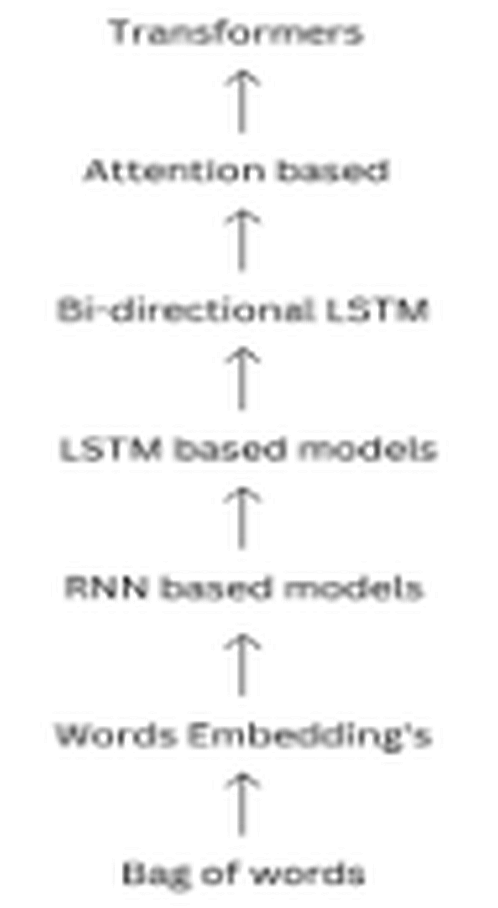
“Bidirectional LSTM” is like being an expert cook who can anticipate which flavors will be needed next and remembers all those you’ve already used, to ensure a cohesive flavor experience from start to finish. Attention-based models are like having a kitchen assistant who constantly tastes and adjusts the dishes, focusing on perfectly balancing the flavors according to the needs of the recipe. Finally, Transformers represent an advanced culinary ensemble with a master chef directing the kitchen, where each ingredient is used optimally in real-time, creating a harmonious and dynamic flow that results in an extraordinary gastronomic experience.
During our sessions, our work with Ladino and AI draws on a wide range of digital projects that support linguistic study, cultural interpretation, and historical inquiry. E-Sefarad provides weekly online conversations that help maintain interest in contemporary Ladino culture and students can use AI to summarize a talk and generate follow up discussion questions. The American Ladino League promotes global community participation through initiatives such as International Ladino Day, which fits well with an AI activity where students design a thematic session proposal based on past events. At the University of Washington, the Sephardic Studies Program preserves manuscripts and oral histories offering opportunities for students to test AI based transcriptions and annotate cultural references. The Salti Institute at Bar Ilan University maintains extensive Ladino literary archives; students can ask AI to identify geographic or thematic patterns in selected folktales. The Autoridad Nasionala del Ladino in Israel promotes scholarly and public engagement, their AI task can include designing a small cultural event based on themes from its publications.
A second group of resources focuses on corpora, narratives, and academic interpretation. CoDiAJe provides an interactive linguistic corpus of Ladino texts allowing students to analyze verb patterns, compare Ladino with modern Spanish, and ask AI to generate hypotheses about language change. SefaNar, Katja Smid’s narrative catalogue, organizes Ladino stories and materials, and students can request AI generated thematic outlines or write alternative endings. The Angela Ma. Arbeláez Archive on Greek Jewish Heritage documents oral histories from 2010 to 2024; AI can help identify motifs, emotional cues, and regional linguistic features in the transcripts. Ladinokomunita, a global Ladino writing forum, encourages creative expression and an AI assisted task can classify message threads by topic and inspire students to produce their own entries. Sephardic Horizons publishes scholarly and cultural essays related to the Sephardic world; students can ask AI to extract central arguments or prepare debate questions that connect the essays to the historical development of Ladino.
Newspapers and community organizations give students practical spaces to write, edit, and imagine contemporary Ladino communication. “La Djente”, the Ladino newspaper affiliated with The Sephardic Jewish Brotherhood of America - La Ermandad Sefaradi, provides short articles, community notes, and cultural reflections. Students can use AI to propose follow up pieces, create short interviews, or draft responses written in Ladino. The American Sephardi Federation itself develops cultural programming and publishes resources that support learning, which allows students to brainstorm with AI how to transform one of the topics into a classroom activity or a digital exhibit concept. Combining all these resources in a structured workflow encourages students to analyze grammar, explore cultural context, interpret historical narratives, and develop original writing in Ladino while using AI as a tool for expansion, reflection, and creative output.
This list represents only a small selection of what exists, and it is not meant to be an exhaustive catalog of Ladino resources or activities. Over the years I have developed many additional exercises that did not involve Gen-AI; we plan to integrate others as the work evolves. As a team, we are always glad to think together with other colleagues, students, and community members about new sources, new approaches, and creative possibilities within the Ladino and Sephardic world. Whether working with contemporary writers, exploring poetic forms in Ladino, or experimenting with digital tools, the range of potential activities is truly vast, the only real limit is the imagination of the person guiding the learning process.
The subsequent phase of the AI progress involves creating custom AI models using advanced machine learning algorithms, particularly focusing on natural language processing (NLP) and speech recognition technologies. These models are designed to recognize, transcribe, and translate Ladino texts and speech into widely spoken languages, enhancing the accessibility of Ladino resources. The tools will undergo testing in controlled environments to evaluate their performance, including speech recognition accuracy, text translation quality, and the usability of educational applications designed for language learning.
Many of these projects emphasize community engagement and educational initiatives to revitalize Ladino. They aim to highlight the cultural significance and historical depth of Ladino not just a language, but also a vessel for Jewish diasporic history. Advanced capabilities like pattern recognition and NLP can be leveraged to develop robust resources supporting these projects (Bird & Chiang, 2012; Adams et al., 2017).
However, the integration of AI also raises concerns. The potential for AI to replace human expertise could lead to deskilling among cultural heritage professionals, while the authenticity of AI-generated interpretations must be carefully monitored to avoid misrepresentations. To address these issues, community feedback is gathered through surveys and structured interviews with Ladino-speaking communities, measuring their perceptions of AI tools and their effectiveness, as well as their well-being in the context of HL learning (Zhou and Yongcan Liu, 2024). Workshops are also organized to engage participants in a participatory design process, ensuring the tools meet specific community needs.
Ethical oversight is a priority, particularly given the sensitive nature of working with an endangered language. This includes obtaining informed consent, anonymizing personal data, and maintaining transparent communication about the research goals and methodologies. By integrating ethical practices with advanced AI capabilities, these initiatives aim to balance technological innovation with cultural sensitivity and community-driven preservation.
AI offers significant potential to aid in the preservation and revitalization of Ladino. Key areas where AI contributes include:
- Automated Documentation: AI-powered voice recognition tools enable automatic transcription of oral narratives in Ladino, aiding in the creation of global archives. Automating the transcription and translation of archival materials held by academic institutions makes it possible to process historical documents more efficiently, ensuring greater accessibility and accurate preservation of cultural heritage. In addition, projects such as CoDiAJe - Ladino Corpus,5 done with Tei-XML, which have already digitized a substantial corpus, can now leverage AI tools to analyze these collections at unprecedented speeds, providing deeper insights into linguistic patterns and cultural nuances. However, the limited amount of digitized Ladino data still poses a challenge for training robust AI models (Adams et al., 2017).
- Translation and Transcription: Neural translation techniques allow for the precise analysis and translation of Ladino texts. AI-driven tools have successfully processed historical and contemporary texts and oral narratives, bridging the gap between archival preservation and modern usage.
- Interactive Learning: AI platforms can provide personalized learning experiences, adapting to individual progress and offering real-time corrections. For example, relational databases integrated with AI can store extensive language data and generate interactive exercises, such as fill-in-the-blank questions or multiple-choice quizzes. AI also analyzes learners' inputs, providing instant feedback to improve their skills. These platforms engage learners with endangered languages and offer valuable pronunciation analysis and corrective feedback. This adaptability is vital for revitalizing Ladino, which often lacks comprehensive teaching resources. Recent research has demonstrated the effectiveness of these platforms in enhancing user engagement and language acquisition strategies (Cohen et al., 2024).
- Accessibility, Dissemination, and Conversation: AI-generated tools augment the global conversation about Ladino. For example, we created an automated podcast and promotional video. For this podcast and promotional video, we used NoteBookLM from Google Studio AI (highly recommended if you do not know it by now). However, many other applications (i.e. 11Labs) on the market offer a wider range of languages and greater control.
The database for this podcast is a compilation from years of Ladino research notes. While still in early stages, such tools ensure the preservation of Ladino content in digital formats, increasing accessibility and facilitating its use in educational contexts.
Interactive Learning Through AI Chatbots
OpenAI provides tools that allow users to create custom GPT-based chatbots,6 tailored to specific needs and preferences. These chatbots function as personalized assistants, capable of supporting language learning in creative ways (Khatib & Mattalo, 2024). For instance, during the summer of 2024, as I studied Judeo-Spanish in a course led by Liliana Benveniste from E-Sefarad, I developed a home-helper chatbot to complement my learning experience.7 I have since created similar chatbots for each of my courses, providing interactive support.
The only limitation is our imagination; chatbots can be programmed to handle a wide range of tasks, from providing cultural insights to teaching vocabulary interactively. The following is an example of interaction with the chatbot:
- User: Give me five easy songs to learn in Ladino.
- (Wait for the output)
- User: I want to learn the words of the first song. Give me the words and help me learn them.
- (Wait for the output)
This approach offers a dynamic and engaging method for learning Ladino, combining modern AI technology with traditional language education to enhance retention and user interaction. The chatbot not only provides learning materials but also interacts in real-time, adapting to the learner’s pace and preferences.
Integrating AI with projects like Sephardi Spaces, which maps Sephardic migration patterns and their cultural impact, can deepen our understanding of how migration has shaped Sephardic identity. AI tools for language preservation can analyze migration data, revealing trends and patterns beyond historical records. For example, Sephardi Spaces visualizes journeys, like that of Moshe Levi Yulee whose son, David, became Florida’s first Jewish senator. His path from Morocco to Gibraltar, the Virgin Islands, Virginia, and Florida is traced.
The predictive modeling capabilities of AI, for example, can assist in anticipating environmental or human factors that might threaten tangible and intangible cultural heritage, enabling proactive management strategies (Spennemann, 2024). Community engagement is a cornerstone of this research since many of the individuals and histories tracked have descendants within the local community. Workshops and seminars are organized in the Ladino-speaking community to introduce AI tools, gather feedback, and refine the applications accordingly. These efforts are crucial in ensuring that the community feels a sense of ownership over the preservation process, fostering support and active participation.
As in many databases of Sephardic communities, AI applications are becoming central. AI-driven speech recognition tools have been developed to transcribe oral histories and narratives from the Ladino-speaking community (Besacier et al., 2014; Adams et al., 2018), facilitating the creation of a future digital archive accessible to linguists and the global community (Bird & Simons, 2003). This archive preserves Ladino’s rich cultural expressions and idiomatic language, which are essential for educational and cultural continuity (Harris, 1994).
The AI applications developed have significantly enhanced the documentation and revitalization of Ladino. The digital archive has improved accessibility to Ladino resources, sparking increased academic and cultural interest. The language learning platform has received positive feedback from users who report greater engagement and improved learning outcomes. Additionally, the project has facilitated cultural reconnection, helping younger generations engage with their heritage and use Ladino more actively.
These tools have enhanced Ladino documentation and revitalization, increasing access to resources, improving learning outcomes, and fostering cultural reconnection among younger generations. Additionally, digital platforms broaden community engagement, creating forums and virtual events that connect Ladino speakers and learners worldwide, extending cultural exchange and collaboration beyond physical boundaries.
Prompt Engineering for Educational Use
Educational AI can be categorized into three approaches (Ouyang&Pengcheng, 2021):
AI Directed: The student is a passive receiver of knowledge provided by an instructor or system.
i.e. Diseño de simulasyones i eskenarios ke salen de Inteligensia Artifisyala para ambezo práctico. Egzempio: Simulasyon de una konversasion en el sok del siglo XVI en Salonika.AI Supported: The student collaborates with AI, guided by educators to connect either their own wisdom or the instructor's insights to discover new concepts.
i.e. Kreasion de eskenarios para kaso de estudio relevante. Egzempio: Kaso de estudio sovre la poesia del ladino en la epoka de la ekspulsion de Espanya.AI Empowered: The student leads their learning journey, with educators serving as guides, similar to the flipped classroom model.
i.e. Estimular kontenido kreyado por los elevas, kon guia de inputs de Intelijensia Artifisyala. Egzempio: Kreasion de blogs personales en Ladino.
Applications in Knowledge Dissemination
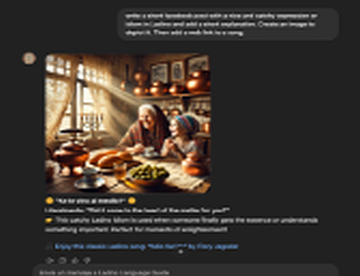
For broader outreach, a chatbot LLM specialized in Ladino can be invaluable. AI-driven tools can overcome the time-intensive nature of content creation, increasing engagement by enabling efficient production of posts in multiple languages. This fosters greater community interaction and enriches the dissemination of cultural knowledge.
Represents the adage "Mas vale tadre ke nunka” (Better late than never) highlighting the urgency and importance of preserving cultural heritage.
Example for Students

Instruct a student to write a command in Ladino for an AI to generate a specific image. This task integrates language learning with technology, fostering both creativity and practical skills in utilizing AI tools.

Pide al elevo ke eskriva una instruksyon en ladino para la Intelijensia Artifisyala para krear una imaje.
Egzempio:"Krea una imaje ke muestra una famiya sefardita ke esta sentada alrededor de la mesa i komiendo kuzina sefardita."
Kriá un dialogo / konversasion / trabaho de klasa sovre la imaje.
Such examples illustrate how AI can bridge the gap between education, cultural preservation, and community engagement, providing scalable, interactive solutions.
Transcription of Rashi Script
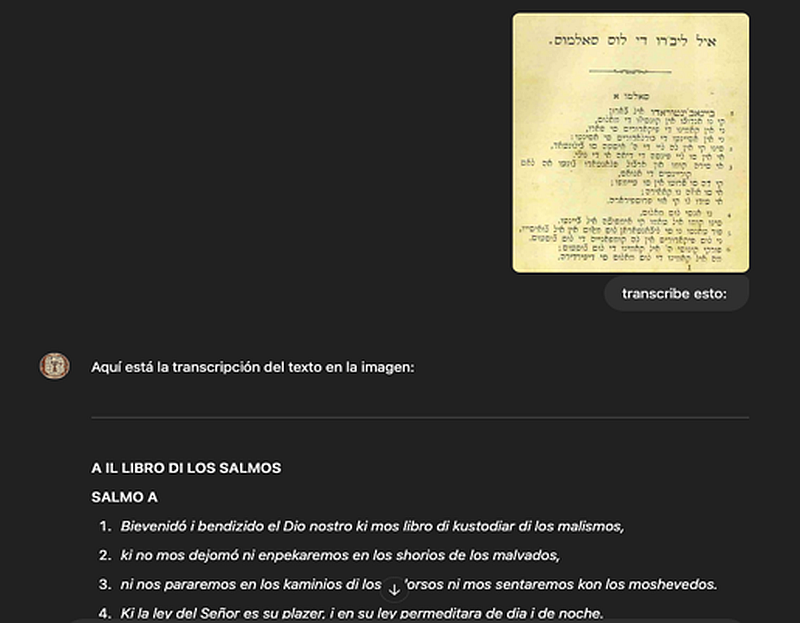 An AI transcription system demonstrates its potential to transcribe Rashi
script from historical texts. AI has already demonstrated its ability to
recognize Rashi script, albeit with occasional vocabulary errors (see
Figure 5). While not yet perfect, these systems that often use ways of
Optical Character Recognition (OCR) improve rapidly, offering
increasingly accurate results.
An AI transcription system demonstrates its potential to transcribe Rashi
script from historical texts. AI has already demonstrated its ability to
recognize Rashi script, albeit with occasional vocabulary errors (see
Figure 5). While not yet perfect, these systems that often use ways of
Optical Character Recognition (OCR) improve rapidly, offering
increasingly accurate results.
The development of specialized Large Language Models (LLMs) for Rashi characters promises to significantly enhance accuracy and cultural sensitivity, saving countless hours of transcription work. This allows researchers to focus more on analyzing texts and understanding their linguistic and cultural significance. During many Ladino workshops, , much time was spent on transcription rather than on deeper exploration of the language and text content. Automating these labor-intensive processes through AI can free resources for creative and community-oriented initiatives.
Institutions like the Salti Institute, with its vast archive of handwritten Solitreo letters, can benefit greatly from AI's capabilities. Many letters are difficult to decipher due to paper deterioration or illegible handwriting. The potential of Handwritten Text Recognition (HTR) in AI models excels in recognizing patterns and synthesizing information, aiding in the management and preservation of large collections. Additionally, these tools can predict artifact decay, to help institutions develop effective preservation strategies.
 Digital Narration with AI
AI narrates stories or folktales in Ladino, preserving oral traditions and expanding their reach online. The figure presents an interesting AI tool (AI Comic Factory) to animate traditional stories.
The impact of AI on cultural heritage extends beyond transcription and preservation to educational and experiential initiatives. At the University of Miami, we developed an extended reality (XR) component to accompany the ongoing physical exhibition, The Golden Age of the Jews of Al-Andalus (August 2024 - June 2026). Student-led tours are enhanced by a Maimonides avatar which interacts with visitors through dynamic, conversational exchanges. Through augmented reality (AR), users can virtually explore historical settings and engage with digital reconstructions of cultural artifacts. Recent studies (Hwang, Lee, & Jeon, 2024) demonstrate that AI integration within immersive environments, such as the metaverse and platforms like Engage, and foster more interactive and authentic learning experiences, thereby enriching contemporary education. Furthermore, the use of AI to generate 3D models of fragile or endangered artifacts supports both preservation and research, enabling detailed examination of culturally significant items without risk of damage.
The preservation of Ladino, a language of profound heritage, aligns with the principle of safeguarding knowledge and tradition. AI serves as a tool, much like the quill or parchment of old, to document, teach, and connect those who hold this language dear. Its algorithms, if used wisely, can gather scattered fragments, amplify the voices of the past, and ensure that the wisdom embedded in this tongue continues to enlighten future generations. Yet, as with all tools, it is the intention and wisdom of its user that determines its value. What greater mitzvah than to preserve the essence of a people’s soul?
Such tools exemplify the integration of AI into cultural preservation and engagement, demonstrating its ability to bridge the past and present, while inspiring future connections to history and heritage.
As part of an academic project titled “Sephardi and ChatGPT: AI as a Digital Frontier in Cultural Heritage,” students actively create 3D models of community artifacts, such in the example of the The Seven Heaven Challah, to merge education with preservation. Such efforts illustrate the transformative potential of AI in redefining how we preserve, interact with, understand, and access cultural heritage assets (Addison, 2000). These advancements promise a future where historical legacies are not only preserved but made more accessible, engaging, and sustainable for generations to come.
AI greatly enhances public engagement with cultural heritage through virtual and augmented reality platforms. These technologies make heritage more accessible and interactive, offering users the opportunity to explore cultural sites and artifacts in ways that were previously unimaginable. The Rekrei Project8 (formerly Project Mosul) illustrates how AI and virtual reality can transform public interaction with heritage. Using crowdsourced photographs from tourists and locals, AI algorithms reconstruct 3D models of artifacts and sites that have been destroyed or are otherwise inaccessible. These models are then made available on virtual reality platforms, allowing global audiences to experience cultural heritage in immersive and educational ways. This approach not only preserves artifacts digitally but also fosters a deeper, personal connection to history (Stylianou-Lambert et al., 2015). Benjamin Lee’s application of Computational Humanities (CH) and database to the analysis of historic Ladino newspapers using Machine Learning (ML). Lee’s innovative approach in using computational analysis to extract and analyze visual content from thousands of digitized pages presents a novel way to access and understand the transnational dynamics of Sephardic print culture (Lee, 2022). Previously, we needed elaborated computational knowledge, today, this methodology can significantly enhance how scholars and educators engage with Ladino content, offering deeper insights into its historical, linguistic, and cultural contexts.
Looking forward, novel frameworks, such the one introduced by Miao et al. (2024), align words between languages using explicit word prediction and translation ranking objectives, significantly improve sentence embeddings in low-resource languages. These techniques could be instrumental to enhance the computational understanding and process Ladino by aligning it more closely with high-resource languages, thus preserving its linguistic nuances more effectively. In addition, expanding data sources to include more dialects and variants of Ladino could improve the models' accuracy and robustness. This modern approach requires increasing interdisciplinary collaboration with linguists, cultural historians, and AI ethicists to enrich the research, and ensure that AI tools developed are culturally sensitive and linguistically accurate. It is a question of time until we will have adequate models and agents to better our interaction with Ladino. I predict that by 2026, we will already have a large enough database so advanced AI technologies like deep learning and semantic analysis could further enhance the models' capability to understand and generate Ladino in contextually appropriate ways. Until then, caminos de leche i miel!
Bibliography
Adams, O., Makarucha, A., Neubig, G., Cohn, T., & Bird, S. Cross-Lingual Word Embeddings for Low-Resource Language Modeling. Proceedings of the 15th Conference of the European Chapter of the Association for Computational Linguistics, 2017, pp. 937–947.
Besacier, L., Barnard, E., Karpov, A., & Schultz, T. Automatic speech recognition for under-resourced languages: A survey. Speech Communication, 56, 2014, pp. 85-100.
Bird, S. & Chiang, D., "Machine Translation for Language Preservation." Proceedings of COLING 2012: Posters, 2012, pp. 125–134.
Bird, S. & Simons, G. Seven dimensions of portability for language documentation and description. Language, 79(3), 2003, pp. 557-582.
Cohen, S., Mompelat, L., Mann, A., & Connors, L. “The linguistic leap: Understanding, evaluating, and integrating AI in language education”. Journal of Language Teaching, 4(2), 2024, pp.23-31.
Crystal, D. Language Death. Cambridge: Cambridge University Press: 2000.
Fishman, J. A. Reversing Language Shift: Theoretical and Empirical Foundations of Assistance to Threatened Languages. Multilingual Matters. 1991.
Harris, T. K. Death of a Language: The History of Judeo-Spanish. Newark: University of Delaware Press: 1994.
Harrison, K. D. When Languages Die: The Extinction of the World's Languages and the Erosion of Human Knowledge. Oxford: Oxford University Press: 2007.
Hwang, Yohan, Seongyong Lee, & Jaeho Jeon. "Integrating AI Chatbots into the Metaverse: Pre-service English Teachers’ Design Works and Perceptions." Education and Information Technologies, 2024.
Kirschen, Bryan, editor. Judeo-Spanish and the Making of a Community. Cambridge: Cambridge Scholars Publishing: 2015.
Khatib, Rima & Brandon Mattalo. "Enhancing Learning Experiences with GenAI Chatbots: A Tutorial Approach." ICIS 2024 Proceedings, Article 17, 2024.
Miao, Z., Wu, Q., Zhao, K., Wu, Z., & Tsuruoka, Y. Enhancing Cross-lingual Sentence Embedding for Low-resource Languages with Word Alignment. Findings of the Association for Computational Linguistics: NAACL. 2024, pp. 3225-3236.
Ouyang, Fan & Pengcheng Jiao. "Artificial Intelligence in Education: The Three Paradigms." Computers and Education: Artificial Intelligence, vol. 2, 2021, p. 100020.
Soylu, Dilek & Ayşe Şahin. "The Role of AI in Supporting Indigenous Languages." AI and Tech in Behavioral and Social Sciences, vol. 2, no. 4, 2024, pp. 11-18.
Spennemann, Dirk H. R. "Will Artificial Intelligence Affect How Cultural Heritage Will Be Managed in the Future?" Heritage, vol. 7, 2024, pp. 1453-1471.
Stylianou-Lambert, T., Boukas, N., & Christodoulou-Yerali, M. Museums and cultural sustainability: Stakeholders, forces, and cultural policies. International Journal of Cultural Policy, 20(5), 2015, pp. 566–587.
United Nations Educational, Scientific and Cultural Organization (UNESCO). (2022). A decade to prevent the disappearance of 3,000 languages. UNESCO-IESALC.
Zhou, Yue & Yongcan Liu. "Language Learner Well-being in Heritage Language Learning: Conceptualisation, Measurement, and a Pathway to Flourishing." International Journal of Bilingual Education and Bilingualism, 2024.
1 Dr. Shai Cohen is a Senior Lecturer in Modern Languages and Literatures at the University of Miami and Director of the AI and Humanities Lab. His research spans the legal and cultural intersections between Jewish and Christian communities in medieval Spain, with a particular focus on the converso experience; political satire in seventeenth-century Spain; and Sephardi studies of migration, memory, and identity. He leads the Sephardi Spaces project, which maps historical and contemporary trajectories of Sephardic migration and identity across the globe.
2 The Potential of AI in Language Preservation and Revival, Published: 08/14/2023; Consulted: July 2024.
3 View the video I created with the help of HeyGen.com here where I speak in languages I do not fully control, using lip-sync technology.
4 A notable success story to reference is the revival of the Māori language which has recently become a leading example and research focus for language revitalization efforts. i.e. la app de Te Hiku Media that preserves the History and revive te reo Māori.
5 CoDiAJe - The Annotated Diachronic Corpus of Judeo-Spanish.
6 A chatbot is an AI-based program designed to simulate human conversation through text or voice. It uses natural language processing (NLP) to understand questions, generate responses, and assist users in tasks such as information retrieval, learning, or customer service. In research and education, chatbots often serve as interactive agents that enhance engagement and personalize user experiences. For further reading, see: IBM, What is a chatbot? (2024), Oracle, Chatbot Definition & Meaning (2024).
8 For virtually preserved sites, the 3-D archive hosted by Rekrei offers a compelling model of digitally mediated memory and community-engagement.