
Carlos Yebra López
Ladino on the Internet
Sepharad 4
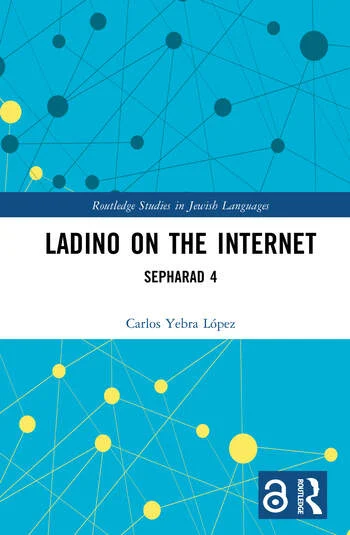
London: Routledge, 2024, ISBN: 9781003473664
Reviewed by Cailee Davis1
Dr. Carlos Yebra López’s Ladino on the Internet: Sepharad 4 marks the first comprehensive critical analysis of the online revival of the Ladino language, a Sephardic language which evolved from a combination of Hebrew and Spanish. Employing a Revivalistics methodological framework which emphasizes the importance of speakers and community over “armchair linguistics,” Yebra López provides a survey of the practical and pedagogical aspects of Ladino preservation and revitalization in the digital age. The author argues that the global recovery of Ladino occurred largely because of the internet. This revival first emerged in the internet forums of the 1990s. Secondly, the revitalization of Ladino evolved alongside the technological advances of the digital age.
The book, therefore, follows the intersecting timelines of internet growth and online Ladino-usage to arrive at an age which Yebra López terms “Sepharad 4,”- the fully realized online articulation of the Sephardic diaspora and the linguistic evolution of Ladino as a cyber-(post)vernacular.
The first chapter explores the early stages of Ladino online and the emergence of the first Ladino digital “homelands.” Particular focus is given to Ladinokomunita, a Ladino email list created in 1999 which the author compares with other Ladino email lists and similar initiatives in Yiddish. The chapter traces the cyber-standardization of Ladino through the digital empowerment of members of the Sephardic diaspora, which culminated in the development of Ladino as a cyber-(post)vernacularity.
Chapters two and three look at the growth of Ladino on social media platforms and language-learning applications. Chapter two provides a survey of various community-run digital Ladino archives housed on YouTube, including Nasionala del Ladino, eSefarad, Wikitongues, and Ladino 21, which Yebra López co-founded in 2017. The author analyzes the multimodal and multisemiotic (vernacular/post-vernacular) aspects of these digital archives, as well as the interactive possibilities afforded to users, in comparison to similar digital archives in Yiddish. Chapter three, then, discusses the significant shift in digital Ladino language sources in the age of social media. The author provides a survey of Ladino-speaking Facebook and WhatsApp groups, TikTok, and Instagram activity, and engagement on X (formerly Twitter); the chapter also discusses language-learning applications including the popular Duolingo, which has Yiddish but not Ladino learning options, and uTalk, for which Yebra López helped with translation. The analysis here explores the linguistic-hybridity-afford by digital spaces, issues of standardization, and the democratization of language.
The three Ladino-learning initiatives which emerged during the COVID-19 pandemic as a result of what Yebra López terms the “Ladino Zoom Boom” are the focus of chapter four. In his rigorous examination of the Sephardic Digital Academy, Enkontros de Alhad, and the Oxford School of Rare Jewish Languages, where the author teaches, Yebra López argues that the increase in online Ladino learning platforms during the pandemic constitutes a significant shift in Ladino’s status as an endangered language. The author makes the case that the digital Ladino-speaking community has gained a critical presence on the internet with a dedicated focus on transgenerational language submission, engaging younger generations through Zoom and social media, and therefore, requires a more positive re-evaluated according to UNESCO’s classifications of language vitality.
In an interesting pivot, the fifth chapter engages with representations of Ladino on streaming platforms. The chapter compares the pilot seasons of the Israeli drama The Beauty Queen of Jerusalem (2021) and the Turkish drama Kulüp (2021). The discussion explores the need for Ladino representation in mainstream media, both for the purposes of raising awareness and pedagogical impact, and acknowledges the practical limitations of authentic representation of Ladino on commercial media platforms. Yebra López’s examination of Ladino representation on-screen compliments his earlier acknowledgements of Ladino music in previous chapters; however, despite engaging with these mediums, the author neglects to explore other critical mediums of Ladino representation, such as literature and rabbinical writings, some of which are available in digital spaces as eBooks and audiobooks.
The final chapter looks towards the future of Ladino preservation and usage. The author discusses possible advancements in the age of AI, crypto currency, the Metaverse, and so forth to propose the formation of a digital homeland for the Sephardic diaspora. Without the support of a Ladino nation-state to further preserve and revitalize the language and culture, a digital network-state is, the author seems to suggest, the only way forward. To do so, Yebra López acknowledges the crucial role that younger generations will play in the realization of this digital state; here, he emphasizes the transgenerational aspect in which the youth, the minority of Ladino speakers, must educate the elderly, the majority speakers, on said technological possibilities. While this final chapter is largely hypothetical, the author seems to suggest that Ladino can only thrive online, largely disregarding any potentialities of cultivating the language offline beyond immediate circles.
The book’s conclusion returns to and reinforces the notion that Ladino speaking and learning is now primarily conducted online. The author makes a considerable effort to acknowledge the current limitations of Ladino-usage on the internet; he also urges for more inclusivity among Ladino speakers when embracing ‘non-native’ speakers and continuing digital initiatives.
Overall, Yebra López’s analysis of individual technologies and platforms, along with the incorporation of interviews and surveys which the author conducted, are the book’s biggest strengths. Much of the book compares the strides in Ladino-usage and preservation with similar efforts conducted in Yiddish and Hebrew, providing practical information on the preservation of endangered languages through technology and digital spaces. While acknowledging that the power of preservation lies with Sephardim themselves, the book cautions against gatekeeping and emphasizes the ease of language-learning afforded to outsiders by digital accessibility. Given the book’s focus on digital homemaking and a Sephardic network state, other Ladino-language online spaces, including digital newspapers and magazines, are noticeably absent. The book’s exploration of the growth of Ladino, and the larger Sephardic, culture could have benefitted from an analysis of these initiatives. This book is available through open access (https://doi.org/10.4324/9781003473664) remains relevant to scholars and individuals interested in the methodologies and tools available for the preservation of endangered languages.
1 Cailee Davis is a doctoral researcher at the University of Oxford, and holds an MA in Holocaust Studies, with Distinction, from the University of London. Her work tracks transgenerational memory in representations of the Holocaust and has been published in Film & History, Holocaust Studies, and The Journal of Holocaust Research. Cailee has completed fellowships with the United States Holocaust Memorial Museum, the European Holocaust Research Infrastructure at the Jewish Museum in Prague, and the Holocaust Education Foundation at Northwestern University.