
Woven in Secret
The Crypto-Jewish Legacy Behind Latin American Ritual
By Rifka Epstein1
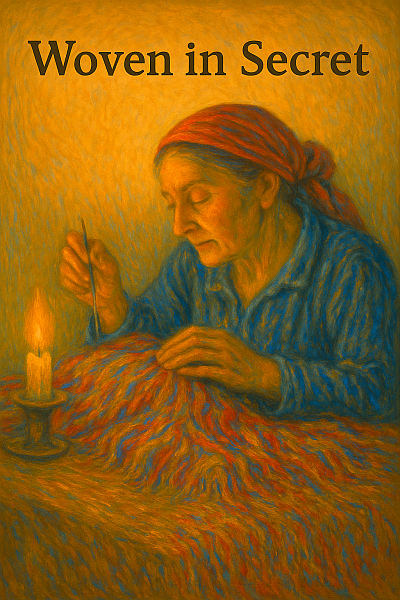
A silent craft, a hidden faith — the Crypto-Jewish story woven through generations.
Illustration generated by AI at the author’s request (via OpenAI’s image generation tool).
This article investigates the potential continuities between Jewish ritual memory and Latin American cultural practices that may reflect Crypto-Jewish origins. Rather than asserting a direct or uninterrupted lineage, it considers how remembrance, secrecy, and survival strategies embedded Jewish resonances into customs now perceived as local, Catholic, or indigenous. These symbolic gestures, often sustained through domestic and communal rituals, served as discreet carriers of identity, particularly in female-centered spaces where tradition was quietly maintained across generations. This is not simply history. It is identity: lived, guarded, and, even now, rediscovered.
My research does not follow a formal ethnographic method; instead, it weaves together personal encounters, oral histories, community practices, and cultural fragments that refuse to vanish.
This article is offered in two parts. The first examines historical and scholarly sources regarding possible points of contact, for example, the adaptation of Jewish circumcision practices into indigenous initiation rites in certain remote regions, or the parallels noted between indigenous mourning customs and Sephardic Jewish rituals, as discussed in works by scholars such as Seymour B. Liebman (The New World of the Crypto-Jews, 1970), Nathan Wachtel (The Faith of Remembrance, 2001), Judith Laikin Elkin (The Jews of Latin America, 1998), Regina Igel (Crypto-Judaism in Brazil, 2010), and Judith Roumani (editor and contributor to Sephardic Horizons, particularly on themes of cultural continuity and identity), whose collective research traces Crypto-Jewish survival and interaction with indigenous cultures in Latin America, especially in Mexico and Peru. These patterns are drawn from published research and archival traces, including collections such as the Archivo General de la Nación in Mexico and the Inquisition Records from Lima, with citations provided in the endnotes.
The second part reflects on lived experiences and field conversations, particularly those from communities I’ve worked with in northern Mexico and the Andean highlands of Peru where ritual patterns and oral testimonies have pointed toward possible traces of hidden Jewish memory. I’ve had over 20 years of educational work in Latin America. It is more speculative and interpretive, but grounded in the belief that identity often hides not only in surnames or documents but also in rituals, songs, and inherited silences.
While no single piece can claim to answer the complex question of Crypto-Jewish continuity, I hope this essay invites readers to look again at what lies just beneath the surface, in gesture, in story, and in memory, and to consider the ways that remnants of Jewish identity may live on in forms often overlooked by official history.
I. Pachamanca: Echoes of Shabbat, Korban Pesach, and Survival
%20and%20Pachamanca.png)
Chamin (Cholent) and Pachamanca
Food was among the safest languages of survival. While prayer books could be burned and Hebrew silenced, a recipe, passed hand to hand, mother to daughter, could endure. In the Andes, one such communal meal may carry sacred memory in its steam.
High in the Peruvian highlands, families gather to prepare pachamanca, a ceremonial feast cooked underground using heated stones. Meats, potatoes, beans, herbs, and corn are layered with care then sealed beneath the earth to bake slowly in nature’s embrace. Often described as an indigenous ritual honoring Pachamama (Mother Earth), the structure and rhythm of the practice raise deeper questions. Could this act, communal, elemental, and bound by sacred timing, hold fragments of hidden Jewish memory?
A Whisper of Shabbat
Among Crypto-Jews, Shabbat observance often retreated into the kitchen, shielded by everyday gestures. One of the most enduring symbols was the hidden dish2 — chamim, tfina, or sefrina — prepared in advance and left to slow-cook in the embers overnight. Though disguised as ordinary fare, it was quietly shared on Shabbat morning, preserving sacred rhythm through scent and secrecy.
In northern Mexico, one woman told me that her grandmother used to place a heavy pot deep into the coals on Friday afternoon, covering it with thick cloth and ash. “We thought it was just abuelita’s special bean stew,” she said with a smile. “But later I learned — that stew was our Shabbat.”
This practice, often passed down without explanation, allowed Jewish women to maintain the rhythm of Shabbat even under the shadow of persecution.
Pachamanca’s slow preparation, carefully arranged before sundown, sealed beneath the soil, and left to cook until the appointed time, mirrors this rhythm. Though it may have outwardly honored the Andean earth, for some, the act may have also echoed the sanctity of a Shabbat meal, held in secret beneath the watchful eyes of colonial authorities. The steam that rose from the ground may have carried the same silence as a whispered blessing.
The Ghost of Korban Pesach
There is another echo layered in the stones: the memory of the Korban Pesach, the Passover offering. In ancient Israel, the sacrifice was prepared outdoors, over fire, and consumed communally, ritually bound to the theme of freedom through fire. Though this practice ceased after the destruction of the Second Temple, its memory was preserved symbolically in the seder, and emotionally through yearning.
For Crypto-Jews in the Andes, celebrating Passover would have been unthinkable in public. Yet the deep spiritual need for commemoration may have found refuge in food that could be mistaken for something else. Pachamanca, with its structured layering, earth-based cooking, and collective participation, may have offered not only warmth and nourishment, but also a hidden altar. One that whispered, “we remember.”
Steam, Silence, Survival
As Martha Few observes in her study of colonial Guatemala and Peru, food preparation was a vital space where women preserved cultural power and spiritual resistance, often concealed beneath ordinary tasks.3 Similarly, David Gitlitz documents how Crypto-Jews used food, fire, and silence to veil sacred observances in daily life.4
Pachamanca may not be found in the Haggadah, nor named in a siddur, but it speaks a language recognizable to those who listen. In every steaming earth oven still burning in the Andes, there may linger not only the spirit of Pachamama, but also the ghosts of Shabbat candles long extinguished, and the embers of a forgotten sacrifice.
II. Festa Junina: Bonfires, Blessings, and Buried Calendars
When rituals had to conceal themselves, the calendar often became a mask. Holy nights shifted dates. Saints took the names of silenced prophets. And in Brazil’s joyful June bonfires, one might glimpse the embers of something older, rituals remembered quietly, even as they were celebrated aloud.
Festa Junina, one of Brazil’s most widely celebrated festivals, fills the month of June with rural pageantry, traditional dances, and Catholic devotion. Originally brought by Portuguese colonizers, the festival honors saints such as Anthony, John the Baptist, and Peter. Over time, it absorbed indigenous, African, and Iberian elements, producing vibrant regional variations deeply rooted in Brazilian identity.
Central to the celebration are communal feasts, quadrilha dances, and rustic attire that idealizes countryside life. Music pulses with forró rhythms, and tables overflow with seasonal treats. Among them is canjica, a warm, sweet porridge made from hominy corn, milk, and sugar. This use of dairy is particularly intriguing, given the festival’s timing near Shavuot, the Jewish holiday commemorating the giving of the Torah, which is also marked by dairy foods and agricultural thanksgiving.5
While no direct evidence links Festa Junina to Crypto-Jewish practice, what survives of these hidden communities is often found not in documentation, but in patterns. David Gitlitz notes that Crypto-Jews frequently preserved religious memory through domestic rituals and substitutions that appeared culturally neutral or safely Catholic.6 In this light, Festa Junina, centered on food, fire, and seasonal celebration, may offer more than folklore. It may hold a disguised remembrance of sacred time. Could a bowl of canjica warm more than the body? Could the bonfires honor not only saints, but hidden Sinai echoes?
Such questions need not be resolved to be worth asking. They invite us to listen closely, to look between the lines of tradition, and to wonder what survives—not in the texts that were lost, but in the customs that quietly remained.
III. El Día Grande: Fasting in Silence, Faith in Secret
Some sacred days were so deeply embedded in memory that even fear could not erase them. Fasting endured as a form of protest, of remembrance, and of whispered reverence. For those who no longer dared to speak the name Yom Kippur, the words El Día Grande said just enough, and never too much.
Among the holiest dates in the Jewish calendar, Yom Kippur, the Day of Atonement, has long held a unique position in Jewish life. For Crypto-Jews in Spain and the Americas, stripped of synagogues, community support, and religious freedom, this day did not disappear. It was renamed, cloaked in ambiguity, and observed in secret. El Día Grande, "the Great Day," became a term that both honored and obscured its meaning.
The name offered protection. Fasting on that day became an act of spiritual defiance, a silent ritual of repentance and resistance. Inquisition records from colonial Mexico document individuals who abstained from food on unnamed sacred days. One descendant recalled, “My abuela always said there was one day every year when no one was to eat… I only learned later it was the Day of Atonement.”7
Such memories, partially lost, partially protected, testify not only to ritual continuity, but also to the quiet determination of those who refused to forget. In rural regions of Mexico and Central America, El Día Grande was often associated with major Catholic feast days, but the rituals surrounding it frequently mirrored Jewish patterns: pre-prepared meals, white garments, and quiet solemnity.
Stanley Hordes notes that among Crypto-Jewish communities in Northern Mexico and New Mexico, families often lit candles on Friday evenings and refrained from work on unnamed "holy days," echoes of Shabbat observance that persisted long after their origins were forgotten. These practices were frequently aligned with El Día Grande, providing a Catholic framework through which Jewish memory could endure.8
Seth Kunin highlights how familial transmission, especially by women, preserved ritual forms even as the explicit Jewish content faded.9 Similarly, Gitlitz describes how Crypto-Jews used public Catholic rituals, such as saints’ processions, to mask private observances, a strategy he calls "festival disguises".10
Thus, El Día Grande may be more than a feast day; it is a ritual palimpsest, layering Catholic, indigenous, and Crypto-Jewish elements into a single sacred rhythm. Beneath the visible celebration lies a deeper cadence of survival, fasting, and faith remembered in silence.11
IV. Día de los Muertos: Remembering Beyond the Grave
Day of the Death and Yahrzeit
Beneath marigolds and skull-painted smiles, Día de los Muertos pulses with echoes of something older, something hidden. Rooted in Mexico’s Indigenous and colonial past, it continues to shape traditions in Mexico and in some Latin American communities touched by Mexican cultural memory. And for some, it may preserve encrypted echoes of Jewish mourning.12
Though widely framed as an Aztec-Christian syncretism, scholars and descendants alike have pointed to a subtler layer: remembrance practiced in secrecy. Among Crypto-Jews commemorating the dead required caution. Crosses were absent, saints unmentioned. Candles flickered not only for departed relatives, but for ancestors whose names were erased, martyrs of a forbidden faith.
Rather than ornate public altars filled with saintly imagery, some families created quiet spaces: a photo, a plate of food, and soft candlelight. One oral tradition from Mexico recalls a great-grandmother who, every autumn, laid out offerings and whispered names. “It is for our people,” she would say, without ever explaining who “our people” truly were. No Kaddish was spoken aloud, but perhaps it was felt.
In recent years, the success of Pixar’s Coco (2017) has reignited reflection around memory and identity. For some descendants of Crypto-Jews, the film stirred unfamiliar questions: Who are the ancestors not on my ofrenda? What memories were hidden from us, and why? As Abuelita in the film declares, “Our family comes from a long line of music,” but in some homes, the silent song was one of survival, not celebration.13
Today, among those exploring their Jewish ancestry, Día de los Muertos has become more than cultural expression. It offers a moment to both honor family and awaken memory. In the layered rituals of remembrance, a hidden spark still flickers.
Anthropologist James Sexton documents these intersections in detail, describing how certain altars among Crypto-Jewish descendants deliberately omit Catholic symbols while preserving candles, food offerings, and photographs, rituals aligned with Jewish mourning traditions. He notes that in some households, the timing of the observance and the presence of fasting evoke echoes of Yom Kippur. Similarly, journalist Jerome Socolovsky has identified parallel practices, particularly the absence of Christian iconography, as signs of Crypto-Jewish continuity.14
V. Festival de las Velitas: Light in the Darkness, a Crypto-Jewish Beacon
On the night of December 7, streets, windowsills, and sidewalks across Colombia glow with hundreds of flickering flames, small candles lined in rows like rivers of fire. Known as the Festival de las Velitas, “the Little Candles Festival,” this beloved tradition marks the Feast of the Immaculate Conception and opens the Christmas season. But beneath its Catholic framing lies another story: a ritual of light lit in secrecy, silence, and defiance. For descendants of Crypto-Jews, these flames may have been more than festive decoration, they were survival by candlelight.15
During the Inquisition, Jewish identity was punishable by torture and death. Yet one act persisted across Iberia and colonial Latin America: the lighting of candles on Friday nights. These flames, small and hidden, served both as prayer and protest. Women lit them in ovens, behind shutters, or deep within cellars, publicly honoring saints, privately honoring Shabbat and the ancestors who refused to disappear.16
In this light, the Festival de las Velitas takes on new resonance. Its quiet reverence, domestic location, and luminous intensity mirror the hidden rituals of Crypto-Jewish resistance. These are not cathedral candles tied to Eucharist or procession, they are intimate flames, glowing at the edges of homes, lit at dusk, marking a sacred pause. Even the date is significant: early December, often overlapping with Hanukkah, the Jewish Festival of Lights, born of revolt and rededication. While the two traditions are distinct, their convergence suggests a palimpsest: one ritual layered atop another, never fully erased.
Oral testimony from descendants in Medellín adds a striking detail; in some families, velitas are lit not just for one night, but for eight, without knowing why. Elsewhere in Latin America, only two nights are observed. The persistence of eight evenings, mirroring Hanukkah’s span, invites deeper reflection: when ritual memory fades, form often survives.17
In a world where survival demanded assimilation, the language of light became a code. And so perhaps, even today, Colombians kneeling to light their velitas are walking paths first traced by hidden Jews. Their flames may rise in honor of Mary, but they may also whisper to the matriarchs who kept the Sabbath alive in the dark.
VI. La Limpia: Cleansing the Body, Guarding the Soul
Among the many rituals practiced in Latin America, La Limpia, a spiritual cleansing ceremony using herbs, eggs, or incense is widely regarded as a blend of indigenous and Catholic traditions. Yet within some families of hidden Jewish descent, this practice may have carried an additional layer: a whisper of taharah, the Jewish ritual of bodily and spiritual purification.
Although typically performed to dispel the “evil eye” or remove negative energies, elders in Crypto-Jewish households often imbued La Limpia with solemnity, modesty, and intention. The use of rue (ruda), myrrh, rosemary, and copal incense echoes both ancient Jewish medicinal writings and the aromatic elements of Temple service.18
One testimony from a woman in northern Mexico described how her grandmother conducted La Limpia every Friday before sunset, using a white cloth, olive oil, and murmured prayers, without invoking saints. “It was just for protection,” she said. “She said it’s how our people kept the darkness away.”19
The ritual’s timing, language, and symbols suggest a veiled form of pre-Shabbat spiritual preparation. For some Crypto-Jews, La Limpia may have served dual purposes: physical healing and spiritual preservation in a world where overt Jewish rituals were forbidden. Hordes notes that rituals of bodily purification often adapted to local forms, even as they preserved inner frameworks of Jewish meaning.20
Notably, the ritual use of eggs in La Limpia, particularly the inspection of yolks for traces of blood, bears resemblance to halachic practices in kashrut. In traditional Jewish law, eggs must be checked to ensure they are free of blood before consumption. This meticulous attention to purity, when echoed in folk practices, may signal submerged continuities.
What appears today as folk healing may once have been a disguised act of devotion, a way to guard the soul when prayers had to remain unspoken. Together, these quiet rituals, performed in kitchens, whispered behind curtains, and passed down without names, form a hidden liturgy of endurance. Across centuries and continents, they continue to flicker like embers in the hearth of memory.
Conclusion: The Hidden Sparks Still Burn
Crypto-Jewish traditions in Latin America are not merely relics of the past, they are living embers, flickering quietly through stories, rituals, and inherited silences. From El Día Grande to La Limpia, from the covering of mirrors, to secret fasts, and candle lightings, these customs tell a story of endurance, identity, and resilience across centuries of persecution and forgetting.
Though often hidden beneath Catholic symbols or interwoven with indigenous ritual forms, many of these practices carried distinctly Jewish rhythms, echoes of Shabbat, mourning rites, and ancestral reverence that survived exile, violence, and erasure. As more descendants begin to rediscover these fragments, the journey is not merely one of nostalgia or genealogy. It is a return, a reweaving of meaning into the fabric of memory.
In a world where identity is often flattened or simplified, the stories of Crypto-Jews remind us that what is suppressed does not disappear. It transforms. It adapts. It survives in a grandmother’s whispered prayer, in the smell of rue on a Friday afternoon, or in the quiet defiance of lighting candles behind closed doors. To study these rituals is not simply an academic pursuit. It is an act of witnessing, of listening, of honoring the unspoken liturgies that kept the Jewish soul alive, even in silence.
And yet, many questions remain. How many of these rituals emerged from deliberate preservation and how many from unconscious echo? What role do memory and imagination play in reconstructing identities long denied? And what does it mean to belong to a tradition rediscovered, rather than inherited openly? These questions are not easily answered. But perhaps they were never meant to be. Like the rituals themselves, they are invitations—to remember, to wonder, and to kindle what still flickers beneath the ash.
הַנִּסְתָּרוֹת לַה' אֱלֹקֵינוּ, וְהַנִּגְלֹת לָנוּ וּלְבָנֵינוּ עַד-עוֹלָם
“The hidden things belong to the Lord our God, but the revealed things belong to us and to our children forever.” Deuteronomy 29:2
Works Cited
Bodian, Miriam. Hebrews of the Portuguese Nation: Conversos and Community in Early Modern Amsterdam. Bloomington: Indiana University Press, 1997.
Few, Martha. Women Who Live Evil Lives: Gender, Religion, and the Politics of Power in Colonial Guatemala. Austin: University of Texas Press, 2002.
Gitlitz, David M. Secrecy and Deceit: The Religion of the Crypto-Jews. Albuquerque: University of New Mexico Press, 2002.
Gitlitz, David M., and Linda Kay Davidson. A Drizzle of Honey: The Lives and Recipes of Spain’s Secret Jews. New York: St. Martin’s Press, 1999.
Hordes, Stanley M. To the End of the Earth: A History of the Crypto-Jews of New Mexico. New York: Columbia University Press, 2005.
Kagan, Richard L., and Abigail Dyer, eds. Inquisitorial Inquiries: Brief Lives of Secret Jews and Other Heretics. Baltimore: Johns Hopkins University Press, 2004.
Leon, Stephen A. The Third Commandment and the Return of the Anusim. Jerusalem: Mazo Publishers, 2014.
López, Rocío. Herbolaria y Creencias Populares en el Norte de México. Monterrey: Universidad Autónoma de Nuevo León, 2006.
Rothstein, Edward. “Crypto-Jews of the Southwest.” The New York Times, March 6, 2008.
Sexton, James. “Crypto-Jews and the Day of the Dead: A Case of Cultural Convergence.” Journal of Latin American Jewish Studies, vol. 5, no. 2, 2013, pp. 45–60.
Socolovsky, Jerome. “The Secret Jewish History of the Day of the Dead.” The Forward, October 31, 2016.
The Holy Bible – Deuteronomy 29:28. Hebrew-English Tanakh Translation. Philadelphia: Jewish Publication Society, 1985.
1 Rifka Epstein is an educator, researcher and professor emerita whose work explores hidden Jewish identities in Latin America, especially Crypto-Jewish traditions passed down through food, ritual, and storytelling. With five decades of teaching experience in Venezuela, the U.S. and Israel, she combines scholarship, technology, and intercultural dialogue to connect learners across generations and borders. She continues to share her work through lectures, community projects, and virtual storytelling from her home in Beit Shemesh, Israel.
2 David M. Gitlitz and Linda Kay Davidson, A Drizzle of Honey: The Lives and Recipes of Spain’s Secret Jews (New York: St. Martin’s Press, 1999), 143–145. See also Gitlitz, Secrecy and Deceit: The Religion of the Crypto-Jews (Albuquerque: University of New Mexico Press, 2002), 206–209.
3 Martha Few, Women Who Live Evil Lives: Gender, Religion, and the Politics of Power in Colonial Guatemala (Austin: University of Texas Press, 2002), especially chapters 3–4.
4 D. Gitlitz, Secrecy and Deceit: The Religion of the Crypto-Jews (University of New Mexico Press, 2002), pp. 112–115, 248–252.
5 On Shavuot customs involving dairy foods and harvest symbolism, see: Ruth Langer, To Worship God Properly: Tensions Between Liturgical Custom and Halakhah in Judaism (Hebrew Union College Press, 1998), pp. 163–165; and Hayyim Schauss, The Jewish Festivals: A Guide to Their History and Observance (Schocken, 1996), pp. 103–106.
6 D. Gitlitz, Secrecy and Deceit: The Religion of the Crypto-Jews (University of New Mexico Press, 2002), pp. 214–216.
7 Oral testimony shared with the author during an informal conversation. While not formally documented, it reflects recurring patterns in Crypto-Jewish memory, where Jewish practices were preserved through family habits and passed down without explicit religious framing.
8 Stanley M. Hordes, To the End of the Earth: A History of the Crypto-Jews of New Mexico (Columbia University Press, 2005), pp. 139–141.
9 Kunin 2009, pp. 63–65.
10 D. Gitlitz, Secrecy and Deceit: The Religion of the Crypto-Jews (University of New Mexico Press, 2002), p. 217.
11 Both Hordes and Gitlitz describe the veiling of Jewish ritual under Catholic terminology and the strategic use of euphemisms such as El Día Grande.
12 Día de los Muertos traces its origins to indigenous Mesoamerican practices, especially Aztec rituals venerating the dead, but it has since been adapted across Latin America and in diasporic communities. See Claudio Lomnitz, Death and the Idea of Mexico (Zone Books, 2005).
13 Italics are used to reflect internal reflection and ancestral questioning, marking a shift from narrative to introspective voice. This stylistic choice aligns with conventions in ethnographic writing, where typographic variation signals shifts in speaker perspective or memory evocation (cf. Van Maanen, John. Tales of the Field: On Writing Ethnography. University of Chicago Press, 2011; Behar, Ruth. The Vulnerable Observer: Anthropology That Breaks Your Heart. Beacon Press, 1996).
14 On the Crypto-Jewish resonance within Día de los Muertos practices, see James Sexton, “Crypto-Judaism and Syncretism in Contemporary Mexican Altars,” in Journal of Latin American Jewish Studies, vol. 4 (2013), pp. 50–55; and Jerome Socolovsky, “Mexico’s Secret Jews Keep Tradition Alive,” NPR, October 30, 2017.
15 On Crypto-Jewish reinterpretations of public ritual and hidden observance, see David Gitlitz, Secrecy and Deceit: The Religion of the Crypto-Jews (University of New Mexico Press, 2002), pp. 149–152; Stanley Hordes, To the End of the Earth: A History of the Crypto-Jews of New Mexico (Columbia University Press, 2005), pp. 98–101.
16 See Miriam Bodian, Dying in the Law of Moses: Crypto-Jewish Martyrdom in the Iberian World (Indiana University Press, 2007), and Richard L. Kagan & Abigail Dyer, eds., Inquisitorial Inquiries: Brief Lives of Secret Jews and Other Heretics (The Johns Hopkins University Press, 2004).
17 Personal interview with informant (name withheld), Medellín, Colombia, April 2023.
18 Rocío López, Herbolaria y Creencias Populares en el Norte de México (Monterrey: Universidad Autónoma de Nuevo León, 2006), pp. 87–89. See also references to aromatic plants in Exodus 30 and Talmudic medicinal texts.
19 Personal interview with informant (name withheld), Northern Mexico, February 2023.
20 Stanley M. Hordes, To the End of the Earth: A History of the Crypto-Jews of New Mexico (Columbia University Press, 2005), pp. 158–160.