
Olivier Morel
The “German Illusion”
Germany and Jewish-German Motifs in Hélène Cixous's Late Work
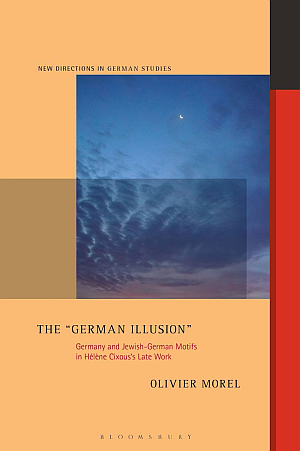
New York: Bloomsbury Academic, 2023. ISBN: 9798765107379
Reviewed by Regina Igel1
Before embarking on the journey of writing this essay in book form, Mr. Morel, a French American filmmaker, university professor, and writer created the documentary "Ever Rêve Hélène Cixous" that featured the Algerian French writer and playwright Hélène Cixous. It portrays her multifaceted roles as a feminist activist, university professor, novelist, philosopher, literary critic, playwright, and poet. The documentary captures her lectures, interviews, strolls, travels, memories, and engaging conversations with him. The book, The “German Illusion” – Germany and Jewish-German Motifs in Hélène Cixous’s Late Work, serves as either a companion piece to the documentary or an extension of its narrative. Before diving into the book by Olivier Morel, it is suggested to read Cixous’s Osnabrück Station to Jerusalem: A Memoir2 as the author incorporates many passages from that book into his very well-done scrutiny of its many parts.
Most of the analysis of Cixous’s writing contained in The “German Illusion” shows citations and excerpts from her later works that emphasize Germany, its Jewish and non-Jewish citizens during the Holocaust period in particular. Additionally, the essayist mentions how Germany played a significant role in shaping Cixous’s upbringing in Oran, Algeria, where her parents relocated when Hitler initiated his political endeavors in 1933. Morel translates a statement by Cixous: “I am the result of more than one country of birth” (p.6).3 Her latest works, as focused on by Morel, concentrate on early stages of her life while in Algeria. Although Germany seeped into her home from her German mother, grandmother, and an aunt, thus, Cixous’s identity was shaped by two strong forces. According to one of Cixous's declarations, as quoted by Morel, Hélène stated that her upbringing involved living, in fact, in Oran and, in imagination, in Osnabrück while being cared for by the three German Jewish women throughout her childhood years. Once she confessed: “I always cherished Germany. However …” (p. 7).
Most of her maternal lineage relatives were murdered in the centers of death, except for Ève, her mother, who married Georges Cixous, an Algerian Jewish doctor with whom she moved to Oran fleeing the Nazis. Hélène was born in 1937 in that city. Tragically, Dr. Cixous succumbed to tuberculosis when Hélène was eleven years old.
About the two countries in her formative years, Morel states:
“The Algerian dimension of Cixous’s life and work has been well documented and studied within the broader field of postcolonial studies. . . . The German dimension, and precisely what Cixous calls the ‘Jewish-German odyssey’ of her family, has been much less explored. . . . Cixous had never truly confronted herself directly in writing with what I call a German and a Jewish-German ‘trope’ in her oeuvre. . . . Her writing of the ‘hématome,’ of her ‘bruise,’ is sublimated into a powerful poetic horizon, an odyssey with a ‘Germany’ that she has always cherished . . . However …” (p.7).
Hélène Cixous’s works may be complex, but they are not complicated. At first, a reader might tend to think that her writings are difficult to understand, mainly in her book that is almost entirely devoted to Osnabrück.4 It is because, perhaps, she deals with the spirits, the ghosts of her mother’s relatives who were hauled out from their residences and sent to death. A short dialogue between Cixous and her son exemplifies her natural approach to her decision of going to Osnabrück, which she did for the first time in 2015. In 2019, she returned there again in the company of Olivier Morel, who filmed her for the documentary already mentioned.
“Do you know anyone in Osnabrück? My son asks me.
“A crowd of dead people. People who are very much alive in books. They are waiting for me, I say.”5
The complexity of her wordings includes experimental writings, as noticed by Morel. For example: the opening lines in the book Osnabrück Station to Jerusalem, A Memoir, where sentences or paragraphs start with a low-case letter; many ending by commas; neologisms are created; poems are inserted in a page in prose; the isolated words or full paragraphs in German are enclosed within the French pages, whose translation to English is provided by Morel when quoting excerpts from such texts. Included in her experimental writings are visualizations of the horrors that dismembered Jewish families and fragmented their homes and possessions.
Accordingly, the city’s name appears in Morel’s book as “Part II” ‘Os, na, brück’ The capital of Memory (1933-1935)”, since, in the words of Cixous, the city “dis-membered” (p. 56), so it makes all sense that its name appears through disjointed syllables. The profile of that town before the war was “painted” by her grandmother, called Omi in several of Cixous’s books, as a good place to live. So much that she hesitated to move at the insistence of her daughter, Hélène’s mother, to Algeria. It was only in 1938, when Hitler closed all lands his army had invaded that she left, thanks to a French passport she held at the time. Omi brought with her a photo album containing pictures of many family members. With them, Cixous built up her land of ghosts, the family she never met personally but that she immortalized in her writings and lectures.
Many areas of the latest literary production by Cixous are covered by Morel in his book. Among them is the importance of stressing that in Osnabrück, her mother’s family received the only telephone in the town. Since nobody else had a phone at home, they didn’t use it, for its main purpose was to connect people. It might symbolize the isolation of the Jonas family, her mother’s family, as much as their isolation also in Oran. The latter was not only because the German ladies didn’t speak French, but also because of the anti-Semitic atmosphere spread out by the Muslim neighborhood. Later, Hélène would say that a common trait between the German and the Algerian cities was anti-Semitism. Morel also refers to Cixous’s admiration for Montaigne (1533-1592), to whom the creation of the “essay,” a literary genre not used until he started it, is attributed. Cixous planted her essays in the essayistic architecture created by the French philosopher.
All said and written, there is no passage of either book, Cixous’s Osnabrück Station . . . or Morel’s The “German Illusion” . . ., that states that Hélène Cixous was half Mizrahi and half Ashkenaz. She tends to identify herself as French Algerian. And Jewish. Nevertheless, it is a pleasure, and a challenge to read Cixous’s works and Morel’s analytic approach to many of them.
1 Regina Igel is Professor Emerita, Department of Spanish and Portuguese, University of Maryland, College Park, MD.
2 Hélène Cixous, translated by Peggy Kamuf, Osnabrück Station to Jerusalem: A Memoir, New York: Fordham University Press, 2020.
3 Quoted from Cécile Wajsbrot, Une autobiographie allemande, Paris: Christian Bourgois Editions, 2016.
4 Hélène Cixous, Osnabrück Station to Jerusalem, A Memoir, New York: Fordham University Press, 2020.
5 Ibid, p. 7.