
Sleeping with the SS (2025)
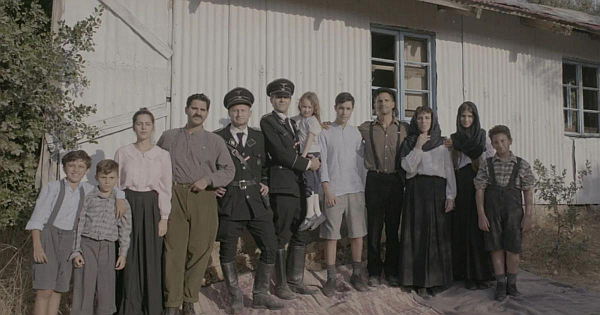
Directed by Rami Kimchi
60 minutes, Hebrew with Greek, German, and English subtitles
Close Encounters of the Nazi Kind
Reviewed by Lyn Julius1
It was forty years ago that the Greek-born uncle of Rami Kimchi, then a neophyte Israeli film director, drew him aside; he had a brilliant idea for a film. Kimchi, who is also a cultural historian and academic, had other fish to fry, among them was the award-winning Night of Fools, a film he made in 2017 about the Jewish-dominated resistance in wartime Algeria.
It was only in the last ten years that Kimchi set about exploring his uncle's idea. By the time the film was released, his sixth and most costly to-date, his uncle was dead. In addition, most of the people he interviewed had not lived long enough to see the project completed.
Sleeping with the SS was finally launched at the Tel Aviv Cinematèque in January 2025. Notwithstanding its titillating title, it is a docu-drama, combining historical facts and dramatic reconstructions. It tells the true story of Ziko, a young orphan from Salonika, in an engaging way. Salonika was one of the most Jewish cities in the world until eighty percent of the community was deported to Auschwitz in March 1943. Ziko was one of the lucky ones; he was able to survive the war in a remote farm in the hills above the city of Volos along with two Jewish families with children of similar ages.
The children enjoy a rural idyll until a notorious Nazi SS Unit turns up. They were intent on fighting the Communist partisans hiding in the mountains of the Pelion peninsula and rounding up any Jews they could find for deportation. The Nazis demand to be billeted with the Jews in their farmhouse. Fearful of discovery, the Jews disguise themselves as Greek shepherds. They have to answer to Greek, not Jewish names. Ziko, who spoke only Ladino, must pretend to be deaf and dumb.
As in any documentary an academic historian, Ran Bar Shalom, fills in the historical context, but the film takes an original approach. It moves between actual survivors' testimonies and dramatic encounters between the Nazis and their Jewish hosts performed by actors. The narration alternates between Hebrew, Greek, German, and English. Using a degree of artistic license, Kimchi builds the suspense; there are moments when the Jews' cover is almost blown. Did someone utter a Ladino swearword? Isn’t that clarinet a Jewish instrument? Well lubricated by ouzo, the men, nevertheless, even manage to have a party and the two groups part on good terms. Nazis and Jews take photos together and even exchange addresses. Once the war is over, almost all the Jews immigrate to Israel. They have children and lead fulfilled lives. But Kimchi can find no trace of the Nazis.
Few films focus on the impact of the Holocaust on Greek Jews. Fewer still document what happened in the Greek countryside. The Jews in the farmhouse survived because the partisans protected them, whereas local Greeks in Salonika, for instance, collaborated with the Nazis. Jews were also hard to identify, being physically indistinguishable from Greeks, whereas they stuck out like a sore thumb among Slavs and Poles. This miraculous story, says Kimchi, could never have taken place in Eastern Europe.
Sleeping with the SS has found acclaim in Jerusalem and Tel Aviv. It has had a successful European premiere in London, organized by Harif, the UK Association of Jews from the Middle East and North Africa. Since 7 October, however, Kimchi has found few interested parties outside Israel willing to show his film. “In any case,” he reflects ruefully, "only pro-Palestinian Israeli films get screened in Europe.”
More's the pity because Holocaust education has neglected the experiences of Sephardi victims in Greece and the Balkans, as Rami Kimchi did himself when he almost failed to listen to his own uncle's story. ‘Sleeping with the SS manages to capture precious testimonies in the nick of time for the benefit of generations to come.
1 The British-born daughter of Iraqi-Jewish refugees, Lyn Julius is a journalist, speaker, blogger, and founder of Harif, the U.K. association of Jews from the Middle East and North Africa. Her work has appeared in JNS News, Jerusalem Post, Times of Israel, Jewish Chronicle, Fathom, The Article, The Guardian, etc. Her book Uprooted: How 3,000 Years of Jewish Civilisation in the Arab world vanished overnight was published in 2018 (Vallentine Mitchell) and has been translated into Norwegian, Portuguese and Arabic, a Hebrew translation is in progress.