
Francisco Bethencourt
Strangers Within
The Rise and Fall of the New Christian Trading Elite
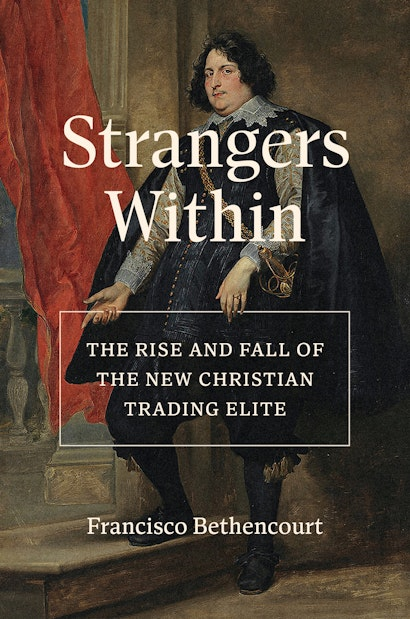
Princeton: Princeton University Press, 2024, ISBN: 9780691209913
Reviewed by Seth Kamil1
Describing Strangers Within as “epic” is a notable understatement on multiple levels. It is a sweeping study of the Jewish merchants, traders, and financiers of the Iberian Peninsula whose very past was systematically obscured for survival. Focusing on the some 260,000 Jews of Spain and Portugal who were forced into conversion to Christianity and became “New Christians” between 1391 and 1497, Bethencourt approaches the task by carefully outlining his framework, methodology, and other central components of his study in a delineated introduction. His carefully explained decision to treat the New Christians as an ethnic group and not a religious or nationalistic entity is compelling and a valuable addition to the interpretation of Jewish history of the period.
The work is divided into four distinct, chronological, sections. The first section, Transitions (1490s-1540s) sets the historical framework for understanding the Jewish peoples before and during the mass conversion to Christianity. Bethencourt demonstrates his decision to focus upon the elite merchants as their hold on the expansive trade networks and their wealth minimized the impact, and even resisted the discriminatory edicts of the Iberian crowns and Rome. While the elites are the primary focus, in part because of available archival records, the role of lesser merchants is not neglected.
As Spain and Portugal joined in the 1580s and expanded their colonial and exchange influence, so did the role of the New Christian elite traders. This is the half century explored in the in second section, Expansion (1550’s-1600s). The increased trading opportunities that emerged during these decades were global in scale and the New Christians were central to the expansion despite the corresponding spread of the Inquisition and discrimination. Strangers Within combines carefully outlined and annotated discussion of the move into West Africa, Asia, and Spanish America, with the examination of central individual figures. The intricate family histories are aided by the addition of genealogical tables imbedded in the text. For example, four generations of the Caldeira family are outlined. Family scion and New Christian Manuel Calderia’s responsibilities, in the year 1556 alone, included serving as a banker to Philip II; obtaining a contract to import enslaved workers to Spanish America; and overseeing a lucrative agreement for shipbuilding in Flanders. Simultaneously, there was an increase in restrictions and persecutions of New Christians. By combining the previous historiography of the era with the examination of individual families, Bethencourt offers a fresh reexamination of the familial and business connective tissue that had appeared to have been unexplored or explained as broken ties (pp. 195-196). The depth and breadth of the New Christians involvement in both serving the crown and personal successes is remarkable. Their role in the slave trade is an important and well-contextualized inclusion.
Another notable assessment is the evaluation of the diversity within the communities. New Christians were far from a monolithic ethnic group. Notable tensions and rifts became apparent following the efforts to secure the general pardon of 1604. These fractures and, at times, complicated and contrary results are addressed in the third section, Resistance (1600s-1640s). This period also saw the simultaneous growth of European colonialism and exchange along with a corresponding increase in opportunity for the New Christian elite to “reconnect” with the Jewish communities in places with fewer religious restrictions (p. 207). The most compelling chapter, for me, was Chapter Twelve: Identities. The New Christians who maintained a semblance of Jewishness, often through memory and tradition, found themselves doing so in disparate ways. The opening of Protestant Europe created a different set of identity opportunities than within the Ottoman Empire.
While the New Christian merchants were exploring new markets and avenues of identity, dramatic changes were taking place within the global Portuguese economic and political world. The metaphor of one hand reaching out in welcome (old world centers) while the other hand is curled in a fist (new world centers) came to mind. The Portuguese separation from Spain and corresponding Dutch-Portuguese War impacted both Europe and across the seas. The expulsion from Japan in 1639, where Bethencourt notes New Christian merchants controlled upwards of forty-five percent of the trade routes was then coupled with the 1661 Treaty of The Hague that ceded Brazil from the tolerant Dutch to the Portuguese, who in turn, extended the Inquisition.
These mid-seventeenth century rapid domestic and global changes, notably the return and expansion of the Inquisition, along with an increase in competing non-Iberian merchants, form the final section of the book aptly named Decline (1650s-1770s). Having eased the reader into incorporating the expansion of New Christian movement beyond the Iberian Peninsula, we are immediately reminded of the overarching physical and psychological toll brought on by the persecution of the Inquisition both at home and abroad. The stories of individual families and the decisions to migrate, appease, or attest compliments the detailed institutional history of the Inquisition and presents a nuanced understanding of the ongoing myriads of challenges faced. The two hundred plus years of Iberian New Christian survival and success is connected to the emergence of Sephardic trade communities in Amsterdam, London, and beyond.
Section Four highlights several opportunities for future research and exploration, but also a reminder that Strangers Within is limited to the Iberian experience. The book begins with a map of the New Christian and Sephardic centers of the sixteenth to eighteenth centuries opposite page one. Yet most of the colonial towns or cities, especially in the Atlantic World receive scant to no mention. Many of the family names mentioned, Carvalho, Mesquita, Morais, Nunes, and Ulhoa, to name a few, continued as successful merchants and traders in the colonial West Indies and North America. The Carvalho-Nunes family is a useful example. Chaves de Carvalho, an elite trader is highlighted for his diverse Brazil trade and lending money to a leadership of the colony. Ensnared by the Inquisition in 1706, his property was seized and he was spared exile due to illness. The description concludes noting “we know that he was alive in 1712, when his son, Francisco Carvalho Chaves, was detained by the Inquisition” (p. 431). Is it possible that the father and son were related and economically engaged with the Nunes Carvalho family that can be traced from the Iberian Peninsula to Amsterdam, London, Barbados, Charleston, and New York? Or could the elite Mesquita merchant family be the same Barbados family who founded the 1680s cemetery of the Spanish and Portuguese Synagogue in New York? Perhaps they were no longer financiers to kings or overseeing the building of a fleet, but they were certainly successful and not just surviving, they thrived.
Addressing the New Christians as an ethnic group rather than a religious community is a refreshing approach to the subject and, in many ways, elevates the work beyond the questions of Jewishness. Rather than deciphering what it meant if a secretly family lit Friday night candles or ate pork and how over the course of generations and centuries attempted to interpret symbolism, this is useful new approach to the history of the people and period. This interpretation is problematized, however, by the widespread geographic and cultural diversity within the New Christian communities. How to differentiate between those who embraced Iberian Christianity from those who were identified as part of a hidden, or Converso, entity? Bethencourt provided new insight to my thinking about how the individual and family units of New Christians and Sephardic Jewish merchants and traders lived in the colonial West Indies prior to the formation of traditional communities. These mid-seventeenth century migrants to Barbados, Curacao, New Amsterdam, and elsewhere were not living under the yoke of the Inquisition. Bethencourt answered many questions that emerged while reading his work. At the same time, two questions for a future generation of scholars worthy of research emerged: How did the Iberian Jewish converts, often isolated through threat of expulsion, torture, or death, maintain Jewishness? Or did they evolve into something new?
The Times Literary Supplement named Strangers Within a “Best Book of the Year”2 and the award is well deserved. It is a complex and nuanced history that engages innovative interpretive methods to bring a narrative of epic scale to scholars and readers. At the same time, numerous avenues of future research are noted that open subtle doors for pursuit by future historians.
1 Seth Kamil received his PhD in History from Columbia University in 2024. His thesis “The Inter-Colonial Provisioning of Barbados from New York and New Jersey, 1650-1765” in part addresses the Sephardic merchant communities of the period. Seth is the co-founder and president of Big Onion Walking Tours.
2 On the author’s website: https://www.kcl.ac.uk/people/francisco-bethencourt.