
Anastasios Karababas Translated by Lina Molokotos-Liederman
In the Footsteps of the Jews of Greece
From Ancient Times to the Present Day
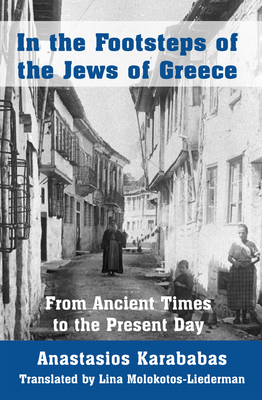
London: Vallentine Mitchell, 2024, ISBN:
978-1803710433
[Original Greek publication, Athens: Psychogios, 2022]
Reviewed by Christina Karageorgou-Bastea1
The book offers a panoramic view of Jewish presence within today’s Greece, with emphasis on the period of nineteenth to twenty-first century. It is divided into ten chapters. The main corpus of the history is contained in chapters two to eight, where a succinct history of Jewish communities in the different geographical regions is told. Particular importance is given in the book to the communities of Thessaloniki (chapter two) and that of Athens (chapter eight), the historically most vibrant community of Jews until the Holocaust and the one most active today, respectively. Chapters nine and ten briefly deal with the memory of the Holocaust and the still existing prejudice against Jews, respectively. This corpus of information is enclosed within a brief introduction, where the aims of the book are exposed and an epilogue that emphasizes the forgetfulness of the Greek Orthodox population regarding the contributions of Greek Jews to shaping the country’s modern character as well as the community’s struggle for recognition and achievement, of visibility as an active and appreciated part of the nation. Two lengthy sections, the notes to each chapter and the bibliography at the end of the book bespeak the range of research that the author undertook. The volume contains two sections of illustrations, with images of members of the Jewish communities in different moments and places of Greece, as well as of buildings, monuments, and memorabilia.
Place organizes the exposition for each chapter from two to eight, focusing either on a city in the case of Salonica (chapter 2) and Athens (chapter 8), or on geographical regions related to each other by the interwoven lives of Jewish communities established across their cities, towns, and villages. Such are the cases of Macedonia and Thrace (chapter 3), Epirus, Euboea, Central Greece, and Peloponnese (chapter 4); Thessaly (chapter 5); Ionian Islands (chapter 6); Crete, Dodecanese, and Cyclades (chapter 7). The narrator follows a chronological order. He starts with the history of the Romaniotes, namely, of the Jews that have lived in the geographical space of today’s Greece probably since the 6th century B.C.E., and who have had a continued presence throughout the ancient and Byzantine times. Karababas then refers to the arrival of the Sephardim from Spain and Ashkenazim from Eastern Europe in the early Ottoman occupation of the Hellenic region. He then focuses on the pre-Holocaust, independent Greek Jewish communities of the nineteenth and early twentieth centuries; and finally, the history of the Shoah survivors in Greece and the Hellenic-Jewish diaspora, mainly in Israel and the United States.
The author draws his information from travelers’ narrations, published archival material, and periodical and bibliographical sources, while for the most recent times he incorporates testimonies from survivors. For each region, the reader finds information on the relationships between the Jewish, the Greek Orthodox, and at times other religious and ethnic communities, the social and professional life of the Jewish population, the educational and cultural achievements of the communities, the crucial historical events that give a sense of history unfolding. Karababas allots the final parts of chapters two to eight to the account of how life was exactly before and after the Second World War. He makes a point of narrating how the members of the different communities were deported and killed, betrayed, or in few exceptional cases, such as that of Volos, a city in Central Greece, and of the Ionian Island of Zakynthos, saved by their fellow Greeks. He always includes some of the names and ages of the deportees. Other important elements that Karababas consistently refers to are how some members of the different communities escaped to the mountains to join the left-wing resistance, and what the fate of the survivors and their livelihood were after returning from the camps, up until the most recent events in Greek-Jewish life.
Of particular interest are the detailed and extensive comments on advances in original research, which Karababas includes in chapter nine, “Historiography and Memory of the Holocaust in Greece since 1945.” The author points to the fact that Jewish presence in Greece has received attention by the Greek scientific community, especially in the past thirty years. In the last chapter, the author, following Andreas Pantazopoulos, proposes the term “judeophobia” for what characterizes social, cultural, religious, and ideological prejudices towards Jews, in Greece today. This is an attitude that has elements of anti-Semitism, anti-Judaism, and anti-Zionism, and is enacted frequently in the Greek public sphere. Karababas brings to the fore events in which prominent figures of the entire ideological spectrum of the Greek polity and Orthodox Church have used hatred speech and lies against the Jews in the past. On the other hand, the author also gives space to information on expressions of respect, camaraderie, and recognition of the Jewish community by the rest of Greek society.
While the book does not posit or answer historical, social, cultural, and/or anthropological issues, the author has the gift of clear exposition. The work is based on understandable organizing principles that help the reader follow different narrative threads but also allow for the search of targeted information on historical periods and geographical areas. Because of the inclusion of extensive bibliography, Karababas addresses those interested in furthering their knowledge on the subject. At the same time, the testimonial material he incorporates and the human stories he narrates have the capacity of impacting affectively, an element of paramount importance in the amplification of cultural competence, through empathy, for non-Jewish readers, in Greece, and through Lina Molokotos-Liederman’s translation for an English-speaking audience, interested in the presence of Jews in this Mediterranean country.
1 Christina Karageorgou-Bastea is Professor of Hispanic Literature at Vanderbilt University. She specializes in modern poetry from Mexico and Spain. She is the author of Beyond Intimacy. Radical Proximity and Justice in Three Mexican Poets (McGill-Queen’s University Press, 2023), Creación y destrucción del Imperio en Tirano Banderas de Vale-Inclán (Ediciones Clásicas/Minnesota University Press, 2013), and Arquitectónica de voces: Federico García Lorca y el Poema del cante jondo (El Colegio de México, 2008). She has written extensively on Jewish Mexican authors Myriam Moscona and Gloria Gervitz. At the moment she is preparing a monograph on human rights and literature in Greece and Spain.