
Brahim El Guabli and Mostafa Hussein
Remembering Jews in Maghrebi and
Middle Eastern Media
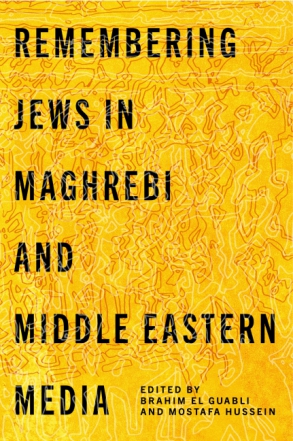
University Park, PA: The Penn State University Press, 2024, ISBN: 978-027109-7558
Reviewed by Ronnie Malley1
The resurgence of Jewish memory in Maghreb (North African) and Middle Eastern cultural production over the last thirty years stands as a central theme in the collection Remembering Jews in Maghrebi and Middle Eastern Media by Brahim El Guabli and Mostafa Hussein. The volume contains a forward by Lital Levy, associate professor of comparative literature at Princeton University, an introduction by the editors, and nine chapters by authors reflecting on remembrance and unreconciled loss of Jews in communities throughout the Middle East and North Africa. The book—the culmination of a project that began with a two-day workshop convened by Brahim El Guabli under the mentorship of Professor Ella Shohat in May 2019 at the Williams College Oakley Humanities Center in Williamstown, Massachusetts— investigates the significance of Jewish memory, not only as a recollection of cohabitation but as a lens through which contemporary societies can reassess pluralism, tolerance, and shared histories. The complex relationships between Jews, Christians, and Muslims in the region, while imperfect, were characterized by centuries of legal, social, and cultural overlap—practices that allowed these communities to negotiate existence despite the imbalance between majority and minority populations (pp. 2-3).
The collection of essays explores the rich "convivance," a term that denotes deeply intertwined cultural and linguistic spaces, between Jews and Muslims in the Maghreb and Middle East. This coexistence was dramatically severed by nineteenth-century European colonial interventions that altered the legal and social fabric, particularly through institutions such as the Alliance Israélite Universelle (AIU) founded in Paris in 1860. Legislative shifts such as the Crémieux Decree granting Algerian Jews French citizenship in 1870 further drove wedges between communities, sowing division in a politically volatile colonial environment (pp. 3-6). Contrary to common assumptions, these ruptures were not always products of Zionism, but also of broader European colonial ambitions to manipulate regional power structures under the guise of minority rights advocacy.
In the Introduction, El Guabli and Hussein argue that a productive understanding of Jewish-Muslim separation emerges only by considering a constellation of historical forces: the founding of Israel in 1948, colonialism, Zionism, and the policies of postcolonial regimes (p. 8). These changes resonate not only as loss for Jewish communities but also as a diminishment of the broader societies' cultural and demographic tapestry, impacting democracy and pluralism (p. 15). Against both nostalgia and polemic, Remembering Jews in Maghrebi and Middle Eastern Media calls for, “attention to a more productive theorization of what literature and film bring to the field of Jewish studies from the perspective of Maghrebi and Middle Eastern studies,”(p. 17).
Brahim El Guabli’s chapter, “Generative Absence and Mnemonic Literature in Morocco,” inaugurates the volume’s focus on generative loss, using the case of Morocco to argue that Jewish departure catalyzed a considerable body of 'mnemonic literature' (al-kitāba al-istidhkāriyya), which considers Jewish-Muslim coexistence through the prism of generational memory (p. 26). El Guabli highlights a range of novels and films such as Kamal Hachkar’s documentary Tinghir-Jerusalem: Echoes from Mellah (2013), tracing Amazigh Jewish-Muslim relationships in Morocco, Majid Shokor’s On the Banks of the Tigris (2015) exploring Iraqi Jewish musical contributions, and Safinez Bousbia’s El Gusto (2011) a musical documentary of an Algerian band. Popular television series like Egypt’s Ḥarat al-Yahud and the UAE’s Um Hārūn also continue this mnemonic project.
Further analysis of prominent literary works of the region—Yawmiyyāt muslim yahūdi (Diary of a Jewish-Muslim; Kamal Ruḥayyim, 2014), Fi qalbī unthā ‘ibriyya (Hebrew woman in my heart; Khawla Ḥamdi, 2013), and Majnūn laylā al-yahūdiyya (Madman of the Jewish Layla; Ḥamad Ḥamīd al-Rāshīdī, 2016)—reveals not only what was lost but also the creative ways in which absence begets narrative and societal inquiry. El Guabli’s engagement with Abdelkébir Khatibi’s theoretical formulations sharpens this focus, highlighting the void left by Jewish departures as a stimulus for new intellectual currents rather than just a site of mourning. He distinguishes his chapter by stepping outside propagandistic literary tropes and instead, elevating voices of a new generation of creators using media to grapple with meaningful memory and mutual pasts.
Abdelkader Aoudjit’s essay, “On the Wrong Side of History: the Jews in Algerian Literature,” begins by tracing the long and multilayered presence of Jews in Algeria arriving in waves from the ninth century BCE through the fifteenth century CE, and the subsequent modern unraveling of the long history of coexistence. Through novels such as La Dépossession (The dispossession; Rachid Boudjedra, 2017), Al-Bayt al-andalusi (The Andalusian house; Waciny Laredj, 2011), Le Foehn, ou, La Preuve par Neuf (The Foen, or Casting out nines; Mouloud Mammeri, 1957), Al-Zilzal (The Earthquake; Tahar Ouettar, 1974), and Le Dernier juif de Tamentit (The last Jew of Tamentit; Amin Zaoui, 2012), Algerian authors evoke nostalgia and mourn the ruptured interfaith mosaic that entwined Jews, Arabs, and the native Amazigh. Yet, this remembrance is also accompanied by a fraught narrative where, under colonial and wartime duress, Jews were often framed as betrayers by accepting French protection and citizenship at the expense of local solidarity during seismic events such as World War II and the 1954 Algerian War of Independence (p. 49). Literature in this context becomes both courtroom and confessional for the complex politics of belonging and identity.
Mostafa Hussein’s chapter, “Literary Representations of Jews in Twenty-First Century Arabic Literature in Egypt,” offers an account of Egypt’s lingering Jewish memory. The essay seeks to provide a, “nuanced understanding of the use of Jewish characters in novels to explore Jewish people‘s roles in twenty-first century Egyptian society and culture,” adding that, “Jews are almost absent from modern Egyptian space, yet they have never left Egypt’s collective memory” (p. 73). Major ruptures, such as the founding of Israel in 1948, the 1956 Suez Crisis, and a subsequent exodus of Jews, define Egypt’s modern narrative of such loss and absence.
Hussein highlights literary works that attempt to recover the lost pluralism of Egyptian society, including Ḥadd Al-ghawayah (The edge of error; ‘Amr ‘Afia, 2004), Tuyur Al-‘anbar (Birds of ambergris; Ibrāhīm ‘Abdelmegid, 2000), and Yahūd Al-iskandariyyah (Jews of Alexandria; Mostafa Nasr, 2016). These narratives capture shared urban spaces, cultural syncretism, and the complexity of interfaith relationships, frequently casting the latter as once normal, but later depicted as taboo in literature from 1948 through the Camp David Accords (1978-1979). Throughout, Egyptian novels confront the paradoxical situation of a virtually absent Jewish population that haunts the collective memory of a cosmopolitan past and identity of modern Egypt (p. 88).
Iskandar Ahmad Abdalla’s chapter, “Al-Zaman al-Gamil Refigured: Jews and Re-Narration of the Nation on Egyptian TV,” investigates al-zaman al-gamil (the beautiful age) and its re-narration in the groundbreaking Egyptian television series Ḥarat Al-Yahūd (The Jewish Quarter). Through this nostalgic lens, Abdalla foregrounds moments of national unity, religious plurality, and normalized Jewish-Muslim-Christian relations where neighbors, friends, and lovers mingled without rigid boundaries (p. 95). The television series is less about recapturing a lost golden age and more about critiquing current modes of representation. Abdalla notes that the endeavor signals a wider search for alternatives to sectarian narratives and a longing to rediscover Egyptian cosmopolitanism through popular culture (p. 109).
Sarah Irving’s essay, “Death, Burial, and Loss in Ali al-Muqri’s Al-Yahūdi al-ḥali (The Handsome Jew)” is a reading of al-Muqri’s novel, which focuses on a tragic interfaith romance set in seventeenth-eighteenth century Yemen. The protagonists, a Jewish boy and a Muslim girl, cross social and religious boundaries with high personal cost. Irving employs the concept of postcolonial nostalgia, highlighting how literary representations of Jewish-Muslim romances serve as a language to approach painful questions about ethnicity, religion, and exclusion (pp. 113-114). Death and burial rituals become metaphors for cultural and social boundaries and serve as narrative devices to explore both the historical centrality of Jews in Yemeni society and the enduring complexity of assimilation, identity, and belonging (p. 119).
The overarching themes that Irving extrapolates portray a culturally interconnected society, but religiously rigid and separate. The common human theme of tragic love symbolically offers a window to glimpse opposing communities, paradoxically, with similar cultural interpretations that exist within their respective faiths. Irving’s account of Al-Muqri’s work highlights the nuanced complexities of former Jewish and Muslim relations in Yemeni society with descriptions of cultural and religious practices, approaches to dealing with societal gender dynamics, and the ostracizing of lovers from both of their respective communities in life and in death.
Stephanie Kraver’s chapter, “Bearing Witness and Resurrecting Kurdish-Arab-Jewish Memory in Madha ‘an al-sayyida al-yahūdiyya Rāḥīl?” explores Salim Barakat’s 2019 novel, Madha ‘an al-sayyida al-yahūdiyya Rāḥīl (What about Rachel, the Jewish lady?), set in the Kurdish-Arab-Jewish-Armenian crossroads of Qamishli, a multiethnic town in northern Syria during the mid-twentieth century and the rise of the Ba’ath party. The novel reconstructs the multidirectional memory of a heterogeneous city whose character was fundamentally altered by the 1967 war and the exodus of Jews (pp. 137, 142). Kraver highlights the role of language in shaping social and ethnic identities, emphasizing the loss of Jewish and other minority traditions as a source of both nostalgia and essential critique for understanding Syria’s present (pp. 147-149).
Ilker Hepkaner’s chapter, “Documenting and Debating Turkey’s Loss,” investigates the representation of Turkish Jewish life through the film documentaries Las Ultimas Palavras (The last words; Rita Ender, 2015) and Hermana (Sister; Enver Arcak, 2016). Both documentaries, though differently produced and distributed, offer in-depth explorations of Sephardic communities, the persistence (and decline) of Judeo-Spanish language, and attempts to document living traditions (p. 154). Hebkaner asserts that Ender’s and Arcak’s works stand as pioneering efforts to write Jewish experience into Turkish historical memory at a time when such voices are at risk of being forgotten.
Nadia Sabri’s essay, “Exile in a Contemporary Artistic Project in Morocco: Jewish Memories in Form and Concrete Territories,” shifts focus to the visual arts with her analysis of the 2016 exhibition Exiles: A Dialogue with the Museum of Moroccan Judaism in Casablanca. The exhibit’s fragmented narratives and collaborative approach evoke the nature of memory and inclusion from multiple perspectives, suggesting that artistic projects can surface stories and histories that have been marginalized in literary and social discourse (p. 171). The installations act as both historical interventions and forms of healing, offering new methods to remember and imagine Jewish pasts in Morocco (p. 187).
Lior B. Sternfeld’s chapter, “Narrating the Homeland from Exile: Iranian Jewish Writers, Writing on their Departure, Identity, and Longing,” provides a rare perspective on Iranian Jewish experience, analyzing memoirs such as Dorit Rabinyan’s Persian Brides (1998), Roya Hakakian’s Journey from the Land of No: A Girlhood Caught in Revolutionary Iran (2004), and Jaqueline Saper’s From Miniskirt to Hijab: A Girl in Revolutionary Iran (2019). Despite Iran’s sizable Jewish population, representation remains sparse and largely confined to Jewish authors themselves. Sternfeld argues that inclusion and trauma unite the Iranian Jewish and broader experience of Iranians, as loss and mourning under various political regimes become shared narratives across faiths (p. 207). The genre of Iranian Jewish memoir thus assumes a crucial role in illuminating the possibilities and limits of belonging during eras of revolutionary change.
Although Lital Levy’s foreword and occasional remarks by several contributors briefly highlight aspects of Iraqi Jewish media and cultural production, the editors acknowledge that the volume lacks a commensurate comprehensive exploration of Jewish life in Iraq. Nevertheless, Remembering Jews in Maghrebi and Middle Eastern Media provides an essential catalog of media and analysis of the interplay between loss, memory, and creative work within the broader Middle East and North Africa.
1 Ronnie Malley is a musician, producer, and educator whose professional work and academic research focuses on the Middle East, North Africa, South Asia, and medieval Spain. He holds a BA in Global Music Studies from DePaul University and an MA in Languages (Arabic and Hebrew) from University of Chicago, where he is currently a third-year PhD student in Ethnomusicology.