
Aomar Boum, illustrated by Nadjib Berber
Undesirables
A Holocaust Journey to North Africa
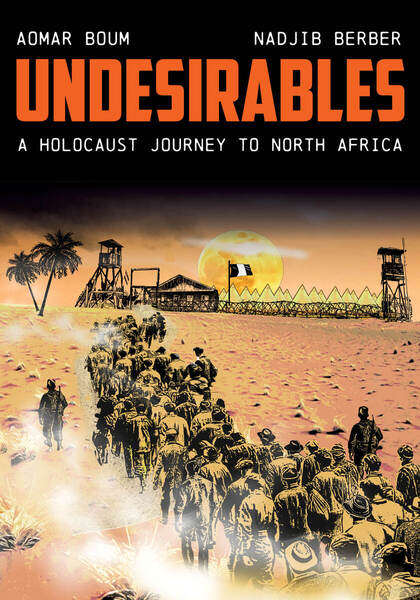
Stanford: Stanford University Press, 2023, ISBN: 9781503632912
Reviewed by Rachel Simon1
The Undesirables enables the common reader to realize that the Holocaust was not limited to Europe but took place also in North Africa. Furthermore, readers don't just get basic information but can actually view prominent and fictional figures as well as locations, actions, and documents. In order to make this knowledge accessible to the common reader, a historical anthropologist and an artist, both of North African origin, collaborated in creating a graphic novel. Aomar Boum, who was born in Morocco, is a professor at the University of California, Los Angeles and published scholarly works extensively on the Holocaust in North Africa and on Jewish-Muslim relations there. Nadjib Berber, who was born in Algeria, is a comic artist who was active in Algeria, Tunisia, France, and the USA. Based on extensive archival research, the novel presents actual figures, like politicians, scholars, and community leaders, but the story itself centers on hybrid fictional figures of various nationalities, religions, ethnic origins, and occupations all of whom were composed from contemporary sources and were considered “undesirables” by the German and French regimes during the Second World War. Thus, while one reads the historical background, conversations among the protagonists and their thoughts, they and the locations they inhabited are also actually visible in minute detail.
The novel's main character is Hans Frank, a non-observant German Jew from Berlin who is the son of a Sephardi leftist mother and an observant, patriotic Ashkenazi father, the owner of a book shop who had served with distinction in the German army during the First World War. By the time the story starts, the parents are divorced and the mother is back in Spain while Hans is a journalist in a progressive German newspaper. He becomes aware of the rise of the Nazi Party and the danger it might bring to Jews and German liberals, though his father does not feel threatened and believes that this is just a temporary episode. As part of his journalistic investigations, Hans learns about the International League Against Antisemitism (LICA) and its leaders. As the story progresses, one reads and sees the growing power of the Nazi Party, culminating in the ride over the office of the newspaper Hans works in, the arrests of its editor and several reporters as well as of Hans' father. Meanwhile, Hans himself is warned that he might be arrested; he hides safely in a working class neighborhood of Berlin and then escapes to Paris.
While in Paris, he meets LICA members, including an Algerian Jew who escaped his country because of the increased Antisemitism in Algeria initiated by its European settlers. As Antisemitism rises in France, Hans becomes aware of Jewish-Muslim cooperation and the positive attitude of the Moroccan Sultan toward the Jews. Due to his mother's illness, Hans moves to Spain and gets first-hand impressions of the Spanish Civil War and the growing threat of Fascism, especially as Germany's relations with Spain and Italy strengthen.
Following the German invasion of Poland, Hans decides to join the French Foreign Legion and moves to Algeria where he is trained and then participates in the fighting in Norway. During this time he meets additional characters, each representing different population segments which the French regime regards as “undesirables” as a result of their ethnic background and political views. After France is occupied by Germany, Hans is demobilized; as a German Jew is sent to a labor camp in the Algerian Sahara where the internees are constructing a segment of the Trans-Saharan Railway (which was never completed) aimed to tie together the French Empire connecting Sub-Saharan Africa, West Africa, and North Africa. In words and images, including maps depicting the camps in the Sahara and French West Africa, the novel presents the hard life in the camp, the harsh attitude of its commanders, and the friendly relations among the internees. Hans also meets the rabbi of the nearby village and learns of the lengthy friendly Jewish-Muslim relations there. Due to demands for better living conditions made by Hans and other internees, he is transferred to another camp, where the living and work conditions are even harsher culminating in putting bound individuals in open coffins facing the hot Saharan sun for hours and days, with several people not surviving the torture and dying. Eventually Hans succeeds to escape to Morocco, and eventually welcomes the Allies who land and liberate North Africa.
A lot of known and lesser known historical facts are brought to life through this graphic novel. It is accurate and very detailed, highlighting several events and processes regarding the Second World War in Europe and North Africa. It enables the reader to follow the stages of the growing threat of Nazism and Fascism and how various groups and individuals reacted to it. The novel's climax is the situation in North Africa during the Second World War which is commonly known less than events in Europe, focusing on the cruelty of the authorities and their collaborators toward the “undesirables.” The novel also demonstrates the cooperation of the various ethnic, religious, and political “undesirables.” How the mutual support of the latter helped them, in most cases, to survive is shown. While the situation has been examined in numerous scholarly publications, this graphic novel makes it accessible to the common reader, and the detailed and accurate illustrations are a key factor in making the horror concrete. Indeed, the novel should be read slowly in order to fully observe, absorb, and appreciate the illustrations.
1 Rachel Simon, Ph.D. (Hebrew University) is an independent scholar doing research on the Jews of Libya, the Middle East, and North Africa with special reference to women, Zionism, youth, education, printing, publishing, and journalism. Her numerous publications include Change Within Tradition among Jewish Women in Libya (Seattle: University of Washington Press, 1992) and Cultural, Social, and Political Perceptions in the Folktales of Libyan Jews: Life in a Tale (Newcastle upon Tyne: Cambridge Scholars Publishing, 2024).