
El Niño de La Guardia
The Making of a Libel and Its Survival
Part I
By Leah Bonnín1
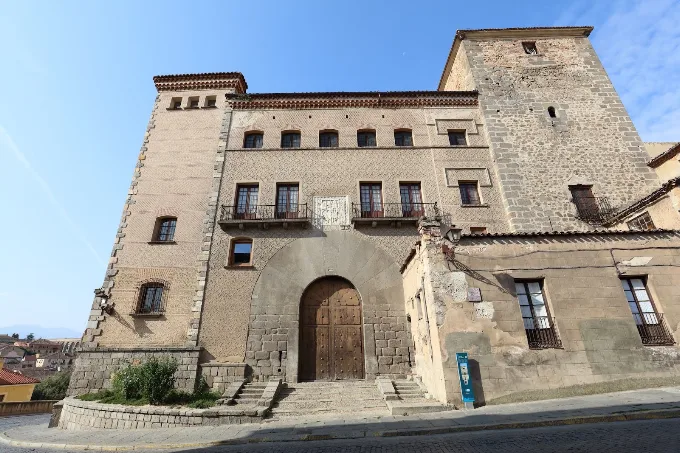
House of Marqueses of Lozoya in Segovia
Used as an Inquisition tribunal and prison, 1486-94.
Photo by Riota Suzuki
The Arrest
In fifteenth-century Castile, roads were especially threatening spaces for some people. One morning in early June 1490, on his way back from a pilgrimage at Santiago de Compostela to his home in La Guardia in the province of Toledo, a certain converso, a traveling wool carder by trade named Benito García, was arrested in an inn in the Leonese town of Astorga. Some drunkards who had stolen his saddlebags accused him of carrying consecrated hosts to perform sacrileges. Arrested by an employee of the Inquisition, he was immediately brought before the highest ecclesiastical authority of the city, Pedro de Villada, vicar of the diocese of Astorga.
Benito García was taken to Segovia where he was subjected to interrogation to make him confess. Faced with the refusal to plead guilty and ignoring the terrified declarations of innocence of the convert, the vicar ordered him to be whipped and tortured with water and the rack. This proved to be very effective. In a ‘confession’ made on June 6, 1490, Benito explained that “in belief and in practice” he had secretly returned to the Jewish religion when the Inquisition was established in Toledo in 1485. He had been encouraged by Juan de Ocaña and other converts from the same village and by some Jews with the surname Franco of the neighboring town of Tembleque.
When this information reached his ears, between June 16 and July 19, 1490, the inquisitor Fray Tomás de Torquemada ordered the arrest of Benito García's “accomplices.” The neighbors in La Guardia were: Juan de Ocaña, Alonso Franco, Lope Franco, García Franco, and Juan Franco, the Jewish shoemaker by trade, along with Yucé Franco of Tembleque, and Moshé Abenamías, a resident of Zamora.They were accused of unspecified crimes against the Catholic Church, without any evidence. They were all transferred to the prisons of Segovia. It is assumed that the arrests were due to the Inquisition’s need to ‘prove’ the existence of a conspiratorial network by which the Jews induced converts to Judaize and to relapse into Jewish practices.
Segovia
Why were they sent to Segovia if the main defendant Benito García and the rest of the prisoners belonged to the diocese of Toledo?
In the second half of the fifteenth century, Segovia, unlike other Castilian cities, still maintained the jurisdictional autonomy that Alfonso VI had granted it in the eleventh century when he promoted its repopulation. It was an important enclave on the migration route of cattle and shepherds from summer pastures to winter pastures and viceversa. Thanks to the trade in textile and cloth crafts, Segovia was one of the first commercial and artisan cities in Castile. It was also a center of religious, administrative, and political power. King Enrique IV, who had received it from his father, Juan II, showed great affection for the city as he demonstrated with various efforts: reforms in the fortress, collaboration in the choir and the cloister of the cathedral, and legal provisions that promoted the economic development of the city and its council and favored the establishment of important lineages.
The Infanta Isabel resided in Segovia. One day after the death of her half-brother Enrique IV, she left the fortress with her husband Fernando de Antequera and proclaimed herself “queen and possessor” of Castile. Isabel and Fernando, known as the Catholic Monarchs, tried to unite Aragon and Castille with religious cohesion, hence the importance of the Inquisition, led by Fray Tomás de Torquemada. Initially, it was to identify conversos who continued with the Jewish practices, to differentiate them from sincere converts, and to prevent Jews from having influence on recent converts.
The Inquisition
The court of the Inquisition was led by Fray Tomás de Torquemada who resided in Segovia. Torquemada was the prior of the Monastery of Santa Cruz la Real, the first of the monasteries of the Order of Preachers founded in Spain. As prior, Torquemada imposed strict Dominican rule; his "prudence, righteousness, and sanctity" greatly pleasing the king and queen, who made him their confessor. After a royal trip to Andalusia in 1477, when some clerics warned the king and queen that conversos were still practicing Jewish rites, he requested that Pope Sixtus IV grant a papal bull for the creation of the Tribunal of the Holy Office on November 1, 1478.
Over time, Fray Tomás de Torquemada became the lord of the Inquisition. At the request of Queen Isabel he was appointed Inquisitor General of Castile by Pope Sixtus IV in 1483. Shortly afterward, at the request of King Fernando and despite the opposition of the Aragonese institutions, Sixtus IV himself appointed him Inquisitor General of the kingdoms of Aragon and Valencia and of the Principality of Catalonia, of the city and of the bishopric of Barcelona. The new inquisitorial tribunal was of a political nature, controlled by the king. It replaced one that had been in the Crown of Aragon since 1242, dependent on the bishops of each diocese. Between 1483 and 1484, the Supreme Council of the Inquisition was created. On February 3, 1486, Torquemada himself was appointed Inquisitor General of the entire monarchy and the tribunal of the Inquisition was established in Segovia “[to] eradicate the severe illness that constitutes the return to Judaism of the New Christians and, at the same time, to guarantee the Jews the practice of their religion.”
The inquisitorial tribunal of Segovia was inaugurated in the convent of Santa Cruz la Real at a time when there was a widespread anti-Jewish and anti-converso climate in the city. Some Franciscan friars preached that that the Jews were deceiving many Christians. A certain Hernando de la Plaza held that New Christians who maintained relations with Jews and Moors should be considered as excommunicated.
The Segovian Aljama
Until the middle of the fourteenth century, the Jewish quarter of Segovia or aljama was one of the most prosperous and populous in Castile; centuries earlier it had been inhabited by noted individuals including the wise, Kabbalist disciple of Abulafia (1240-circa 1291), Joseph ben Abraham Gikatilla (1248-after 1305), and the writer and scholar Joseph ibn Shem Tov (died in 1480), as well as the physician of King Enrique IV, and chief rabbi Jacob Aben Nuñez. Its importance lay in being the true administrative, political, and economic power center of the Castilian aljamas. It suffered setbacks after the assault of 1391 and Fray Vicente Ferrer’s preaching in 1411, but rose again and acquired great social, political, and contributory relevance during the reigns of Juan II and Enrique IV, between 1419 and 1474.
Like the aljama of Ávila, it did not have a majority Jewish population. Nor did it boast of notable sages, or of having innovative printing presses. It was home to the land owners Abraham Senior (Segovia 1412-1493), his son-in-law Meir Melamed (second half of the 15th century), and an important network of financiers and tax collectors whose activities extended from Oviedo and León, in the north, to Utrera, Llerena and Jerez, in the south. It had three public synagogues (the Mayor, the Campo and the Cofradía), as well as a private one belonging to Abraham Senior, and a beit midrash or house of study.
During the initial years of their reign, the Catholic Monarchs followed previous royal custom of treatment of the Jews, between tolerance and persecution, according to their own needs. They showed a favorable attitude to the Jews’ presence because the Jews ultimately protected their interests. “All the Jews of my kingdoms are mine and are under my protection and defense, and my duty is to defend and protect and to maintain in justice,” Isabel had written in a document in 1477 that sowed hopes among Jews and conversos. In 1480, however, while in Toledo after their trip through Andalusia, the monarchs saw a large number of conversos who continued with Jewish rites and customs. They made a radical change and ordered that the Jews live separately from the Christians, renewing the provisions of the Ayllón laws of 1412. On April 24, 1481, the monarchs signed a decree in Calatayud, instructing Rodrigo Álvarez Maldonado to go to Segovia to execute what had been agreed:
It is ordered that the garden walls between the houses that border the Christians and Jews should be raised … [to more than two meters high]. In these walls there would be no gaps or holes through which Jews could speak or communicate with Christians, or Christians with Jews.
Seven arched gates closed the Jewish quarter of Segovia; Jews were forced to reside within this quarter, although they could continue to carry out their professional activities in the rest of the city. All this implied an increase in anti-Jewish propaganda as the population deduced that the Jews no longer enjoyed the protection of the monarchs. It also led to a decline in commercial activities and social relations between Jews and Christians. Despite popular belief, however, the Jews continued to count on the protection of the monarchs, among other reasons because a large part of the financial effort that sustained the war against the kingdom of Granada fell on them.
The Segovian Conversos
A considerable number of conversos or New Christians resided in Segovia; many had chosen baptism to save their lives and/or social position and lived next door to their relatives and former coreligionists. The relationship between Jews and conversos, as well as the degree of Jewish observance of the latter, has been a subject of debate among historians. From close affinities, "they formed a people, united by ties of religion, destiny and messianic hope," according to Yitzhak Baer.
Precisely because of the affinities with their former coreligionists and Jewish relatives, the conversos were viewed with contempt and repugnance by Old Christian society, as we read in Pulgar’s Chronicle of the Catholic Monarchs2:
You must know, that the customs of the common people of theirs before the Inquisition, no more and no less than that they were of the Jewish stinkers themselves, and this is caused by the continuous conversation they had with them; thus they were drinkers and gluttons, who never lost the Jewish way of eating: special dishes, and pots of adafina, jars of onions and garlic, refried with oil, and the meat they stewed with oil, which they threw in instead of bacon and fat because they heard the bacon and oil with meat is a thing that makes the breath smell very bad; and so their houses and doors smelled very badly of those delicacies; and they themselves had the smell of the Jews because of the delicacies and because they were not baptized (...) they did not eat pork except in a place where they were forced to; they ate meat on fast days and vigils; they kept the Passovers and Sabbaths as best they could; they sent oil to the synagogues for the lamps; they had Jewish women who preached to them in their houses in secret, especially to the women in secret; they had Jewish rabbis who slaughtered their cattle and fowl for their business; they ate unleavened bread at the time of the Jews, meat, tajeles; they performed all the Jewish ceremonies of secrecy as far as they could; thus men and women always excused themselves from receiving the sacraments of the Holy Church, except by force of the Church...
Beyond baptism, forced or not, Jews and conversos shared a past and a way of thinking, that could not be erased overnight, especially since the Church did not bother at all to offer any training to neophytes. Mental sympathy was also manifested in a humorous vision of certain situations that had to do with shared past experiences or teachings received in childhood or with the particular names of certain places. For example, both Jews and conversos jokingly called the kosher butcher's shop “octopus of the field.” The use or knowledge of Hebrew learned during childhood was also a point of connection between them, as evident in testimonies before the Inquisition: "He has seen Pedro Garcia de Alonso Arias talking many times in Hebraic..."(26/12/1489).
The existence of these ties between Jews and conversos formed the basis of economic and social relations and influences among those who occupied positions of responsibility at court, as was the case with families at the highest levels of social stratification. Among the conversos were the De la Hoz, Del Río, and the Arias Dávila families. Among the Jews, the Vives, Lumbroso, Meme, Melamed, and Senior families. Contrary to what was thought for a long time, the conversos, given their position of influence, were patrons to their former coreligionists. When necessary, they offered donations of oil, money, wheat, and ornaments to the synagogues or helped Jews in need. Both acted as mediators to arrange marriages. This does not change the fact that specific converted individuals, such as Antonio de Ávila and Alonso Enríquez, were involved in anti-Jewish and anti-converso activities.
Some neophytes joined Christian society as doctors, accountants, officials, and land owners at court; most continued with the trades they had held before converting, such as brassworkers, dyers, tailors, or silversmiths. The most influential managed to be canons and aldermen and even climb to positions in the nobility and display a coat of arms on the door of their houses. Influential figures were Diego del Río, the royal secretary Alonso García de la Hoz, several members of the Arias Dávila family, the treasurer and chief justice of Segovia Andrés Cabrera, and Doctor Diego Fernández Laguna, who had an excellent reputation and attended to the flower of Segovian society, and his son Doctor Andrés Laguna.
Despite the fact that in many cases, the positions of owners of royal, councillor, seigneurial, and ecclesiastical rents were a continuation of the roles they had held before conversion, the presence of the conversos at the court of Enrique IV and the Catholic Monarchs provoked not a little resentment and envy among Old Christians. Their influence and the fact that the monarchs counted on them for delicate or financial undertakings was resented. In addition, it was suspected that they were enduring their condition as Christians against their will because it had been acquired in times of difficulty or persecution. In order to obtain some advantage or to satisfy a desire for revenge for local or professional quarrels, when they considered it convenient, Old Christians transformed suspicions and assumptions into complaints before the court of the Inquisition without any proof. There was no hesitation to immediately open a file and initiate proceedings.
Families of Conversos in Dispute
One of the outstanding New Christian families was the Arias Dávila, due to the levels of social ascent they had achieved and the important positions of power occupied by several of its members. The converso lineage of the Arias Dávila originated with Diego (1400-1466), formerly called Isaque Abenacar, born in Ávila, son of Gonzalo Arias de Argüello and Violante de Ávila. He converted to Christianity when he was between six and seven years old. Being of humble origins, his enemies said that in his beginnings he earned his living as a peddler. According to documentary evidence, he came to hold important positions in the city of Segovia, where he lived after at least 1434. He was alderman for knights and squires, alderman of Toledo and Madrid, chief accountant of King Enrique IV, member of the Royal Council, and chief notary of privileges and confirmations of the kingdom and the principality.
His second wife, Elvira González, is known to have dedicated herself to the upbringing and education of the children, Pedro, Isabel, and Juan. There is evidence that she was a strong woman with the ability to make her own decisions; on several occasions she represented her husband in the acquisition of patrimonial assets, self-identified as “the wife of my lord Diego Arias de Ávila, chief accountant of our lord the king and of his council.” She was well aware of her participation in the structuring of the family patrimony, as evidenced by the fact that she intervened in the acquisition of urban and rural real estate for different members of the family. In 1457, Elvira appeared in a document together with her husband Diego Arias, already in a situation of power and influence, when he received a license from the king to constitute a majority.
Before his death, Arias Dávila also appeared in the constitution of other estates in 1460, 1461, and 1462 so that his descendants “would be richer and more honourable and have with which to better serve the said Lord King," Enrique IV. his eldest son, Pedro, received the bulk of the estate as an inheritance. The middle daughter, Isabel, married the converso Gómez González de la Hoz, who was also an officer in the service of the crown. The youngest son, Juan Arias Dávila (1436-1497), reached the highest levels of influence. He was educated in Salamanca and Rome. When he was only twenty-four years old, in 1461, he was named administrator of the diocese. He became bishop of the diocese in 1466. During the reign of the Catholic Monarchs, he promoted the establishment of the court of the Inquisition there. His interest in promoting intellectual activity led him to found a grammar and philosophy school in the city and to introduce the printing press with Juan Parix de Heidelberg, who moved to Segovia in 1472, to work on the printing of works for the training of the clergy.
The presence of the Arias Dávila family in the nucleus of civil and ecclesiastical power in Segovia fuelled a rivalry with the married couple Andrés de Cabrera and Beatriz de Bobadilla, both of converso origin. Both families fought for dominance in two large spaces: Segovia with its institutions and the Seseña-Chinchón area, in which the Cabreras were introduced by Queen Isabel herself, though they were territories where the presence of the Arias had been powerful.
Andrés de Cabrera (1430-1522) was born in Cuenca, son of Pedro de Madrid and María Alonso de Cabrera, butler and advisor to King Enrique IV. Enrique appointed him chief justice of the city of Segovia, treasurer of Cuenca and Segovia, and warden of the alcázar, a position that had proven to be key to strengthening Isabel's supporters in the struggle for succession. He was a great friend of the tax collector, Abraham Senior, with whom he maintained close economic and political relations. In Isabel's time, he formed the Holy Brotherhood, a corporation of groups of armed men paid by the municipal councils to pursue criminals, with Senior. Between 1470 and 1473, Cabrera and Senior managed to put down the uprisings against the Jewish conversos in several Castilian cities. During the time of succession to the throne of Enrique IV, the Marquis of Villena, defender of Juana la Beltraneja, wanted to seize Segovia. Cabrera and Senior convinced Enrique IV to reconcile with his half-sister Isabel. In compensation, Andrés de Cabrera received the title of Marquis of Moya and Abraham Senior was promoted to chief rabbi of Castile.
Beatriz de Bobadilla (1440-1511), Cabrera’s wife, was one of the most influential figures in Isabel's court and decisive in Andrés de Cabrera's approach to the Isabeline party. She was born in Medina del Campo, the daughter of Pedro de Bobadilla, warden of the castle of Maqueda and the fortress of Segovia, and Isabel González de Maldonado, nurse of the future Queen Isabel I of Castile. From a very young age she was at Isabel's service, establishing a solid relationship of trust and friendship between them. She was long present in the court.
Queen Isabel had left Segovia in the hands of Andrés de Cabrera and Beatriz de Bobadilla. The Cabrera Bobadilla family had consolidated an important fortune and a social ascent that had culminated in the granting of the marquisate of Moya in June 1480, the date around which the clashes between the supporters of the Cabrera and those of the Arias Dávila family became more frequent. Once enmity between them was declared, it is likely that the Cabreras used the Inquisition to settle old quarrels through a trial against the Arias Dávila. An example of the animosity was the response by Beatriz de Bobadilla, the Marchioness of Moya, to a letter in early 1485. Abraham Senior requested, through Francisco de San Román, information about a niece of her husband, the marquis. He had the the idea of marrying her to an Arias Dávila. She wrote:
Tell Don Habraham that it is true that all those letters he says he wrote to me have been given to me, but how can he want my niece to marry a man who is expected to take out the güesos [bones] of his agüelos [grandparents] to burn, for Don Habrahén knows well that he himself told me that Diego Arias died a heretic.
The Process against the Arias Dávila
The first written accusations against the Arias Dávila family on record are dated January 23, 1486, although the testimonies against the suspects may have been collected over previous years. At this time, it had been a little more than twenty years since the first generation of the Arias Dávila family had died; of the second, only Bishop Juan Arias Dávila was still alive. The third generation was composed of Isabel's children and young men who had a certain power in the city of Segovia. There they participated in political life, especially against the Cabreras. The male branch, which enjoyed the mayorazgo or primogeniture, were all under twenty-five years of age - Diego Arias, Alonso Arias, Juan Arias, Pedro Arias, Hernando. It is likely that the confrontation by the Cabrera family was directed against the bishop since he was the head of the lineage and could use his ecclesiastical power to attract the Arias mayorazgo to Segovia.
The lawsuit began on June 29, 1489.The letter of edict was read against those who had died more than twenty years ago, Diego Arias, Elvira González, and her mother, Catalina González. The testimonies focused at first on Elvira González; they took into account that the matrilineal transmission of Jewishness would end up affecting all her descendants, especially Bishop Juan Arias Dávila.
The incriminating story against Elvira González focused on her close social relations, especially, with Jewish women relatives. In the Inquisitorial documentation, meetings and visitations with her Jewish family: her mother Catalina González, several sisters, a New Christian brother, nephews, nieces, and others are mentioned. An unidentified father is mentioned, perhaps due to ignorance or lack of interest. The context in which the conversion of the family took place is not recorded. The witnesses, some of whom were relatives, presented her as a Judaizing convert and emphasized the abusive treatment of the servants and the intense relations she had maintained with those of her close relatives, mother, sisters and nephews, who had remained Jewish.
The acts of which she was accused had taken place in Ávila, Toledo, and Soria, where she had donated oil for the synagogue, and in the domestic sphere of Segovia. Exchanges of prepared food, the delivery of alms or donations for some celebration, and participation in important lifecycle events such as births and deaths were alluded to. There were also witnesses who pointed out the actions of Diego Arias Dávila's wife in the churches of Segovia and defined her as a good Christian. Many of the accusations against the Arias Dávila were related to what was considered sinful from the Synod of Ávila in 1481 and the anti-Jewish preaching of the Dominican friar Antonio de la Peña. From his pulpit, he warned Christians “that if they did not set fire to the mountain, they could not throw the lobros [wolves] out,” and incited the population to loot the Jewish quarter in Segovia in 1485. In this way, the Inquisition turned Diego and Elvira into crypto-Jews après la lettre, creating an image of them different from the one they had had when they were alive. From the documents that have survived, it is clear that a large number of the witnesses were related to Abraham Senior, the great friend of the Cabrera Bobadilla family. Having protested against the sermons of Antonio de la Peña before the supreme court of the court of Valladolid, he now testified against Diego Arias. Also noteworthy in this process is the number of Segovian Jews who came before the Tribunal, probably thinking that their safety depended on the separation and distancing of the Judaizing conversos. It has to be added that, at one point, the trial against the Arias Dávilas coincided with the beginning of the trial of the Santo Niño de La Guardia in which two Jews were on trial.
Fearing the worst, Juan Arias Dávila tried to stop the lawsuit, but despite the friendship that united them, the monarchs decided to ignore his demands and stay out of it. He also successfully filed an appeal with Pope Innocent VIII to put Diego and Elvira under his protection. Perhaps he feared that the bull issued in Rome on July 5, 1486, by Innocent VIII himself, permitting the inquisitors to dig up and burn bodies of heretics, could become effective. Juan Arias moved to Rome in 1490 and obtained the acquittal of his parents and his grandmother, Catalina González, of the crime of heresy and, therefore, their seized assets were returned to the family. He died in Rome and his body was transferred to Segovia to be buried in the cathedral.
While most of the depositions against the Arias Dávila were made in Segovia, there were also those in Ávila, the first of which took place in 1490. Historians have pointed out three stages of the process. The first took place between January 1486 and the end of June 1489, between the first accusations and the summons to the Arias Dávila family presenting the charges against Catalina González, Elvira González, and Diego Arias. The second was from June 29, 1489 to April 1490, from the summons to the relatives until the departure of Bishop Juan Arias to Rome. The third lasted from April 1490 until the end of the process on April 3, 1498, from the bishop's trip to Rome until the return of the family property seized from the eldest grandson of the marriage of origin. This last stage had a sub-stage between 1490 and August 1492, coinciding with the Edict of Expulsion and the departure of the Jews from the Castilian territories.
The arrest of Benito García in 1490 and his internment, along with the others involved, in the prisons of the Inquisition of Segovia coincided with the third phase of the trial against the Arias Dávila and, more specifically, with the sub-stage from 1490 to 1492. The first documented news of the trial against Benito García and the other prisoners, including the two Jews, however, was recorded in mid-July 1490, when the city did not have a bishop. Juan Arias Dávila had gone to Rome to request help from the pope to try to stop the suit against his family. Thus, Segovia, free of the Arias Dávila and the center of power of the Cabrera Bobadilla families, was a propitious place for the Inquisition to intervene “exemplarily” against Jews and conversos. Was the transfer of those involved to Segovia the intention of the Inquisitor General to make the two processes coincide in space and time? Was it for propaganda purposes, given the importance of the Arias Dávila family and the city of Segovia? Or was it tactical and/or strategic, to undermine relations between conversos and Jews? Could it have been ideological, to accuse Jews, especially Yucé Franco and Moshe Abenamías, of being involved in crimes of heresy, bypassing canonical legislation that had no power over non-Christians since Jews could not be considered heretics? Probably, taking into account that there was a coincidence of witnesses in both processes, it was a little bit of everything.
Before the establishment of the Inquisition, the converso and Jewish communities intermingled relatively frequently, attended each others’ celebrations, shared meals, and their members married among themselves. The conversos saw no problem in preserving customs related to their Jewish origins. When the Inquisition became widespread from 1480 onwards, these practices were considered crimes and constituted a mortal danger to those who carried them out. According to Fernando del Pulgar in the Chronicle of the Catholic Monarchs3:
some clerics and religious persons and many other lay people, informed the King and the Queen, that in their kingdoms and realms there were many Christians of Jewish lineage, who returned to Judaize, and secretly performed Jewish rites in their houses; and they did not believe in the Christian faith, nor did they facilitate the works that Catholic Christians were supposed to undertake... This was known by the King and the Queen, they were very sorry, because people who did not feel well about the Catholic faith, and were heretics and apostates, failed their lordships... Fray Tomás de Torquemada, Confessor of the King, and Prior of the monastery of Santa Cruz de Segovia... this Prior, who was the principal Inquisitor, substituted in his place Inquisitors in all the most cities and towns of the Kingdoms of Castile... and they put in them their letters of edicts, founded in law, so that those who had Judaized, or did not feel good about the faith, would within a certain time come to tell their faults, and be reconciled with Holy Mother Church. By virtue of these letters and edits, many persons of that lineage, within the term that was appointed, appeared before the Inquisitors, and confessed their faults and errors that they had committed in this crime of heresy.... These were more than fifteen thousand people, both men and women... These were burned on several occasions and in some cities and villages, about two thousand households and women; and others were condemned to life imprisonment, and others were given as penance that all the days of their lives they were marked with large red crosses, placed on their garments on their breasts and on their swords... Seeing this way of proceeding, many of that lineage, fearing these executions, gave up their houses and goods, and went to the Kingdom of Portugal, and to the land of Igalia, and to France, and to other Kingdoms... Especially in Seville, and Cordoba, and in the cities and towns of Andalusia at that time four thousand households and more, where many of those of that lineage dwelt; who were absent from the land with their wives and property. And since then, the absence of these people depopulated a large part of that land...
En memoria de Horacio Kohan Z"L, director y editor de Raíces: Revista Judía de Cultura; fundador de la editorial Sefarad Editores; creador y editor de publicaciones anuales de referencia como la Agenda del Año Judío y la Antología del chiste judío. Intelectual abierto y dialogante y magnifico divulgador y promotor de la cultura judía en el mundo hispanohablante. Mejor persona.
[FOR THE LIST OF SOURCES, PLEASE SEE THE SECOND PART OF THIS ARTICLE]
1 Leah Bonnín was born in Barcelona. She holds a degree in Clinical Psychology (University of Barcelona), a Master's degree in Latin American literature (University of Havana), a Master's degree in Jewish Studies (University of Barcelona and Hebrew University of Jerusalem), and a PhD in Literary Studies with a thesis on Testimonial Literature (University of Barcelona). Her publications include an essay, La memoria en el espejo. Aproximación a la literatura testimonial (Anthropos), and three novels Flor de acacia (Obelisco); Come on, baby! (Certeza); Enterrado mi corazón (Betania). She is the scholarly editor of Gad Nassi's book Estorias de los tiempos biblikos (Tirocinio) and has contributed to both academic and non-academic publications: Letras Libres, Lateral, La Ilustración Liberal, Libertad Digital, Cuadernos de Pensamiento Político, Raíces.
2 Hernando del Pulgar, Crónica de los señores Reyes Católicos Don Fernando y Doña Isabel de Castilla y de Aragón, ed. Benito Monfort (Valencia, 1780; repr., Biblioteca Virtual Miguel de Cervantes).
3 Ibid.