
Daniel Bensoussan Bursztein
LA QUESTION SÉFARADE
De la dhimma à la colonisation, une mémoire qui dérange
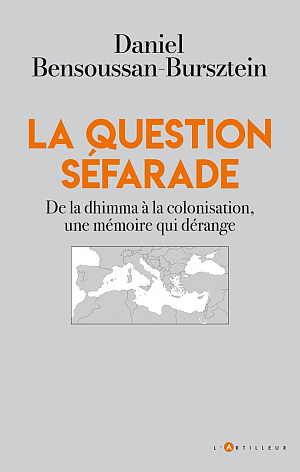
Paris: L’Artilleur: 2025, ISBN: 978-2819912756
Reviewed by Lyn Julius1
In 2015, the Ukraine-born Israeli actress Alona Kimhi created a public scandal when she voiced her frustration with Likud-supporting Mizrahi voters:
Every community has the government it deserves. Long live stupidity, wickedness and false consciousness. Drink cyanide, Neanderthals. Only death will save you from yourselves.
Now and again, the ‘ethnic demon’ bubbles up in Israeli public life, with insults flying between Ashkenazim and Mizrahim. Could this be symptomatic of a deeper rift in culture and politics?
The tension goes back to the 1977 Ma’apach, when the right under Menahem Begin, backed by the great mass of Mizrahi voters, won power. Likud, mostly under the leadership of Benjamin Netanyahu, has since proved impossible to dislodge. Ashkenazim, meanwhile, tend to vote for leftist or liberal parties.
The French journalist Daniel Bensoussan-Bursztein has made the intellectual and political cleavage in the Jewish world the subject of an incisive and detailed new book. He is the author of La Question Séfarade. This is also the title of a 1979 essay by Jean-Paul Sartre on the “Second Israel.”2 Bensoussan-Bursztein straddles the ethnic divide; he is the son of the Moroccan-born historian Georges Bensoussan. He has also studied Yiddish, the language spoken by his maternal grandparents.
The “wars of politics and culture” between Ashkenazim and Mizrahim is a topic I touch on in my own book, Uprooted. But Bensoussan-Bursztein is not afraid to plumb greater depths in these murky waters. He brings a welcome French perspective to the debate. France has the only majority-Sephardi community in the diaspora. Its Ashkenazi intellectuals, many with a Bundist or Marxist background, tend to deride the vast mass of French Jews of North African origin as ‘noble savages’, observant, loud and proud Zionists, vulgar nouveaux-riches from the Sentier, the Paris garment district. You can spot the Tsarforkaïm (an amalgam of “Tsarfatim” and “Marokka’im”) a mile away on Tel Aviv’s beaches.
With trademark meticulousness, Bensoussan-Bursztein identifies a number of misapprehensions coloring the popular post-colonial viewpoint among Ashkenazi academics. Chief among them is the view that the rift between Jews and Arabs in the Middle East and North Africa developed in the colonial era. This distortion projects a myth of pre-colonial interfaith harmony, erases centuries of minority repression under Islam, and puts Arabs on a par as victims of European colonialism with Jews as victims of the European Holocaust. Bensoussan-Burzstein writes “A Jew is an Arab in Poland” (p. 60), evoking a phrase from Philip Roth’s book Operation Shylock.3 Jews who lived in Arab countries are portrayed as complicit with European colonialism; as far as the Arabs are concerned, they are traitors. The Algerian Jews, who held French citizenship, are the most striking example of betrayal. Almost all were ‘repatriated’ to France when Algeria gained its independence in 1962, along with the pieds-noirs colonials.
For the Jews themselves, however, the colonial era represented liberation from institutionalized inferiority as dhimmis under Islam; the colonial period was the only time when they enjoyed opportunity, equal rights, and a modicum of security. Yet, Bensoussan-Burzstein asserts that liberals distort the pre-colonial dhimmi status to make it appear that subjugated Jews were party to a social contract, or enjoyed citizens’ rights. The American scholar Ethan Katz, author of The Burdens of Brotherhood,4 goes so far as to proclaim that Jews in Arab countries were “Islamized Jews” and the Arabs “Judeified Arabs.”
In contrast, the Moroccan Muslim historian Ali Lmrabet remarks that the Arabs and Jews were never brothers, and Jews with Middle Eastern roots report that the dominant feeling towards Arabs was fear. The author quotes a saying popular among Jews: “You cannot trust an Arab even if he has been six feet under for forty years” (p. 223). In Dov Noy’s Moroccan Folk Tales,5 the proverb refers to mistrust of a Muslim.
A debate rages about Jewish identity. At one extreme, Shlomo Sand, a cranky Israeli academic, whose writing is popular in France, denies that Jews are a people; they are either Khazar converts or Arabs. Indeed, the only Mizrahi Jews approved by the far left are those who identify as ‘Arab Jews’, supposedly torn away from their Muslim brethren by the evil Zionists. This is a concept promoted by the post-colonial academics Ella Shohat and Ariella Aïsha Azoulay.
In reality, only a tiny minority of Mizrachim self-define as ‘Arab Jews’. An alternative, proudly Zionist, Mizrahi role model is represented by the minister of Moroccan origin, Miri Regev, or the Egyptian-born spy hero Eli Cohen.
The author contends that the romanticization of Arab-Jewish relations on the left goes hand-in-hand with a whitewashing of Arab antisemitism. Pogroms are downplayed and become ‘incidents’ in North African history. It is even claimed that Mizrahim showcase their victimhood out of jealousy for the Holocaust’s European victims. Bensoussan-Bursztein quotes André Azoulay, the Jewish adviser to the Moroccan king, who told a visiting group from Paris, “It was better than Auschwitz” (p. 59), as if the Arab world was a relative paradise.
Liberal intellectuals berate French Jews for supporting the ‘Islamophobic’ rightwing politician of Algerian-Jewish origin, Eric Zemmour, who stood as a presidential candidate in 2022. They claim that the Sephardim are in an unsavory alliance with the far right. Israel has also invited criticism for reaching out to rightwing European nationalists. Yet, as Bensoussan-Bursztein rightly points out, fourteen Jews were murdered in French terrorist attacks between 2003 and 2023, none by far right extremists.
Today, Israel and France’s Jewish community are mostly composed of refugees from Arab and Muslim antisemitism whose communities have disappeared, yet the memory of their mass exodus is being rewritten. Foremost in the author’s rogue’s gallery of revisionists is the U.S.-based academic and historian of Iranian Jewry Lior B Sternfeld. According to Bensoussan-Bursztein, Sternfeld believes that the Israeli government is exaggerating the dhimmi history of Mizrahi Jews in order to push forward an Islamophobic agenda. The author ends the book with a description of those organizations engaged in campaigning for the rights of the forgotten refugees.
Denial and distortion of Muslim antisemitism are not such an issue in Israel, where most Israelis have at least one Mizrahi grandparent. In the U.S., where a third of (Ashkenazi) young Jews are thought to have distanced themselves from Israel, ignorance of the true facts could have serious consequences. “One is witnessing a massive falling away of unconditional support” (p. 279), the author warns, fearful for the Jewish future. Bensoussan-Bursztein’s book is thus a welcome counterpoint to a disturbing trend. It should be translated into English.
1 Lyn Julius is a journalist, blogger, speaker, and founder of HARIF, the UK Association of Jews from the Middle East and North Africa. She is the author of Uprooted: How 3,000 Years of Jewish Civilization in the Arab World Vanished Overnight and the essay “Cast Out,” Jewish Quarterly, March 2026.
2 Jean-Paul Sartre, “Second Israel,” Les Temps Modernes, No. 392, 1979.
3 Philip Roth, Operation Shylock, New York: Simon & Schuster, 1993.
4 Ethan Katz, The Burdens of Brotherhood, Cambridge: Harvard University Press, 2015.
5 Dov Noy, Moroccan Folk Tales, New York: Herzl Press, 1966.