
Christina Karageorgou-Bastea
BEYOND INTIMACY
Radical Proximity and Justice in Three Mexican Poets
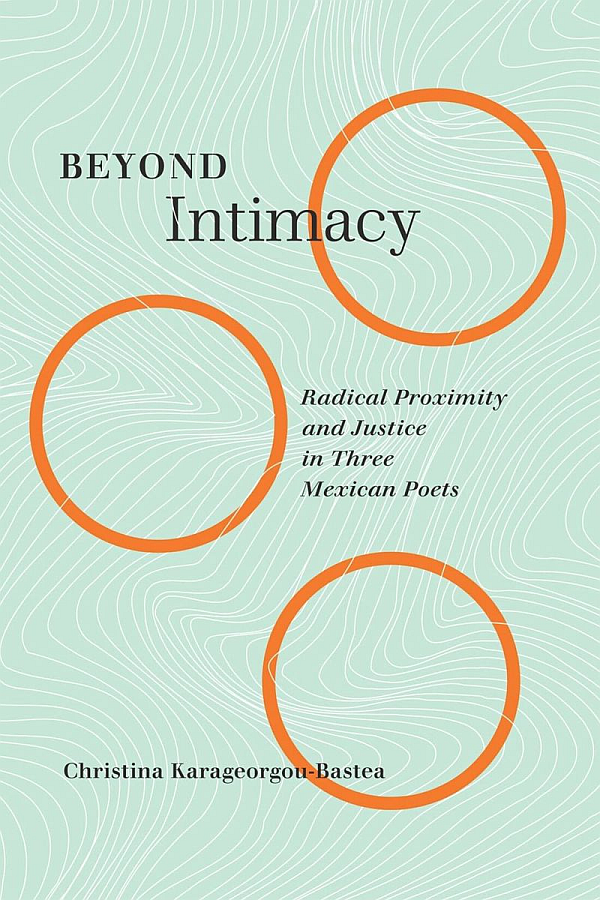
Montreal: McGill-Queen’s University Press, 2023. ISBN: 978-0228016434
Reviewed by Alessia Cassani1
Christina Karageorgou-Bastea’s Beyond Intimacy: Radical Proximity and Justice in Three Mexican Poets offers a nuanced and theoretically rich investigation into the intersections of intimacy, lyric discourse, and social justice in contemporary Mexican poetry. Building on a wide array of critical frameworks, from Badiou and Bakhtin to Berlant, Rawls, and Evans, the study situates intimacy not as a private or sentimental category but as a critical lens through which poetry and justice emerge as dialectical poles.
At the heart of the book lies the notion of radical proximity, which Karageorgou-Bastea defines as the prism through which lyric discourse between self and other becomes a model of justice. Far from being confined to the sphere of personal affect, intimacy here functions as an ethical and social practice: it carries “the moral value we obey and the personal praxis that materializes when we stand morally close to another being in conditions of togetherness” (p. 10). This theoretical framework is tested through detailed readings of three poets, Abigael Bohórquez, Myriam Moscona, and Gloria Gervitz, whose works foreground marginalized voices, such as queer subjects, emancipated mothers, and endangered languages.
The first chapter, The Case for Abigael Bohórquez: Against Injury, turns to Poesida (1996), a collection published posthumously one year after the poet’s death. The very title, fusing poesía and SIDA (AIDS), signals Bohórquez’s intention to link poetic creation with the raw physicality of illness. Karageorgou-Bastea skillfully highlights the dual exclusion faced by Bohórquez: the stigma of disease compounded by the social marginalization of homosexuality. Poesida emerges as a lyric of resistance where death is omnipresent, not only as biological fact but also as social annihilation. Yet, rather than offering a narrative of personal redemption, Bohórquez articulates a poetics of justice rooted in the freedom of desire, envisioning a future that resists society’s systemic unfairness: “A poet’s justice stands for the agonistic process that links the bloodbath to the future” (p. 63).
Chapter two, Enladinar. Intimating with History, examines Myriam Moscona’s Ansina (2015), written in Judeo-Spanish (Ladino), a language on the brink of extinction. Here, Karageorgou-Bastea expands the discussion of intimacy to encompass linguistic survival and cultural memory. By bringing Judeo-Spanish into the public poetic arena, Moscona transforms it into a medium not only for private memory but also for broader discursive engagement, even with scientific themes. The chapter provides valuable contextualization of Judeo-Spanish within Sephardic history and situates Moscona within contemporary Sephardic literature. Ultimately, Moscona’s poetry is read as a form of duty toward history and posterity: “The poems of Ansina are simultaneously a discourse and the simulacrum of social enunciation… an exercise in duty against history and posterity” (p. 102).
The third chapter, Breach of Intimacy, focuses on Gloria Gervitz’s monumental Migraciones. Poema 1976–2020, a “river poem” composed over four decades. Karageorgou-Bastea underscores the tension in Gervitz’s work between the obligations of Jewish matrilineal continuity and the disruptive force of erotic desire. Within this dialectic, the maternal figure occupies a central position: both as the first object of desire and the source of language acquisition. In this context, desire and language become the grounds on which intimacy and justice may be reconfigured (p. 106). Gervitz’s long poem thus exemplifies how radical proximity is not merely a theoretical construct but a lived poetic struggle.
In her conclusion, Karageorgou-Bastea asserts that while intimacy has been “the trademark of lyric poetry ever since Romanticism” (p. 141), in these three poets it transcends individual affect to acquire ethical, historical, and political functions. The book’s closing reflections demonstrate an impressive command of diverse critical traditions, Marxist, feminist, postcolonial, and gender studies, while weaving them into a coherent argument about poetry’s capacity to enact justice. The wealth of intertextual references to philosophers, theorists, and literary critics contributes to a stimulating dialogue between poetic theory and literary criticism.
Overall, Beyond Intimacy sheds new light on Mexican poetry by situating the works of Bohórquez, Moscona, and Gervitz within a framework that highlights the intimate as inherently political. The study proposes original interpretive models that foreground the poets’ dual role as witnesses to marginal experiences and as creators of alternative worlds. As the etymology of poetry (poieîn: to make, produce, create) reminds us, the poetic act is inherently performative: it produces new possibilities of being. Karageorgou-Bastea convincingly demonstrates that in the works of these three poets, poetry becomes not only a space of lyrical expression but also an act of social justice.
1 Alessia Cassani is an Associate Professor of Spanish Literature at the University of Genoa, Italy. Her research focuses on literature written by Spanish Republican exiles in Latin America, women’s literature, and contemporary Sephardic literature.