
Noam Sienna
JEWISH BOOKS IN NORTH AFRICA
Between the Early Modern and Modern Worlds
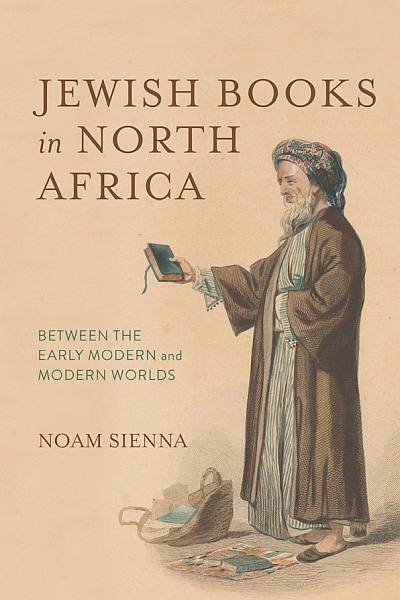
Bloomington, Indiana: Indiana University Press, 2025, ISBN 978-0253073099
Reviewed by Noam Stillman1
Jews are known as “the People of the Book” and academic studies analyzing Jewish books abound. But in this groundbreaking work, Noam Sienna paints a detailed panorama of the book culture of North African Jewry from the sixteenth to the twentieth century. Sienna does not limit himself to the content of books and other reading material such as pamphlets, journals, and paper ephemera, but discusses their production, their distribution across borders, within communities, and within families. No less significantly, he portrays their important function as social objects within Maghrebi Jewish communal life and as connective bonds to the global Jewish community.
In Chapter One, Sienna describes the influx of medieval books, both in manuscript and early printed editions, into North Africa with coming of the Sephardi exiles in the wake of the expulsions of 1492 from Spain and 1497 from Portugal. And the exiles themselves also authored new works and established the techniques of artistic and material forms of early modern Maghrebi Jewish books.
It is noteworthy that manuscript books continued to be widespread in North Africa alongside printed material well into modern times, and in Chapter Two, Sienna introduces the reader to the scribes, the artists, and the patrons of handwritten books, and he argues, to his credit, I would emphasize, that these manuscripts “are not static or fossilized remnants of medieval preprint culture but innovative objects that respond to and engage with Jewish book culture – including printed books — in creative ways” (p. 42). In fact, printed books borrowed from other people or from community libraries were sometimes hand copied by readers for themselves. The continued coexistence of manuscripts and printed books were complementary not oppositional, and the two media borrowed elements of layout and decoration from one another.
There were only two short-lived printing presses in the Maghreb prior to the nineteenth century, the Nedivot press in Fez, which printed less than a dozen rabbinic texts between 1515 and 1522, and the Tanuji press in Tunis which published a single Hebrew book in 1768. However, Hebrew, Aramaic, Judeo-Arabic, and Judeo-Spanish books that were printed abroad, in Amsterdam, Salonika, Constantinople, and particularly in the great printing center of Livorno in Italy, abounded in North Africa. In Chapter Three, Sienna paints a detailed picture of the active contact between the Livornese publishing houses and Maghrebi Jewish authors, merchants, and consumers. He also describes the active role that Jews from North Africa played in these establishments as editors, proof readers, and print specialists. Sienna then devotes an entire chapter (Chapter Four) to the renowned modernizing Jewish scholar and printer, Elia Benamozegh, who was born in Livorno to Moroccan Jewish parents, and in 1854 established one of the most productive Hebrew presses there that produced no less than ten percent of all the Jewish books published there between the seventeenth and twentieth centuries. Sienna argues that although Benamozegh published works by and for Sephardim in the Ottoman Empire and even for Ashkenazi Jews in Europe, he had a definite focus upon the Maghreb and fostering his modernizing Jewish thought there within the parameters of Jewish tradition. Although some scholars, such as Alessandro Guetta, have regarded Benamozegh as an intellectual failure due to the indifference of some of his European colleagues and the sharp critiques of some traditionalist rabbis, Sienna contends that he “played an essential role in a transnational conversation about the evolution of Jewish society in modern times, which brought together scholars and intellectuals from around the Mediterranean and which continued in North Africa and elsewhere long after his death” (p. 114).
In Chapter Five, Sienna describes in detail the establishment and spread of Jewish printer-publishers and bookstores which were often attached to the publishing houses in Algeria, Morocco, and Tunisia during the nineteenth century. These produced hundreds of books, journals, and paper ephemera in Hebrew, Judeo-Arabic, and French. Sienna describes the complex and shifting attitudes toward language with the spread of French colonialism and modernizing role of the Alliance Israélite Universelle schools in Morocco and Tunisia, and French public schools in Algeria. He also discusses the Maghrebi Haskalah and how it differed from the European version. Unlike the latter which was largely secular and even anti-religious, the North African Jewish Enlightenment promoted both Jewish communal and religious identity. Furthermore, religious leaders were among the leading Maskilim.
Chapter Six deals with the phenomenon of Jewish libraries in North Africa. These were normally the private collection of a learned, rabbinical family that served a wider public readership, and called by the Judeo-Spanish designation estudyo (a study hall). Sienna describes in detail the historical evolution and the activity of two case-study libraries, the Abensur and the Serfaty estudyos, both in Fez. The latter included not only religious volumes, but books on science, mathematics, and history as well.
The book ends with a brief “Conclusion: The Ink in My Veins” which is deeply personal and touching, and which I shall leave to the reader to discover its contents.
Jewish Books in North Africa is not only a fine piece of scholarship, but engaging reading as well. Noam Sienna is a highly gifted writer who knows how to address a wide audience, as well as an erudite scholar.
1 Noam (Norman A.) Stillman is Schusterman/Josey Chair Emeritus of Judaic History, University of Oklahoma, and an internationally recognized authority on the history and culture of the Islamic world and on Sephardi and Oriental Jewry. His books include: The Jews of Arab Lands: a History and Source Book, The Jews of Arab Lands in Modern Times, Sephardi Religious Responses to Modernity and The Language and Culture of the Jews of Sefrou. He is Executive Editor of the award-winning Encyclopedia of Jews in the Islamic World.